2 Months with a Printed Checklist on Our Fridge: What Actually Changed
We tried reward charts, verbal reminders, family meetings, and the classic "I already told you three times." None of it stuck. Then we printed a simple weekly checklist and taped it to the fridge. Eight weeks later, I'm writing this because the results surprised me—and not just for the kids.
How We Got Here
For about a year, my wife and I kept trying different approaches to organize household responsibilities with our kids. We'd start something, it would work for a week, maybe two, and then everything would drift back to the default: us nagging, kids forgetting, and everyone getting frustrated.
The core problem was always the same. There was no single source of truth. Who does the dishes tonight? "I did it yesterday!" "No, you didn't!" These arguments happened almost daily. Taking out the trash, cleaning the cat litter, recycling—every chore turned into a negotiation.
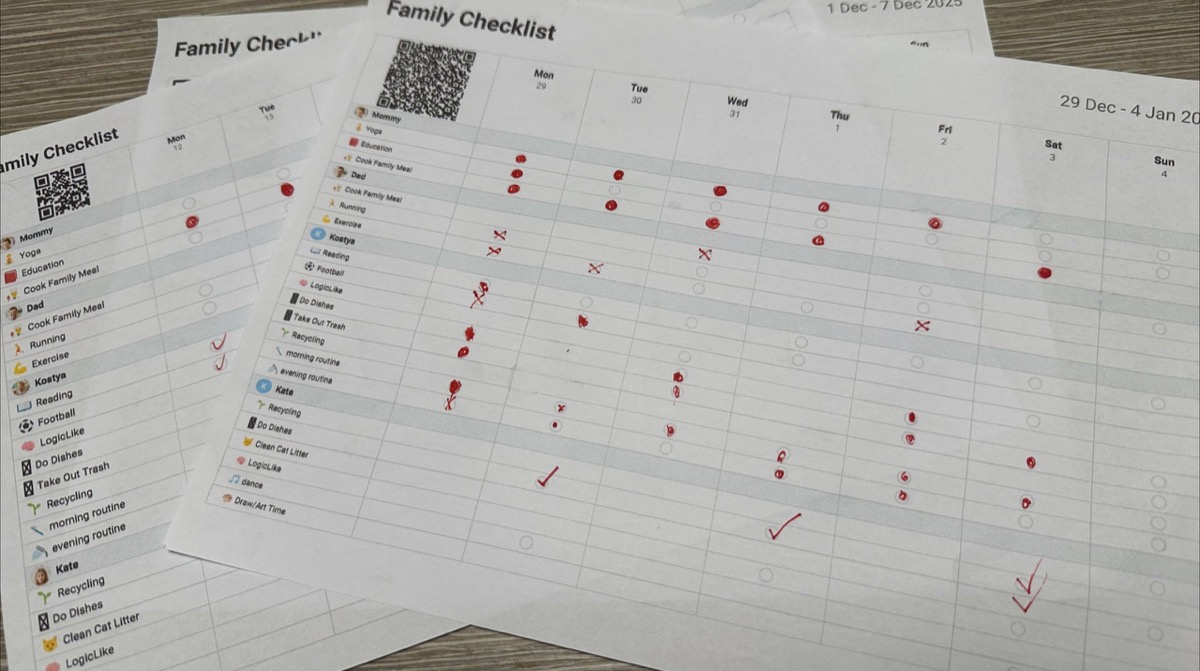
Then I built Family Checklist. Originally it was just for our own family. A simple app where you list family members, assign tasks to each person, and print a weekly chart. We printed the first one on a Sunday evening, stuck it to the fridge, and didn't expect much.
Week 1: The Novelty Effect
The first week, I'll be honest, was mostly novelty. The kids thought it was cool to see their names on a printed chart with little icons next to each task. They were eager to grab a marker and check things off.
I expected this enthusiasm to fade. What I didn't expect was what happened to me.
See, I put myself on the chart too. "Exercise" was one of my tasks. Three times a week. And suddenly, when your commitment is printed on paper and hanging on the fridge where your kids can see it—you feel a different kind of accountability. My 10-year-old actually asked me on Wednesday: "Dad, did you do your exercise today? I don't see a check mark."
That hit different.
Weeks 2-4: The Arguments Stopped
This was the first real change, and it happened faster than I thought. The daily "whose turn is it?" arguments about dishes simply stopped.
Here's why: we assigned dishes to specific kids on specific days. It's printed. It's on the fridge. There's nothing to argue about. Monday and Wednesday: Kostya. Tuesday and Thursday: Kate. It's not a conversation anymore—it's just a fact.
Same thing happened with the other recurring fights:
- Taking out the trash — assigned to Kostya, twice a week
- Cleaning the cat litter — assigned to Kate, every other day
- Recycling — alternating weekly
When everything is written down and visible, there's no room for "that's not fair" or "why do I always have to do it?" The chart is the authority, not mom or dad. This shift was bigger than I expected.
The Unexpected Benefit: Watching Myself
I mentioned the exercise thing, but it goes deeper. When you put your own habits on a family chart, you're making a public commitment. My tasks were simple: Exercise (3x/week), Yoga for my wife, Cook Family Meal for both of us, Running for me.
Before the chart, I'd skip a run and nobody would notice. Now there's an empty circle on the fridge staring at me. And my kids notice. They're not judging—they're just observing. But knowing they can see whether I follow through on my own commitments made me more consistent.
Over these two months, I went from exercising maybe once a week to a solid three times. Not because of willpower. Because of a printed piece of paper on my fridge.
The chart became the authority, not mom or dad. That single shift eliminated 90% of our daily chore arguments.
Month 2: Responsibility Started to Build
By the second month, something shifted with the kids. Not dramatically—I'm not going to pretend they turned into perfect little adults. But the baseline moved.
Kate started doing her tasks without being reminded about half the time. That might not sound like much, but compare it to before when it was zero percent of the time without a reminder. Kostya still needs a nudge sometimes, especially for the less fun tasks, but even he started checking the chart on his own in the morning.
The key thing I noticed: they stopped seeing chores as punishments handed down by parents. The chart reframed chores as just... things on their list. Like homework. You don't love it, but it's yours and you do it.
What Actually Changed After 2 Months
- Daily arguments about dishes: Gone completely
- Clear chore ownership: Everyone knows who does what, no negotiations
- My own exercise consistency: From 1x to 3x per week
- Unprompted task completion by kids: From 0% to about 50%
- Overall nagging from parents: Reduced by roughly 70%
What Still Doesn't Work Perfectly
I want to be honest. Two months is progress, not perfection.
We still need to remind the kids sometimes. Especially on busy days or when friends are over, the chart gets ignored. Some weeks are better than others. There were a couple of weeks where we forgot to print a new chart on Sunday and things slipped back immediately—which actually proved how much the chart was doing.
Also, the marking itself is imperfect. We use markers and sometimes the kids "forget" to check off tasks they didn't actually do (or check off tasks they only half-did). We're still working on the honesty piece.
But here's what I keep coming back to: for an entire year before this, we tried everything. Nothing stuck for more than a week. The printed checklist has been running for eight weeks straight and it's still working. That's not a small thing.
Why Print? Why Not Just Use the App?
This is a question I get a lot, especially since I'm the one who made the app. The answer is simple: a piece of paper on the fridge has zero friction.
You walk by it twenty times a day. You see it when you grab milk. Your kids see it when they get a snack. It's always there, always visible, never needs charging, never sends a notification you can swipe away.
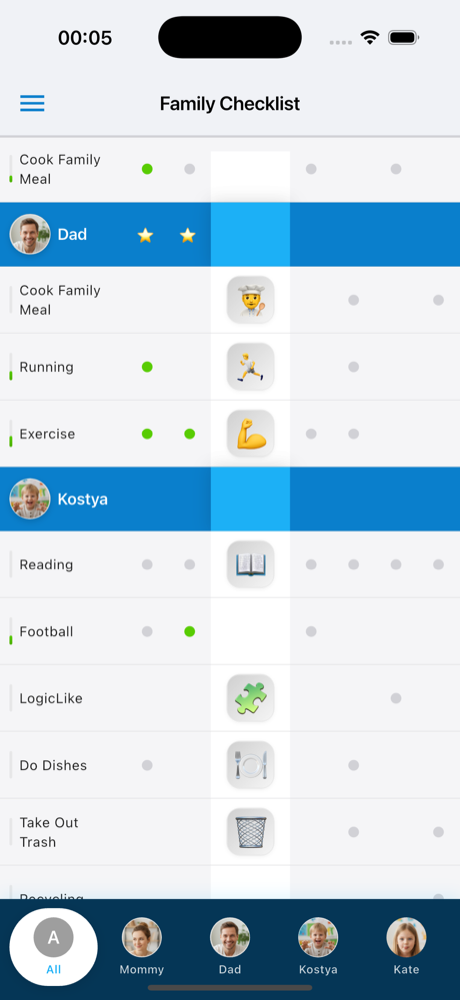
The app is where you set everything up—members, tasks, schedule. But the real magic happens when you hit Print and that chart becomes a physical object in your kitchen. That's where behavior changes.
What I'd Tell You If You're Starting
If you're where I was a few months ago—frustrated, tired of repeating yourself, wondering why nothing sticks—here's what I learned:
Start small. Don't put 15 tasks per kid on the chart. We started with 3-4 each. You can always add more later.
Put yourself on the chart. This was the single most impactful decision. When your kids see that you're accountable too, the whole dynamic changes. You're not the enforcer anymore—you're a participant.
Print it every week. Don't skip weeks. The moment you stop printing, the habit dissolves. Sunday evening, 2 minutes, print, tape to fridge. Make it a ritual.
Don't expect perfection. Expect progress. If your kid does their chores without being asked even twice in a week, that's a win. It compounds.
Let the chart be the authority. When they ask "do I have to?"—point at the chart. When they argue about whose turn it is—point at the chart. Remove yourself from the equation as much as possible.
Two Months In, Still Going
I'm writing this in February 2026. We started in December 2025. Eight weeks. The charts are piling up in a drawer and honestly, looking back at the early ones with barely any check marks compared to now—there's visible progress.
Is it perfect? No. Is it dramatically better than anything else we tried over the past year? Absolutely.
The arguments stopped. The responsibilities are clear. And I'm exercising three times a week because my kids can see my chart.
Sometimes the simplest tools work the best.
Related Articles
Try It With Your Family
Set up your family checklist in 5 minutes. Print it. Tape it to the fridge. See what happens.
Download Family Checklist