After School Meltdowns: Why Kids Fall Apart at 3 PM and What Helps (2026)
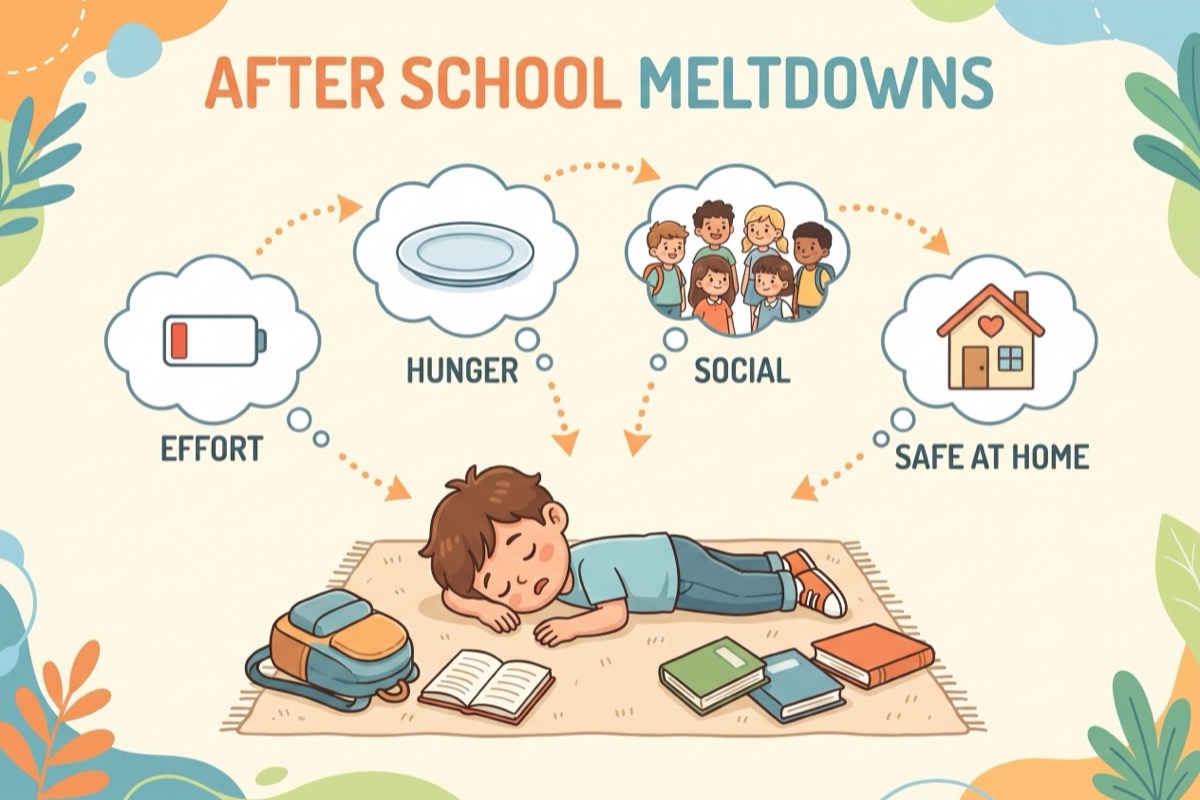
The teacher waves and says your child had a wonderful day. Your child gets in the car, says nothing, and holds it together for about eleven minutes. Then the front door closes, the backpack hits the floor, and the wrong cup starts a twenty-minute catastrophe. After school meltdowns are one of the most common things parents write to us about, and one of the most confusing, because the child screaming at 3:40 was reportedly delightful at 1:15.
The behavior is real and it is not a discipline failure. The popular explanation for it is shakier than it sounds. Below: what is happening after 3 PM, what the research supports, what to do in the first thirty minutes, and when to call someone. For the hour-by-hour structure that prevents most of this, our after school routine for kids is the companion piece.
Is It Normal for Kids to Have After School Meltdowns?
Mostly yes, and your child's age matters most. The American Academy of Child and Adolescent Psychiatry sets out norms by band. Toddler tantrums run two to fifteen minutes, and many toddlers have one a day. Preschool tantrums rarely pass fifteen minutes. For ages six to thirteen, AACAP is blunt: tantrums are much less common, and recurrent or severe ones are a reason to seek help.
So a 5-year-old who dissolves on the doormat three days a week sits inside the normal range. A 9-year-old who does it daily is worth a closer look, because that pattern usually has a findable driver. AACAP adds one detail: most school-age kids with the occasional tantrum are fine in between.
The honest part most articles skip: there is no reliable prevalence figure for after-school meltdowns. Nobody has counted how many 7-year-olds fall apart at 3:30, so any percentage you read was borrowed from something else. The pattern is real and clinically recognized; the number is not. For the rest of ordinary development, our guide to what is normal for kids ages 6-14 sets the baseline.
What Is Actually Going On When Kids Fall Apart After School
Treat the school day as four demands stacked on one small nervous system, plus a release.
Six hours of self-regulation. The Child Mind Institute defines self-regulation as managing emotion and behavior to fit the situation: resisting a strong reaction, calming down, handling frustration without an outburst. School asks for that from 8:15 to 3:00, almost without a break.
Constant social monitoring. Every child in a classroom runs quiet arithmetic on who is friendly today, where to sit, what is safe to say. That work does not stop at recess; it gets harder.
Sensory load. Thirty bodies in one room, hallway noise, a cafeteria at full volume. Some kids barely notice. Some run a low alarm all day.
Hunger and fatigue. The AAP's tantrum guidance covers two practical fixes: a snack for hunger-driven outbursts, protected sleep for fatigue-driven ones. Lunch was at 11:20. It is 3:35.
Then the release. Children perform for teachers and classmates because those relationships are conditional and watched. You are the one person they do not perform for. The meltdown at your feet is not a verdict on your parenting. It is a sign that you are safe.
Child psychiatrist Steven Dickstein describes tantrums and meltdowns as fevers: so many problems trigger them that you cannot stop one until you know the cause. Hence the cause-first table below.
Is "After-School Restraint Collapse" a Real Diagnosis?
No, and it matters that you know why. The term is attributed to Andrea Loewen Nair, a Canadian counselor and parenting educator, whose blog post on it later went viral. It spread because it is a good phrase: it names a real experience and takes the blame off both child and parent.
What it is not: a diagnosis. The phrase appears in no diagnostic manual, has no ICD code, and has no peer-reviewed literature behind it. No studies measure it and no criteria define it. The Child Mind Institute makes the same point one level up: even "tantrum" and "meltdown" are not clinical terms.
Use it as shorthand with your partner, not as an explanation that closes the case. Child Mind lists ADHD, anxiety, learning disorders, autism, and sensory processing differences among the common drivers of frequent outbursts past the expected age.
The Willpower Battery Myth: What the Research Actually Shows
The standard explanation: self-control is a battery, school drains it, your child arrives home at zero. Tidy, intuitive, and weakly supported.
The battery is a theory called ego depletion, attributed to Roy Baumeister's lab in the late 1990s: resist a plate of cookies, then give up sooner on an impossible puzzle. For twenty years it was one of psychology's most cited ideas. In 2016 Martin Hagger and colleagues published a preregistered replication in Perspectives on Psychological Science: 23 laboratories, 2,141 participants, one agreed protocol. The pooled effect was essentially zero. Researchers still argue the details, but the simple "willpower tank empties" story has not held up.
This changes what you do at 3:30. Believe in a drained battery and the only move is waiting for it to recharge, which in most houses means a tablet. List the real inputs and three are yours to move within half an hour: food, movement, and the demand you place on the child. The fourth, sleep, is a this-week project.
We take the same line on the claim that habits form in 21 days, which came from a surgeon's observations rather than a study, in our piece on what the habit research actually found. A useful metaphor is not a mechanism.
What Helps: Cause, Tonight, and This Week
Pick the likeliest driver instead of doing everything at once. Two rows usually cover most of a family's bad afternoons.
| What is driving it | Tonight | This week |
|---|---|---|
| Hunger | A protein snack before you say hello. Not the promise of one. | Pack it the night before. Sugar buys twenty minutes and costs forty. |
| Sensory overload | Dim the room, kill the TV, keep siblings out for fifteen minutes. | One landing spot that is quiet by default. |
| Held-in effort | Sit near them and say nothing. Presence, no questions. | Ten minutes of undivided attention daily, phone elsewhere. |
| Transition shock | Same three things in the same order: shoes off, snack, nothing. | Post the order on the fridge. Pictures under 8, words above. |
| Sleep debt | Bedtime fifteen minutes earlier. Do not frame it as a consequence. | Track the real total for a week. Fix the front end, not the wake-up. |
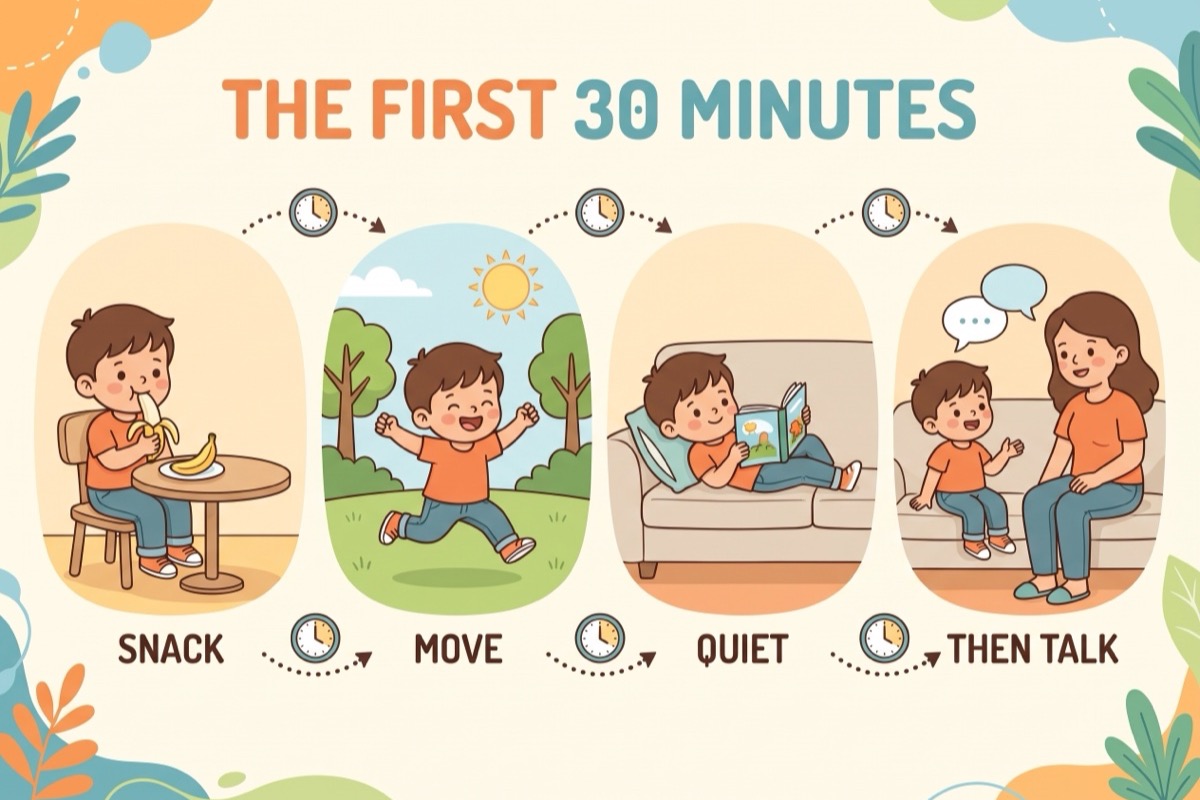
The First 30 Minutes, In Order
The order matters more than any single item in it, and it is deliberately unambitious.
From the school gate to the first real conversation
- Minute 0: one sentence, then stop. "Hi, I missed you." Not "how was your day," not "where is your sweater."
- Minutes 0-5: food, immediately. In the car, at the gate, on the walk. Protein and water head off a real share of after school meltdowns.
- Minutes 5-20: no demands, no questions. No unpacking the bag, no reading log. Twenty minutes where nothing is required is the whole point.
- Minutes 20-30: move the body. Scooter, trampoline, dog, a walk round the block. Movement does more for a wound-up 7-year-old than talking.
- Minute 30: talk sideways. Kids answer better shoulder to shoulder than face to face. Cooking, driving, Lego.
- Then the tasks. Bag, homework, chores, in a fixed order. The after school routine scripts the rest of the evening.
Connection First, Then Correction
If a meltdown is already underway, you are not teaching anything, so do not try. The frame comes from Dan Siegel and Tina Payne Bryson's The Whole-Brain Child: connect and redirect. A child mid-meltdown is not processing logic. Connect with tone, presence and touch if they want it, then redirect once the storm passes. Their companion idea, "name it to tame it," is the same move in words.
The step-by-step version is the Gottman Institute's emotion coaching, five steps from John Gottman's research on how parents handle a child's negative emotions.
The rules do not dissolve after 3 PM. The limit still lands, after the connection rather than instead of it. Our roundup of positive parenting techniques that hold up in research has the wider set.
By Age: 4-6, 7-10, and 11-12
Ages 4-6
- Skip the words at first. Snack, lap, blanket, quiet. Language returns fifteen to twenty minutes after the body settles.
- Use pictures for the sequence. Three photos on the fridge: snack, play, bath. A 5-year-old who can see what comes next argues far less.
Ages 7-10
- Give them a script for the door. A code word for "done talking for twenty minutes" beats slamming something.
- Protect the twenty minutes. Homework, clubs and a sibling's schedule will try to crowd it out. Something gives; not this.
Ages 11-12
- The meltdown goes underground. Door-slamming, one-word answers, contempt for dinner. Same load, more vocabulary.
- Offer solitude as a real option. Come back in thirty minutes with food. Our guide to normal teenage behavior covers the line.
What Does Not Work After School Meltdowns
Five moves that reliably make the afternoon worse, all well intentioned.
- The pickup interrogation. Five questions in ninety seconds, aimed at a child who spent six hours answering questions. Ask nothing for twenty minutes and you get more, not less.
- Screens as the first decompression. It buys quiet at 3:35 but skips the movement and connection, and just moves the fight to whenever you switch it off — the fuller case is in our screen time crisis piece.
- Punishing the meltdown itself. Consequences work on choices, and a 6-year-old whose regulation has run out is not choosing. Hold the limit on hitting. Taking away Saturday because they cried on Tuesday only teaches that falling apart around you is unsafe.
- Arguing the facts. "Your teacher said you had a great day" is true and useless. So is "you were fine ten minutes ago." Both dispute the child's own experience.
- Cancelling everything, permanently. Dropping a club for two weeks is sensible. Removing every demand for a term is accommodation, which shrinks a child's world. If avoidance spreads to mornings, our piece on what to do when a child will not go to school covers that pattern.
One more, quieter. The crash lands on a parent who has been holding it together too. If your own reaction at 3:40 is louder than you want, our piece on breaking the parenting patterns you inherited is about that moment.
Your 7-Day After School Meltdown Plan
One change a day, simple enough for a tired adult. Write one line per afternoon. By day seven you have data instead of impressions.
| Day | The one change | What to watch |
|---|---|---|
| Day 1 | Food within five minutes of pickup. One sentence, no more. | Minutes from door to first flashpoint. Write it down. |
| Day 2 | Add the twenty-minute no-demand window. | Did the flashpoint move later, or vanish. |
| Day 3 | Fifteen minutes of movement after the quiet window. | Mood at dinner versus days 1 and 2. |
| Day 4 | Fix the order and post it where the child can see it. | How many instructions you gave. Aim for fewer. |
| Day 5 | Bedtime fifteen minutes earlier. See the bedtime routine for the wind-down order. | Waking mood on day 6. Sleep debt shows up in the morning. |
| Day 6 | Ten minutes of undivided, child-led attention. Same slot daily. | Whether they tell you things you did not ask about. |
| Day 7 | Read your seven lines. Keep what worked, drop the rest. | Which days were worst, and what they had in common. |
Two notes, both anecdotal. Wednesdays and Thursdays often feel worst. And a new term will undo your progress for a while: that is the load changing, not the plan failing. If mornings are also a battlefield, the same logic applies in our morning routine for kids.
When to Worry About After School Meltdowns
Most afternoon crashes need a snack and a quieter half hour. Some need a professional, and AACAP gives unusually specific thresholds.
- Outbursts lasting longer than 25 minutes. AACAP names this number, with aggression, deliberate self-harm and being unable to calm down, as signs worth assessing.
- Aggression that endangers anyone. Not a thrown cushion. Hitting that leaves marks, thrown furniture, anything aimed at a sibling's head.
- Meltdowns that interfere with school or friendships. If afternoons are why nobody invites them over, this is not just a home problem.
- Angry, irritable or sad in between. AACAP flags this. An occasional storm in a child who is otherwise fine reads differently from a child living in a low mood.
- School refusal, new stomach aches, or sleep falling apart. Afternoon meltdowns plus morning resistance plus 2 AM wakings is a cluster, and clusters deserve a call.
- Talk of self-harm, or of not existing anymore. Take it seriously every time, not just the first. In the US, call or text 988 anytime — it is there for parents too.
Start with your pediatrician, who can rule out sleep problems, hearing and vision issues, and iron levels. Then the school counselor, who can tell you what the day looks like from the inside. ADHD is often missed in a child whose most visible problem looks like anger rather than attention, and anxiety, learning differences and sensory issues sit on the same Child Mind Institute list of drivers. All of it is treatable, and easier to address at seven than at fourteen. Our positive parenting quiz takes three minutes and points you at a next step.
Key Takeaways
- A load problem, not a character problem. Six hours of self-regulation and sensory input, and no food since 11:20.
- "After-school restraint collapse" is a coined phrase, not a diagnosis. Useful shorthand, no research behind it.
- The willpower battery failed its big test. A 23-lab preregistered replication found essentially no ego-depletion effect.
- Food first, questions later. Protein within five minutes, twenty minutes of no demands, movement, then talk.
- Connect, then correct. Limits still apply, after the storm rather than during it.
- Call someone if outbursts pass 25 minutes, involve real aggression, or come with a low mood in between.
Frequently Asked Questions
Why does my child melt down after school?
Because the demands of a school day stack up and the release happens where it is safe. Your child spent six hours regulating behavior, reading the social room and absorbing noise and light, on a lunch eaten hours ago. Home is the first place all day where nothing has to be performed. After school meltdowns are usually driven by hunger, fatigue, sensory load and held-in effort, which is why food and a quiet, demand-free half hour fix so many of them.
Is after school restraint collapse a real diagnosis?
No. The phrase was coined by counselor Andrea Loewen Nair and later spread through parenting blogs. It appears in no diagnostic manual, has no ICD code and has no peer-reviewed research behind it. That does not make the experience less real, and the Child Mind Institute notes that even "tantrum" and "meltdown" are not clinical terms. Use it as shorthand, not as a substitute for looking at ADHD, anxiety or sensory issues when outbursts are frequent.
Why is my child fine at school but terrible at home?
Because school relationships are conditional and watched, and yours is not. A child works hard to meet a teacher's expectations and a classroom's social rules, and that effort is tiring. You are the person they trust enough to stop performing in front of. It is uncomfortable, and it is a good sign about your relationship. Mention it to the teacher anyway, because a child who is unusually compliant at school is sometimes anxious there rather than happy.
How long do after school meltdowns last, and what age do they stop?
Most afternoon crashes are short once the child is home, fed and left alone. AACAP notes that preschool tantrums rarely last past fifteen minutes, and that between six and thirteen they become much less common. Expect the loud version to fade between six and eight, then return quieter at eleven or twelve as door-slamming and one-word answers. Any outburst regularly passing 25 minutes is worth raising with your pediatrician.
How do I help my child right after an after school meltdown?
Stay near, stay quiet and do not teach anything yet. Siegel and Bryson's connect-and-redirect sequence applies: presence and tone first, problem-solving afterwards. Once the crying stops, offer food and water, then give them something physical to do. Save the conversation for bedtime or a car ride, side by side rather than face to face. Name the feeling before you discuss the behavior, and keep the limit you set.
When should I worry about after school meltdowns?
AACAP suggests seeking help when tantrums involve aggression that endangers anyone, deliberate self-harm, an inability to calm down, or when they last longer than 25 minutes. Add these: daily outbursts in a child over eight, meltdowns damaging friendships or school, sleep falling apart, new morning refusal, or a child who seems irritable and sad between episodes. Start with the pediatrician, then the school counselor. In the US, call or text 988 if your child mentions self-harm.
Related Reading
- After School Routine for Kids: The Order That Ends 4 PM Fights
- Positive Parenting Without the Fluff: 7 Evidence-Based Techniques
- Is My Child Normal? Ages 6-14, Typical vs. Red Flags
- My Child Doesn't Want to Go to School: What Works
- Breaking Parenting Cycles: 7 Patterns You're Repeating
- Quiz: What Kind of Positive Parent Are You?
Put the after-school order on the fridge
Kids argue less with a chart than with a parent. Our free Chore Chart Maker builds a visual afternoon sequence in 90 seconds: snack, quiet time, movement, homework, chores. No signup.
Try the Chore Chart Maker