Bedtime Routine for Kids: 7 School-Night Fixes That Work (2026)
It is 8:40 on a Tuesday. The math worksheet is half done, the soccer bag is still in the hallway, and your 8-year-old has just announced that she is "not even tired." The bus comes at 7:20. You do the subtraction in your head and feel slightly ill.
A bedtime routine for kids is the one part of the school day you actually control, and September is when it earns its keep. Wake-ups are an hour earlier than three weeks ago, homework lands at 7 PM, practice ends at 8. Below: the 7-step routine that survives a Tuesday, sleep hours by age with lights-out times, a two-week plan for moving the clock, and what to do when your child is still awake at 10. It pairs with our morning routine for kids: the two ends of the day are one system.
Why Bedtime Battles Get Worse on School Nights
Start with the numbers, because they are worse than most parents assume. The CDC's FastStats on children's sleep, on 2020-2021 National Survey of Children's Health data, puts insufficient sleep at 37% for ages 4 months to 5 years, and across its full 4-months-to-14-years range at 25% (Minnesota) to 50% (Louisiana) by state. A quarter to half of your child's class is short. By high school the CDC's companion page has it at 71% to 84%, and rising since 2009.
Three things collide on a school night that never collide in July. The wake time is fixed and early, so nothing absorbs a late night. Homework, activities and dinner squeeze the wind-down to nothing. And a child who is more tired and more wound up at once looks, from outside, exactly like "not tired."
Underneath that is biology. In the evening cortisol should fall and melatonin should rise, and light and screens push that rise later. A 7-year-old who says she is not tired at 8:15 is usually telling the truth: her body has not been given the signals. Our guide to how much screen time is OK for kids covers the light side; the short version is that a tablet at 8 PM is a cup of coffee for a second-grader.
The good news is unusually solid. Jodi Mindell and colleagues analyzed sleep data from 10,085 families across 13 countries and regions, in the journal Sleep in 2015 (full text). The more nights a week a child had a bedtime routine, the earlier and faster they fell asleep and the fewer times they woke. Every added night helped; seven beat five. One honest limit: the study covered children up to age 5. For older kids the AAP says the same thing, on clinical experience rather than a dataset.
The 7-Step School-Night Bedtime Routine for Kids
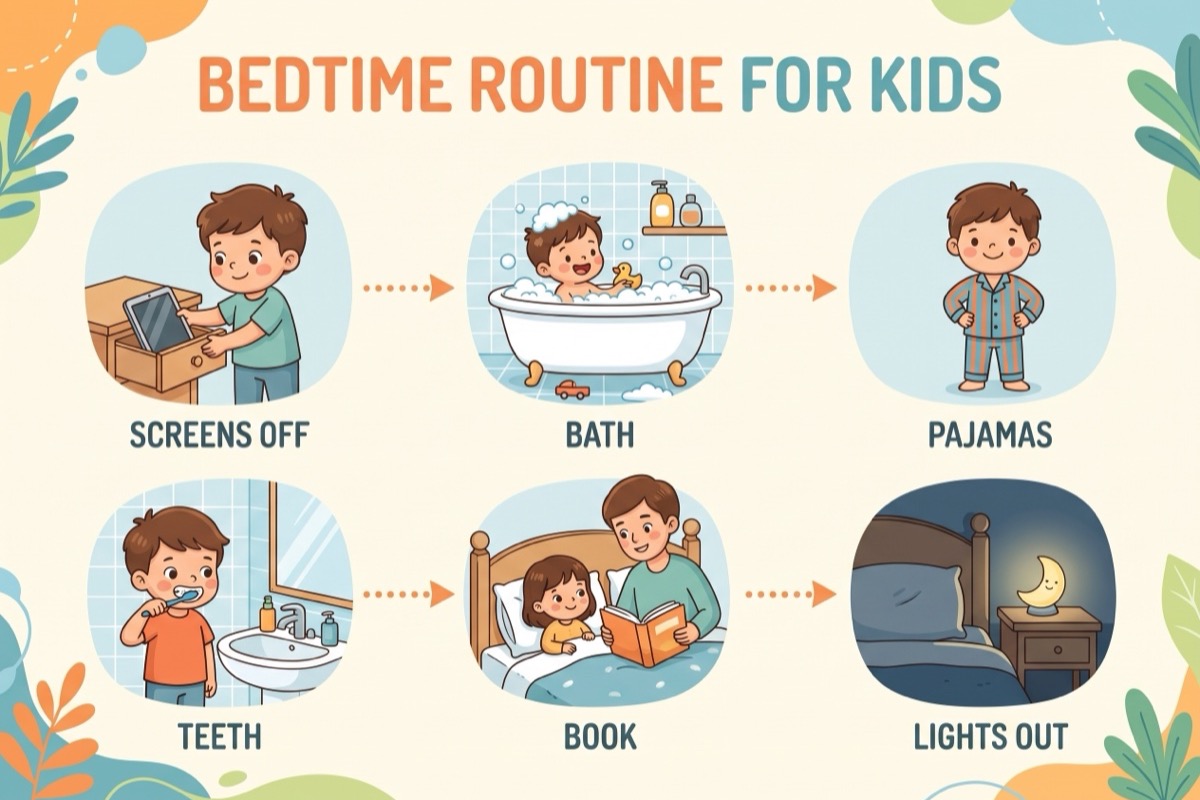
This is the routine, timed for an 8:30 PM lights-out, which suits a 7-to-9-year-old who wakes at 7:00. Slide it earlier or later using the next section. The order never changes; only the clock moves. Bath to lights-out runs 30 minutes, matching the AAP's advice to keep a school-age routine under half an hour.
| Time | Step | What the kid does | What the parent does |
|---|---|---|---|
| 7:30 | 1. Lights down, homework closed | Worksheet in the folder, folder in the backpack, backpack by the door | Overhead lights off, lamps on, blinds closed, TV off |
| 7:45 | 2. Screens off, devices to the kitchen | Plugs the tablet into the kitchen charger; picks tonight's book | Puts their own phone on the same charger. Yes, really |
| 8:00 | 3. Bath or shower | Ten minutes, warm not hot. Alone from about age 8 | Towel and pajamas on the hook, so nothing gets hunted for |
| 8:10 | 4. Pajamas, teeth, tomorrow's clothes | Dresses, brushes two minutes, tomorrow's clothes on the chair | Checks the teeth on the under-8s. Checks nothing else |
| 8:15 | 5. Reading in bed | One picture book at 3-5; 10-15 minutes of their own book at 6-12 | Reads with them, or sits nearby with a paper book |
| 8:25 | 6. Two-minute check-in | One good thing about today, one hard thing | Listens. Does not solve, lecture, or start a long conversation |
| 8:30 | 7. Lights out | Water bottle already by the bed, stuffed animal chosen | Same goodnight line, then leaves. Does not come back to negotiate |
Why the steps sit in that order
- Lights down first. Light is the strongest clock-setter the body has. A dim living room says the day is ending; a bright kitchen with a worksheet on it says the opposite.
- Screens out of the bedroom, not just paused. The AAP's February 2026 media policy names bedrooms and the hour before bed as the first screen-free zones. Night mode does not fix a group chat.
- Tomorrow laid out. The AAP includes a tidy-up step because "everything is ready" calms a child who has started worrying about school. It also buys a quieter morning.
- Two minutes of connection, on purpose. Most stalling is a bid for attention, so give it deliberately and briefly. School worries surface here at 8:25 on Tuesday, not at 6:50 on Monday.
- Cool, dark, quiet, and then you leave. 65-70°F, blackout curtains, a fan if the street is loud. Leaving without reopening negotiations is the step most parents skip, and the one that teaches what lights-out means.
How Much Sleep Kids Need by Age (and What Time Lights-Out Should Be)
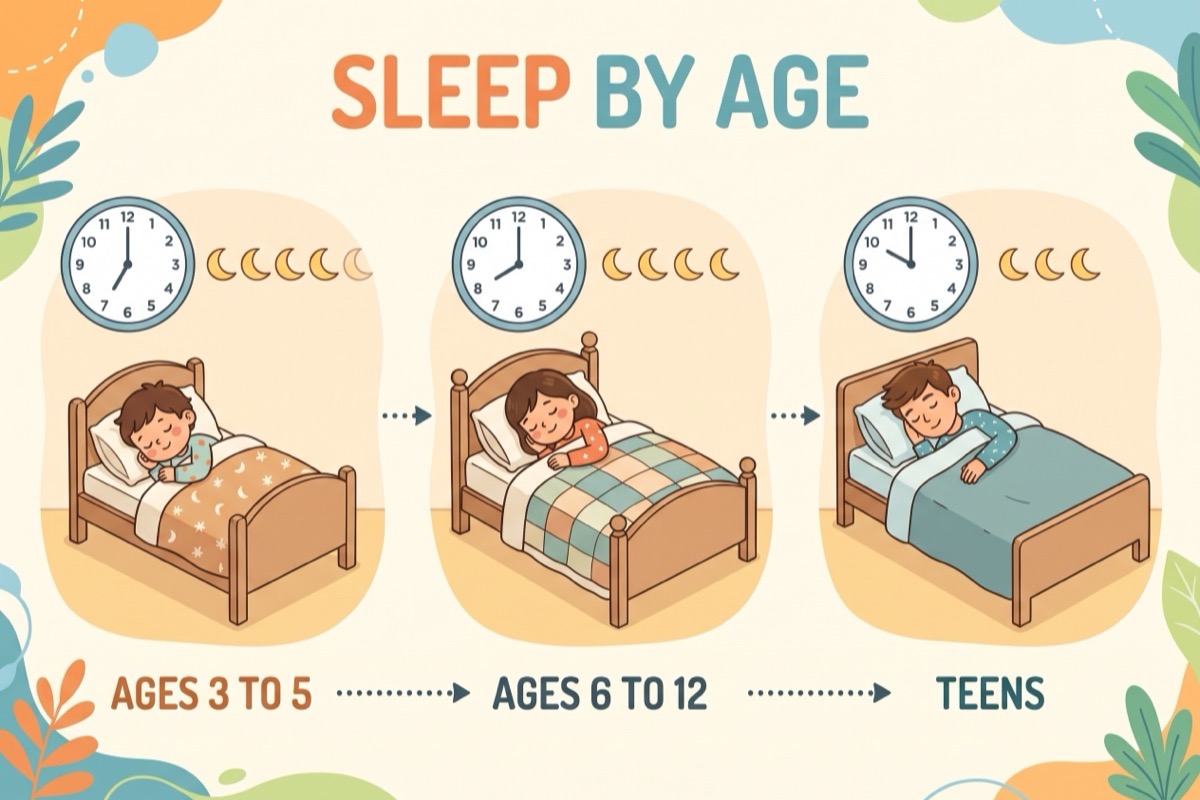
The American Academy of Sleep Medicine consensus statement (Paruthi and colleagues, 2016) sets the ranges below, and the AAP endorses them. They are per 24 hours, so a 3-year-old's preschool nap counts toward the total.
| Age Group | Total Sleep Per 24 Hours |
|---|---|
| Toddlers (1–2 years) | 11–14 hours (including naps) |
| Preschool (3–5 years) | 10–13 hours (including naps) |
| School age (6–12 years) | 9–12 hours |
| Teens (13–18 years) | 8–10 hours |
| Source: American Academy of Sleep Medicine Consensus Statement, endorsed by the AAP. Building a sleep habit takes closer to two months than 21 days. | |
Ranges that wide are not much help at 8 PM. Take the wake time the bus dictates, pick a target inside the range (about 11 hours for ages 3-5 once naps are gone, 10.5 for ages 6-9, 10 for ages 10-12) and count backward.
Worked example. The bus comes at 7:20. Your 8-year-old needs 35 minutes from feet-on-floor to front door, so wake-up is 6:45. Ten and a half hours back is 8:15 PM. That is lights-out, not "start thinking about bed," and the wind-down starts at 7:30. For a 10-year-old on the same bus, 10 hours back is 8:45. The answer to "what time should an 8-year-old go to bed" is a subtraction, not a number.
| School wake-up | Ages 3–5 (11 h) | Ages 6–9 (10.5 h) | Ages 10–12 (10 h) |
|---|---|---|---|
| 6:15 AM | 7:15 PM | 7:45 PM | 8:15 PM |
| 6:30 AM | 7:30 PM | 8:00 PM | 8:30 PM |
| 6:45 AM | 7:45 PM | 8:15 PM | 8:45 PM |
| 7:00 AM | 8:00 PM | 8:30 PM | 9:00 PM |
| 7:30 AM | 8:30 PM | 9:00 PM | 9:30 PM |
Those are lights-out times, and they assume sleep within 15 minutes. If yours takes longer than 20 most nights, move lights-out 15 minutes earlier for a week. The AASM keeps a free bedtime calculator for anyone who would rather not do arithmetic at 9 PM.
Sleep debt compounds. Thirty minutes short a night is two and a half hours by Friday, and in a classroom it looks like ADHD: fidgeting, tears over nothing, forgetting homework that was done. Overtired kids also get more active, so the 8:45 bouncing-off-the-walls act rarely means bedtime is too early.
The 2-Week Bedtime Shift Plan for Earlier Wake-Ups
Most advice stops at "move bedtime 15 minutes earlier every few days," which is correct and useless without a calendar. Here is the calendar, from a drifted schedule (asleep 9:45, up at 8:00) to a school one (asleep 8:30, up at 6:45). Two rules make it work. Wake time moves first: you cannot make a child fall asleep earlier, but a child up since 7:15 is tired by 9:00. And the weekend does not get a pass.
| Day | Wake-up | Lights-out | What else changes |
|---|---|---|---|
| Day 1 | 7:45 | 9:30 PM | Outside for 10 minutes within half an hour of waking. Screens off at 8:30. |
| Day 3 | 7:30 | 9:15 PM | The seven steps start at the new time even if she protests. The routine is the signal. |
| Day 5 | 7:15 | 9:00 PM | If the weekend falls here: same wake time within 30 minutes. No naps, no "just this once." |
| Day 7 | 7:00 | 8:45 PM | Over 30 minutes to fall asleep? Hold here two more days before the next move. |
| Day 10 | 6:45 | 8:30 PM | Target reached. Backpack packed and clothes out the night before. |
| Day 14 | 6:45 | 8:30 PM | Hold. The week the schedule stops being a project and starts being Tuesday. |
If school already started, the wake time is fixed by the bus. Keep it fixed, Saturday included, and move only bedtime. Expect a rough week while bedtime catches up. That is the plan working, not failing.
Homework, Late Practice and Screens: Fitting the Routine Into a Real Evening
The 7-step table assumes an evening with nothing in it. September evenings have everything in them. Three collisions come up in almost every family we hear from.
Homework that spills past 7:30
Rule one: homework happens before dinner, or before the wind-down starts, whichever comes first. Nothing academic after step 1. A worksheet at 8:10 raises cortisol when you need it falling. If the work is not done, it is not done: write a two-line note to the teacher and let the consequence land at school. The homework-ownership skills we lay out for 10-year-olds prevent the 8 PM scramble. And a fourth-grader regularly doing 90 minutes is a conversation with the teacher, not a bedtime problem.
Practice that ends at 8
Some nights the child walks in at 8:15 sweaty, hungry and wired. You are not doing seven steps. You are doing the 20-minute version, and it counts: the order is the same, and the order is what the brain recognizes.
- Food first, five minutes. Something small with protein: toast and peanut butter, a yogurt. A full dinner at 8:15 delays sleep on its own.
- Shower, five minutes. Warm and quick. Skip the hair.
- Pajamas, teeth, tomorrow's clothes, five minutes. The backpack was packed before practice. If it was not, that is tomorrow's lesson.
- Reading in bed, five minutes, then lights out. One chapter, not "until you feel sleepy." The check-in happened in the car.
Lights-out will be 20-30 minutes late on those nights. Accept it and protect the other four harder. Two late nights a week with five good ones is a schedule. Five, with a Saturday sleep-in, is a problem.
Screens, and the hour before bed
The AAP's February 2026 media policy, explained plainly on HealthyChildren.org, is direct: screen-free zones start with bedrooms, and screen-free time starts with the hour before bed. A 2016 JAMA Pediatrics meta-analysis of 20 studies and 125,198 children, mostly teenagers, found that a device within reach at bedtime roughly doubled the odds of inadequate sleep, and one merely present in the room did much the same. Phones and tablets charge in the kitchen from step 2 until breakfast, parents included. Write it into the AAP Family Media Plan so it is an agreement, not a nightly ruling. Our guide to the AAP screen time guidelines by age covers the 5 Cs; in the evening the only number that matters is 60 minutes.
Bedtime Routines by Age: 3–5, 6–9 and 10–12
Same seven steps at every age. What changes is who runs them, and how much the AAP suggests handing to the child as they get older.
Ages 3–5: Parent-Led
You run the routine. They are learning the sequence.
- Pictures, not words. A chart with a toothbrush, pajamas, a book and a bed lets a 4-year-old "read" the routine herself and answers "what's next?" before she asks.
- Small choices only. Which book, which stuffed animal. Not whether, not when. The AAP's advice is to allow flexibility inside the routine while keeping the choices you offer few: control without the clock.
- Mind the nap. A 3-year-old who sleeps 90 minutes at preschool needs less at night; a 5-year-old who dropped naps in kindergarten needs the full 11 hours.
Ages 6–9: Semi-Independent
They can do most steps alone. You provide the clock and the check-in.
- A written checklist on the mirror. Shower, teeth, pajamas, clothes for tomorrow. They do it; you verify with a glance, not a lecture.
- Ten to fifteen minutes of their own reading. Book light, paper book. One of the best sleep habits a child ever builds.
- Expect fears and the occasional wet bed. Both are typical. Our is-it-normal guide for ages 6-14 covers what is ordinary at 7, and the life skills we expect at 8 include running this list unprompted.
Ages 10–12: Self-Managed
They own the steps. You own the boundaries: screen cutoff and lights-out.
- Agree on lights-out together, inside your range. A 10-year-old gets 10 hours. Letting them pick 8:45 versus 9:00 beats announcing it.
- Phones charge in the kitchen. This is the hill. No exceptions for "my alarm is on it." Buy a $10 alarm clock.
- The clock is starting to shift. Somewhere in these years a lot of kids start feeling wide awake at the hour they used to fall asleep. A fixed wake time and morning light are your levers.
Make It a Bedtime Routine Chart Kids Can Run Themselves
The most useful change most families make is taking the routine out of the parent's mouth and putting it on the wall. A bedtime routine chart is why your 6-year-old stops asking "what's next?" fourteen times, and it is how bedtime runs on the night you are stuck on a work call. It also delivers what Mindell's data rewards: consistency. A chart runs the same on Tuesday and Thursday. A tired parent does not.
The chart, ages 6–9
Seven lines, in order, at the child's eye level. Dry-erase marker on a string.
- Homework in the folder, folder in the backpack, backpack by the door.
- Tablet on the kitchen charger.
- Shower.
- Pajamas, teeth for two minutes, clothes for tomorrow on the chair.
- Book in bed.
- One good thing, one hard thing.
- Lights out. The water bottle is already there.
For 3-to-5-year-olds, replace the words with pictures. For 10-to-12-year-olds, cut it to four lines. Print it with our free Chore Chart Maker, since a bedtime chart is a chore chart with a clock on it, or draw one by hand and fill in the seven steps; the same rules for making a chore chart work on school nights apply. Hang it where the child brushes her teeth.
Weekend Drift and the Sunday-Night Reset
Here is the rule that quietly fixes Monday. The AAP's guidance for school-aged children is to keep weekend wake-ups within one hour of the school wake time. Not identical. An hour. A child up at 6:45 on weekdays can sleep to 7:45 on Saturday. If she sleeps to 9:30, her clock is nearly three hours off, and on Sunday night she genuinely cannot fall asleep at 8:30. Parents call that Sunday-night anxiety. Often it is just Saturday.
- Wake within an hour of the school time. Outside for ten minutes before 9 AM. Morning light is what moves the clock.
- No nap after 3 PM for the under-6s. None at all for the 6-and-ups, however tempting the Sunday couch.
- Screens off 30 minutes earlier than a weekday. Sunday is the night the routine needs the most help.
- Backpack packed, clothes out, lunch decided by 6 PM. Not at 8:25 during the check-in.
- The "what's tomorrow" talk happens at dinner. Worry about Monday belongs at the table, not in a dark bedroom.
If Monday mornings are the wreck, the fix is usually Sunday night. Our school-day morning routine for kids covers the other half; the two lists share a backpack.
When Kids Won't Sleep on School Nights: Troubleshooting
You have built the routine, you are consistent, and your child is still lying awake at 9:40. Match what you hear at the door to what is usually going on.
| What you hear | What is usually going on | What to do tonight |
|---|---|---|
| "I'm not tired," then awake for 45 minutes | The body clock is still late, or a screen at 7:50 pushed melatonin back | Hold the wake time and add 10 minutes of morning light. Move lights-out 15 minutes later for three nights, then walk it back every three days. |
| Quiet, but not asleep, then "I can't sleep" | Sleep-onset trouble: sometimes the clock, sometimes an unsaid worry | Let her get up and sit in a dim room with a boring book for 15 minutes, then back to bed. Find the worry in daylight. |
| "I'm scared" (ages 4–8) | Imagination running ahead of reality-testing. Common at this age, and it fades | Nightlight, comfort object, and the check-back: "back in 5 minutes," then 5, then 7, then 10. Most are asleep before the second check. |
| Water, bathroom, one more hug, door open wider | Stalling, and it works | Build every reasonable request into step 7. Then two "bedtime tickets" a night, each good for one request. Most fall asleep holding them. |
The night-owl child
Some children, especially from about 10 on, have a clock that simply runs late. It is not defiance and it is not a habit. A fixed wake time and morning light will move a late clock, but not as far as you would like, and pretending otherwise leaves a child lying in the dark learning to hate her bed. If a 12-year-old still cannot fall asleep before 10 after two full weeks of the shift plan, aim for the low end of the range, 9 hours, and protect it. Nine reliable hours beat ten theoretical ones.
School-night worry
When the sleeplessness is Sunday-specific, it is rarely about sleep. Clark Goldstein, a psychologist at the Child Mind Institute, lays out the sequence: find the specific worry by talking to the child and, separately, to the teacher; keep bedtime and the routine fixed so sleep does not become a second problem; track good nights on a chart so progress is visible; and if the worry is strong and lasting, see a psychologist trained in cognitive behavioral therapy, which has the best evidence for childhood anxiety. If the Sunday worry becomes Monday-morning refusal, our guide to what to do when your child does not want to go to school covers the first two weeks.
When to call the pediatrician
- Snoring most nights, gasping, or mouth-breathing in sleep. Enlarged tonsils and sleep apnea are common at this age and very fixable.
- More than 30 minutes to fall asleep on most nights for a month, with the routine already in place.
- Falling asleep at school or in the car on short trips despite a reasonable bedtime.
- Restless legs, night terrors past age 8, or a sudden change in sleep alongside a change in mood.
None of these is a diagnosis. All are worth a conversation, because a child who is not sleeping cannot show you what she can do.
Key Takeaways
- Count backward from the bus. Wake time minus 10.5 hours (ages 6-9) or 10 hours (ages 10-12) is lights-out. The wind-down starts 45 minutes earlier.
- Seven steps, same order, every school night. Mindell's 10,000-family study found each extra night bought earlier and faster sleep.
- Homework before dinner, nothing academic after that. An unfinished worksheet is the teacher's problem tomorrow, not the bedroom's tonight.
- Screens off 60 minutes before bed, devices in the kitchen. The AAP names the bedroom and the hour before bed as the first screen-free zones.
- Move the clock 15 minutes every two or three days, wake time first. Weekend wake-ups stay within an hour of the school time.
- Snoring, or 30-plus minutes to fall asleep most nights for a month, means a pediatrician. Not a stricter routine.
Bedtime will probably never be the best part of your day, but it can stop being the worst. The trick is not patience, which runs out around 8:50. It is a system that makes the right thing the default, so on the Tuesday you have nothing left, the routine runs anyway.
Frequently Asked Questions
What is a good bedtime routine for kids on school nights?
A good bedtime routine for kids on school nights runs the same seven steps in the same order: lights down and homework closed, screens off with devices charging outside the bedroom, a bath or shower, pajamas and teeth with tomorrow's clothes laid out, 10 to 15 minutes of reading in bed, a two-minute check-in, and lights out. Mindell and colleagues found the more nights a week it happens, the earlier and faster children fall asleep, so Thursday matters as much as Monday.
What time should an 8-year-old go to bed on a school night?
Count back from wake-up. An 8-year-old needs 9 to 12 hours by the AASM ranges, and 10.5 hours is a good working target. If the bus means a 6:45 wake-up, lights-out is 8:15 PM and the wind-down starts at 7:30. A 7:00 wake-up puts lights-out at 8:30. If your child takes more than 20 minutes to fall asleep most nights, move lights-out 15 minutes earlier for a week. If she wakes before the alarm and is cheerful at breakfast, 15 minutes later is fine.
How much sleep does a 10-year-old need?
The American Academy of Sleep Medicine recommends 9 to 12 hours per 24 hours for ages 6 to 12, and the AAP endorses that range. For a 10-year-old, aim for 10 hours on school nights and treat 9 as the floor. With a 6:45 wake-up that means lights-out at 8:45 PM. Signs of a shortfall: needing to be woken every morning, falling asleep in the car, tears over small things after school, or two-hour weekend catch-up sleep.
How do I move my child's bedtime earlier for school?
Move the wake time first; bedtime follows. Shift both 15 minutes earlier every two or three days, ideally starting two weeks before the schedule changes. Get outside light within half an hour of waking, keep weekend wake-ups within an hour of the target, and skip naps for kids over 5. If school has already started, the wake time is fixed by the bus, so hold it on weekends too and move only bedtime. Expect a tired week while bedtime catches up. The table above gives the full calendar.
Why won't my child sleep on school nights?
Usually one of four things. The body clock is still on the later schedule it drifted into, so 8:30 feels like 7:00. A screen within an hour of bed pushed melatonin later. Homework or practice ran into the wind-down and cortisol is still high. Or there is a specific worry about school, which shows up as Sunday-night wakefulness and Monday stomachaches. Fix the first three with a fixed wake time, morning light and a 60-minute screen cutoff. If it takes over 30 minutes to fall asleep most nights for a month, call the pediatrician.
Is melatonin safe for kids who can't fall asleep?
The AAP's position, spelled out on HealthyChildren.org, is that melatonin is not a sleeping pill and should only be used after a conversation with your pediatrician and after healthy sleep habits are in place. Short-term use looks relatively safe; less is known about long-term use, with specific concerns about growth and development during puberty. It is also a real poisoning risk: the AAP counts more than 260,000 child poisoning reports involving melatonin between 2012-2021, two of them fatal. Fix the routine first: a fixed wake time, morning light, screens off an hour before bed. If a month of that does not work, ask your pediatrician.
Related Reading
- Morning Routine for Kids: 5 School-Day Steps That Actually Stick (2026)
- My Child Doesn't Want to Go to School: What Actually Works (2026)
- How Much Screen Time Is OK for Kids? The 2026 AAP Answer (By Age)
- Is My Child Normal? Behavior Ages 6–14, Typical vs. Red Flags (2026)
- Life Skills for 10-Year-Olds: The Checklist Before Middle School (2026)
- After School Routine for Kids: An Order That Ends the 4 PM Fights (2026)
- After School Meltdowns: Why Kids Fall Apart at 3 PM and What Helps (2026)
Put the bedtime routine on the wall
Our free Chore Chart Maker builds a seven-step bedtime chart your child can check off herself: lights down, screens off, shower, teeth, book, check-in, lights out. Printable, no signup.
Try the Chore Chart Maker
