How Much Screen Time Is OK for Kids? AAP Guide by Age (2026)
How much screen time is OK for kids? The short answer from the American Academy of Pediatrics (AAP) is that there is no longer one required number. If you want a number anyway, its January 2026 policy offers an optional range to discuss with your pediatrician. It is under 1 hour a day of entertainment screens for toddlers and preschoolers, and 1 to 2 hours a day or more for school-age kids and teens. For comparison, kids 8 and under already average 2 hours 27 minutes a day (Common Sense, 2025).
Below is one table: the official guidance by age, what kids that age actually use, and one family rule to start with. The last column is our suggestion, not the AAP’s.
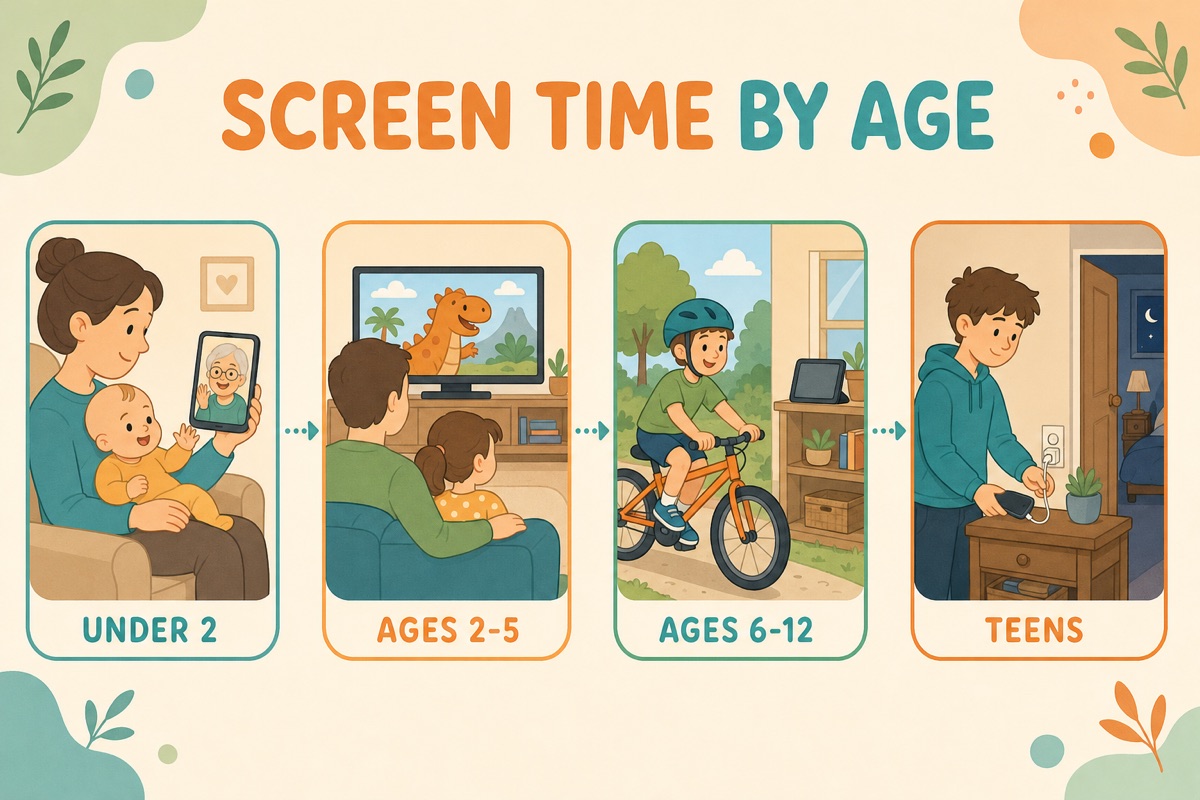
How much screen time is OK for kids, by age
Swipe the table sideways to see all four columns, including the family rule.
| Age | What the AAP and WHO say | What kids actually use | A family rule to start with (our suggestion) |
|---|---|---|---|
| 0–18 months | AAP 2026: infants do not learn from screens, but “occasionally viewing brief, high-quality videos (e.g., Sesame Street) is not detrimental.” Video chat is fine. WHO: none under age 2. | 1 hour 3 minutes a day for all kids under 2 (Common Sense census, 2025 edition) | Video calls with family, yes. Otherwise no screens in the daily routine, and no background TV at meals. |
| 18–24 months | AAP 2026: no separate rule; the optional range starts at “<1 hour/day” for toddlers. WHO: no sedentary screen time for 1-year-olds. | Same: 1:03 a day for under-2s (2025 edition) | If you use a show, one short, slow episode watched together. |
| 2–5 years | AAP 2026: no required cap; optional “<1 hour/day,” quality content, watched together. WHO (2–4): “no more than 1 hour; less is better.” | Ages 2–4: 2:08 a day. Ages 5–8: 3:28 (2025 edition) | One chosen show at a set time, never as the bedtime wind-down. |
| 6–12 years | AAP 2026: optional “1 to 2 hours/day or more” of entertainment media; sleep, play, activity and reading come first. WHO 2020: an average of 60 minutes a day of moderate-to-vigorous activity. | Ages 8–12: 5:33 a day of entertainment media (2021 tween/teen edition, the latest) | “Green list first”: homework, an hour of moving, chores, then screens. Devices stay in shared rooms. |
| 13–17 years | AAP 2026: no required limit, same optional range, no set age for a first smartphone. No screens the hour before bed, no devices in the bedroom. | Ages 13–18: 8:39 a day (2021 edition). CDC: 50.4% of teens 12–17 report 4+ hours (2021–2023) | One agreed phone-free zone (meals or homework) and an overnight charging spot outside the bedroom. |
Sources: the AAP policy statement “Digital Ecosystems, Children, and Adolescents” (Pediatrics, 2026), the WHO under-5 guideline (2019), the Common Sense census for ages 0–8 (2025) and for tweens and teens (2021), and CDC NCHS Data Brief 513.
Notice the gap between columns two and three. From age 2 up, average use sits one to several hours above the numbers in column two, and half of US teens report 4+ hours a day (CDC). That is the honest starting point.
AAP screen time guidelines 2026: what changed, and what did not
In January 2026 the AAP released a new policy statement, published in the February issue of Pediatrics. Its core sentence: “media and children” cannot be viewed “solely through the lens of individual child behaviors or screen limits alone.”
The AAP’s parent explainer, Helping Kids Thrive in a Digital World on HealthyChildren.org, asks families to “move beyond simple screen-time limits and focus on quality, context and conversation.”
Two things are genuinely new, beyond the optional range in the table above:
- No required limit at any age. The AAP’s parent Q&A says “there isn’t enough evidence demonstrating a benefit from specific screen time limitation guidelines.” The policy adds: “The most important considerations are high-quality content and prioritizing healthy activities.”
- A softer line on babies. In 2016 the AAP called screens before 18 months “a bad idea.” Now: infants do not learn from screens, but occasional brief, high-quality video is not harmful.
What did not change: the AAP dropped one-size-fits-all limits for older kids back in 2016. “Two hours a day” was an older rule of thumb; what is new is that the youngest kids lost their fixed cap too. EdSurge called it “one of the biggest shifts from 2016 to 2026: no set screen time limit.”
The household advice is familiar, just firmer: no screens in the hour before bed, no devices in bedrooms, phone-free meals and homework, one screen at a time. Kids “will not miss out on learning opportunities if families delay giving their children a tablet,” and there is no fixed age for a first phone.
Rules like “3-6-9-12” or “7-7-7” are popular rules of thumb, not AAP guidance.
Does homework or educational screen time count?
Not toward the optional range. The AAP’s numbers cover “entertainment (not school-related) media,” and the policy says well-designed media with learning goals, used in moderation, can be linked to learning math and reading. The usage numbers below for tweens and teens also leave schoolwork out.
TV, tablet or phone: does the device matter?
None of the AAP sources we checked ranks one device as worse than another. What they flag is how it is used: alone or together, one screen or several, in a shared room or behind a bedroom door. The policy worries about “noneducational and solo” use, asks for “one screen at a time” and the TV off when nobody is watching, and the parent guide suggests a shared family tablet over personal ones.
Content ratings that actually matter
The AAP’s “Content” C says content quality “shapes whether kids have positive or negative relationships with media,” and for picking shows and apps the 2026 policy points to Common Sense Media and the AAP Center of Excellence. For video games, an ESRB rating has three parts: an age category (E, E10+, T, M 17+, AO 18+), content descriptors that explain the rating, and interactive elements such as online features, which do not change the rating. Our suggestion: read the descriptors and interactive elements, not just the letter.
AI chatbots and kids
A March 2026 Pediatrics review from CHOP (a review article, not AAP policy) lists the risks of generative AI as “misinformation, privacy threats, and false perceptions of AI as a friend or caregiver.” It adds that “current AI use requires boundaries and supervision in early childhood.” Our AI literacy guide for kids and AI homework rules cover it by age.
Average screen time in 2026: what kids actually use
There is no 2026 census of kids’ screen use yet. The newest numbers come from three surveys, and the year matters.
Swipe the table sideways to see all three columns.
| Age group | Average per day | Survey and year |
|---|---|---|
| Under 2 | 1 hour 3 minutes | Common Sense census, 0–8 edition published February 2025, 1,578 parents surveyed August 2024 |
| 2–4 | 2 hours 8 minutes | Same, 2025 edition |
| 5–8 | 3 hours 28 minutes | Same, 2025 edition |
| All kids 0–8 | 2 hours 27 minutes (2:24 in 2020) | Same, 2025 edition |
| 8–12 | 5 hours 33 minutes of entertainment media | Common Sense tween/teen census, 2021 edition (published March 2022), 1,306 kids surveyed fall 2021 |
| 13–18 | 8 hours 39 minutes of entertainment media | Same, 2021 edition |
| 12–17 | 50.4% report 4+ hours a day | CDC NHIS-Teen, July 2021–December 2023 |
How to read these: the young-kid numbers are parent reports. The tween and teen numbers count entertainment only and were collected during the pandemic, after a 17% jump from 2019. The “4 hours 44 minutes” you see quoted for tweens is the 2019 figure. The CDC number is a share, not an average: it asked teens one question about a typical weekday, while Common Sense added up every kind of entertainment screen, so 50% above 4 hours and an 8:39 average can both be true.
The 2025 census also found boys at 2:38 a day and girls at 2:07, and kids in households under $50,000 at 3:48 versus 1:52 in households over $100,000. Forty percent of children had a tablet by age 2.
For teens, a January 2026 JAMA study found about 70 minutes of smartphone use during the school day. A May 2026 JAMA Pediatrics study found about 50 minutes between 10 PM and 6 AM on school nights. Both tracked Android users in one cohort, so treat them as a snapshot.
And parents: 66% of parents of kids 8 and under at least sometimes use screens to keep a child busy so they can get things done. That is not a moral failing. It is 5:40 PM with dinner on the stove, and the plan below is built for that moment.
What the research can and cannot say
Most headlines rest on research that finds links, not causes: useful for planning, not a verdict on your child.
What we can say. In the CDC survey, 27.1% of teens with 4+ hours of daily screen time reported anxiety symptoms, versus 12.3% of teens with less; for depression symptoms, 25.9% versus 9.5%. A Calgary study of 2,441 children linked more screen time at ages 2 and 3 to lower developmental screening scores later. The AAP says heavier solo, non-educational use in ages 0–5 “is associated with” language and other delays and poorer sleep, and that calming preschoolers with devices is linked to weaker emotion regulation.
What we cannot say. None of this proves screens cause anxiety, depression or delays. The CDC data are cross-sectional, self-reported screening questions, not diagnoses. The Calgary effects were small. Orben and Przybylski’s analysis of 355,358 teens found a negative but small link, “explaining at most 0.4% of the variation in well-being,” though other researchers dispute that reading. The AAP calls the teen links “small” and varied, with ages 11 to 14 possibly more sensitive.
The “2026 Frontiers meta-analysis of 20 studies” is actually an editorial introducing 20 non-US papers, and its editors say the data are mostly correlational.
Is it a “screen time crisis”? Half right.
- True: use jumped 17% between 2019 and 2021. Half of US teens report 4+ hours a day. Phones show up during the school day and late at night on school nights.
- Not proven: that screen time causes anxiety, depression or developmental delay. The links are mostly small and correlational, and the AAP itself moved away from a single hour cap.
- What follows for a family: worry less about the exact minute count and more about what screens push out, especially sleep.
Sleep and screens: the clearest rule
If you change only one thing, change bedtime. The AAP says no screens in the hour before bed and no devices in the bedroom. The American Psychological Association links tech use in that last hour to disrupted sleep.
A review of 67 studies by Hale and Guan found screen time linked to worse sleep in 90% of them. A JAMA Pediatrics meta-analysis of 125,198 kids aged 6 to 19 found bedtime device use linked to more than double the odds of too little sleep. Even having a device in the bedroom at night, unused, was linked to inadequate sleep. All three are correlational, but they match the AAP’s reasons: melatonin disruption, arousing content, and the device in the room.
Sleep needs per 24 hours, naps included (AASM consensus, supported by the AAP): 12–16 hours at 4–12 months, 11–14 at 1–2 years, 10–13 at 3–5, 9–12 at 6–12, and 8–10 for teens.
In the 2025 census, 20% of kids 8 and under used a device most nights to fall asleep. The fix is a replacement, not a lecture: our bedtime routine for kids lays out a screen-free wind-down.
The 5 Cs of media use, on a normal Tuesday

The 5 Cs replace “how many minutes” with better questions. They come from the AAP Center of Excellence on Social Media and Youth Mental Health (co-medical directors Dr. Megan Moreno and Dr. Jenny Radesky) and build on Lisa Guernsey’s “3 C’s.” They are a counseling framework, not a tested program, and are not part of the 2026 policy text.
1. Child
“Who is your child, what is their personality?” On Tuesday: your 7-year-old melts down every time the racing game ends. Next week you try a slower building game and watch whether the 4:30 crash shrinks.
2. Content
Content quality “shapes whether kids have positive or negative relationships with media.” On Tuesday: you turn off autoplay. When the episode ends, you pick the next one, or nobody does.
3. Calm
Your child needs other ways to handle big feelings and to fall asleep. On Tuesday: a meltdown starts at the checkout. Before reaching for your phone, you name the feeling and give it a minute. Sometimes the phone still comes out; the goal is that it is not the only tool. If 3 PM is always rough, see our guide to after-school meltdowns.
4. Crowding out
What does media push aside, and what does the family want back? The policy says sports, music, art and outdoor movement “can help crowd out digital media.” On Tuesday: instead of asking how long she was on it, you notice what was missing (outside time, dinner talk, sleep) and add that back first. An after-school routine does most of this, and our no-phone activities list fills long days.
5. Communication
Talk about media “early and often.” On Tuesday: you watch ten minutes together and ask one question: “Why do you think she did that?”
The 5 Cs at each age
HealthyChildren.org has versions for infants, toddlers and preschoolers (2–4), school-age kids, young teens and older teens. The toddler version asks: “What is worth their attention?”, “How do they calm their emotions or go to sleep?” and “What does media get in the way of?”
The Family Media Plan: what the AAP actually suggests
The AAP’s practical tool is the interactive Family Media Plan, listed among the 2026 policy’s recommendations. The page How to Make a Family Media Plan gives three tips:
- Create rules that fit your family: screen-free zones, “one screen at a time,” autoplay and notifications off, quality content, privacy settings, room for other activities.
- Make a plan for every family member, including parents. Phones away at meals and bedtime applies to adults too.
- Revisit it often, for example each school year. Plans “should evolve as your child matures and develops.”
The AAP’s interactive Family Media Plan tool builds a personalized plan for every kind of media in your house. It is more thorough than our week-one plan below, which is a way to get started.
If you start with our week-one plan instead, keep it to one page you can post on the fridge.
A week-one family plan
One small change a day, so by Sunday you have a plan instead of a speech. Our suggestion, built on the AAP advice above.
Swipe the table sideways to see the “Why” column.
| Day | What to do | Why |
|---|---|---|
| Day 1 | Just watch. Note when screens come out and why: boredom, a sibling fight, you cooking dinner. | Crowding out starts with knowing what is being pushed aside. |
| Day 2 | Short family talk. Pick one phone-free zone for everyone: dinner is the easiest start. | The AAP asks for phone-free zones at meals, in bedrooms and during homework. |
| Day 3 | Set up a charging spot outside the bedrooms. Buy or dig out an alarm clock. | Even having a device in the bedroom at night is linked to worse sleep. |
| Day 4 | Screens off an hour before bed. Put the wind-down steps on a visible list. | The AAP says an hour; the APA advisory flags the same hour. |
| Day 5 | Add back the missing thing from Day 1: a walk, a bike ride, a board game after dinner. | The AAP says activities “can help crowd out digital media.” |
| Day 6 | Watch or play one thing together. Ask one question afterward. | Communication is one of the 5 Cs: talk about media “early and often.” |
| Day 7 | Write the plan on one page, parents’ rules included. Put a review date on the calendar for the next school term. | The AAP says to plan for every family member and revisit often. |
Keep the week-one plan on the weekly chart
Add Days 2 to 4 as three tasks in Family Checklist: “phone on the charger,” “screens off,” and “wind-down.” They show up on the weekly chart as steps to tick off, so the reminder lives on the screen instead of in your head. Free for 3 family members with 3 tasks each.


Prefer paper? Build a free printable chart in your browser instead.
Expect pushback around Days 3 and 4. Habits take weeks to months, not a magic 21 days (see why habits take longer than 21 days). Hooking the new step onto one you already do (“phone on the charger, then teeth”) gives it a fixed place in the evening. If pushback turns into a fight, our positive parenting techniques guide has calm scripts to try before taking the device away.
A steady morning routine for kids removes the cartoon-to-get-dressed deal, and real jobs from our life skills checklist by age crowd out scrolling.
When to talk to your pediatrician
Most screen worries are a family-plan problem. Some deserve a call to your pediatrician or school counselor. The American Psychological Association’s 2023 advisory lists signs of “problematic social media use,” including:
- using social media even when your teen wants to stop;
- repeatedly spending more time on it than they meant to;
- lying or sneaking to keep access;
- losing or damaging important relationships or schoolwork because of it.
In our view, also call about ongoing sleep loss, withdrawal from friends or favorite activities, or low mood or anxiety lasting weeks. These are reasons to ask, not a diagnosis; “screen addiction” is not a label to apply at home. Our guides to normal teen behavior versus warning signs and child behavior red flags at 6 to 14 help sort the two. If you are worried about your child’s safety, contact your pediatrician or emergency services. If your child talks about self-harm or suicide, call or text 988, the 988 Suicide & Crisis Lifeline, any time, day or night.
For toddlers, raise it at a well visit if talking or play seem delayed, or if a screen is the only thing that calms your child.
Key Takeaways
- The AAP’s January 2026 policy sets no required limit. Optional range: under 1 hour a day for toddlers and preschoolers, 1 to 2 hours or more for older kids.
- WHO is stricter for little kids: no screen time before age 2 and no more than 1 hour at ages 2 to 4.
- Real use is far higher: 2:27 a day for kids 0–8 (2025 census), 5:33 for tweens and 8:39 for teens (2021 census).
- Research links heavy use to worse sleep, mood and development, but mostly through correlations with small average effects.
- Sleep is the clearest rule: no screens in the last hour before bed, no devices in the bedroom.
- Alongside an optional time limit, the AAP points families to the 5 Cs (from its Center of Excellence) and the Family Media Plan, a plan that includes parents. The 5 Cs are a counseling framework, not a tested program.
Frequently Asked Questions
How much screen time is OK for kids, according to the AAP in 2026?
The AAP no longer sets one required limit. Its parent guide on HealthyChildren.org asks families to focus on quality, context and conversation. For families who want a number, the January 2026 policy says limits "might range from <1 hour/day for toddlers and preschoolers to 1 to 2 hours/day or more" of entertainment media for school-age kids and teens.
What are the 5 Cs of media use?
Child, Content, Calm, Crowding Out and Communication. They come from the AAP Center of Excellence on Social Media and Youth Mental Health. HealthyChildren.org has question lists for each age, from infants to older teens.
How much screen time does the average child have?
Kids 8 and under average 2 hours 27 minutes a day: 1:03 under age 2, 2:08 at ages 2 to 4, and 3:28 at ages 5 to 8 (Common Sense census, 2025 edition). In the latest tween and teen census (2021), 8- to 12-year-olds averaged 5:33 and 13- to 18-year-olds 8:39 of entertainment screen media a day.
Is it OK for a toddler to watch any TV?
The AAP's 2026 policy says infants do not learn from screens, but "occasionally viewing brief, high-quality videos (e.g., Sesame Street) is not detrimental," and video chatting is fine. WHO is stricter: no sedentary screen time before age 2, and no more than 1 hour a day at ages 2 to 4.
Should kids have phones in their bedrooms at night?
No. The AAP says to avoid screens an hour before bedtime and keep devices out of the bedroom. A meta-analysis of 125,198 kids found that even having access to a device in the bedroom at night was linked to not getting enough sleep.
Does screen time cause anxiety or depression?
The link is real but not proven to be cause and effect. The CDC found anxiety symptoms in 27.1% of teens with 4 or more hours a day, compared with 12.3% of teens with less, but the data are cross-sectional. Large analyses find small average effects, and the AAP notes that effects differ from child to child.
Related Reading
- Bedtime Routine for Kids — a wind-down that replaces the screen.
- After School Routine for Kids — screens after the basics.
- Morning Routine for Kids — out the door without a cartoon.
- AI Literacy for Kids — chatbots and AI tools by age.
- Life Skills Checklist by Age — real jobs that crowd out scrolling.
- Normal Teen Behavior or Warning Sign? — a calm checklist for teens.
Put the screen rule inside the daily routine
When the screen rule is one step on the weekly chart, nobody has to remember to announce it. In Family Checklist, “phone on the charger” can sit next to teeth and pajamas. The free version covers 3 family members with 3 tasks each. Printing the weekly chart and syncing across devices come with Premium.