After School Routine for Kids: An Order That Ends the 4 PM Fights (2026)
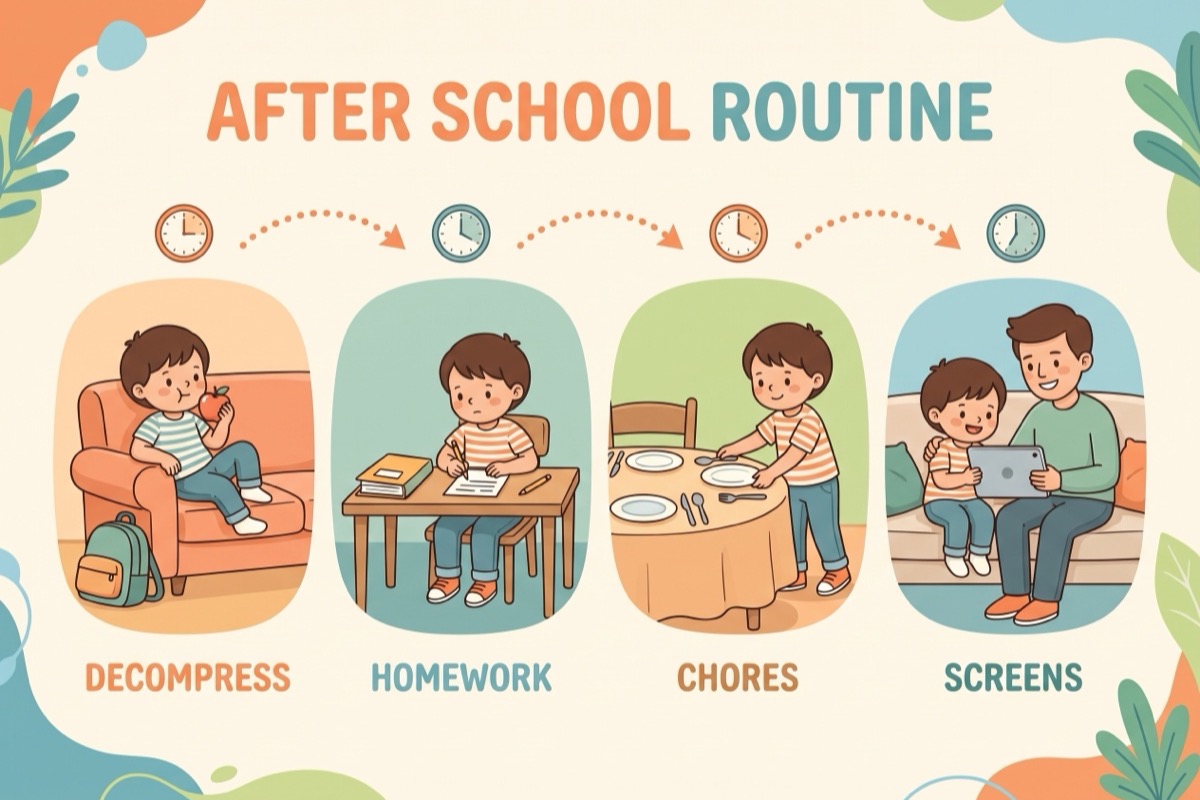
The backpack hits the floor at 3:32. By 3:40 someone is crying about a worksheet, and it is not always the child. Most families do not have an after school routine for kids so much as a pile of things that must happen before bed, attempted in whatever order the afternoon allows. The fix is not more rules. It is a fixed order: decompress, then homework, then chores, then screens. Same sequence every day, with clock times that fit your pickup.
This is the middle piece of our school-day set. The morning routine for kids gets everyone out the door; the bedtime routine for kids on school nights gets them to sleep. This one covers the three and a half hours in between, where most of the yelling happens.
Why the 4 PM Fight Happens (and Why the Order Fixes It)
A child who walks in at 3:30 has spent six and a half hours doing the hardest thing a child does: holding it together. The Harvard Center on the Developing Child describes executive function as three skills working together: working memory, mental flexibility, and self-control. Nobody is born with them, and they keep developing into the mid-twenties. A school day works them hard: sitting still through math, waiting for a turn, not hitting Liam when Liam deserved it. By the time the bus stops, the supply is mostly spent.
Teachers have an informal name for it: after-school restraint collapse. Not a diagnosis, but the pattern is familiar to anyone who has collected a child who was "an angel all day" and then screamed about the wrong cup. Kids save their worst for the people they trust, and the routine's first job is to give it somewhere to go.
The order works because each step puts back what the previous one used. A snack refills the tank. Twenty minutes of movement gets the school day out of the body and covers a third of the 60 daily minutes the CDC recommends for ages 6-17. Homework then gets whatever attention is left. Screens go last because a screen is the only thing on the list a child never wants to stop. Put it first and every transition after it is a fight. Put it last and it is the reason the rest gets done.
The whole routine in one line
Decompress (15-30 min) → Homework (10 min per grade) → Chores (15-20 min) → Screens (after the checklist, on a timer) → Dinner → Bedtime hand-off. The times move with your pickup. The order does not.
The After School Routine for Kids, Step by Step: Decompress, Homework, Chores, Then Screens
Four blocks. The times are defaults for an 8-to-10-year-old; the age section adjusts them.
Snack, movement, and no questions
- Backpack in the drop zone, shoes off, folder on the table. Two minutes, same spot, every day. It saves the 4:05 hunt for the folder.
- The snack is already out when they walk in. Produce plus a protein. The AAP's snack guidance is blunt about packaged snacks: low in nutrients, high in added sugar, hungry again sooner.
- Twenty minutes outside if the weather allows. Bike, backyard, the dog, the park on the way home. This is where the day's tension leaves the body.
Rain plan: Lego on the floor, a dance playlist, a hallway obstacle course. Not a screen, not a worksheet.
- Zero screens, and no questions, for the first 20 minutes. Not "just while I make the snack." Say hello, say one line about the snack, and leave the room.
Same place, same time, timer in view
- Same spot, same time, every school day. Through sixth grade the kitchen table beats the bedroom: you are nearby without hovering.
- Start with the two-minute plan. What is due, in what order, how long each piece takes. Three lines on a sticky note is the planner habit middle school will demand.
- Breaks are scheduled, not earned. Five minutes every 15-20 for younger kids, one per assignment for older ones. The Child Mind Institute comes down to the same three: fixed time, planned breaks, written plan.
- Phones in the basket, laptop tabs agreed in advance. If AI tools are on the table, the family's AI homework rules apply: "explain it to me" yes, "do it for me" no.
- You are in the room, not at the elbow. Answer "how do I start," not "what is 7 times 8." The block ends when the timer does.
One job the family relies on, plus the reset
- One assigned job with a clear finish. Empty the dishwasher, set the table, feed the pet. Our chores for 8-year-olds has twenty to pick from; life skills for 10-year-olds has the fifth-grade version.
- The daily reset. Lunchbox in the sink, bottle refilled, signed folder back in the bag. Three minutes that save the morning.
- Chores sit here on purpose. A tired child can unload a dishwasher, not do long division. Work alongside them for the first two weeks: kids talk more over a dish rack than across a table.
- Same cue every day. "Homework's done, chore time." Never as the penalty for a bad homework block: chores are a step, not a sentence.
For the numbers behind the screen slot, our guide to how much screen time is OK for kids by age covers the research, and the AAP 5 Cs framework is the reference for ages 6 and up.
The Timed Schedule: What 3:30 to 7:00 Looks Like
The default afternoon for a fourth grader who gets home at 3:30 with one adult in the house. Shift the whole table by your arrival time and keep the gaps.
| Time | Step | What the kid does | What the parent does |
|---|---|---|---|
| 3:30 | Land | Backpack in the drop zone, shoes off, folder on the table | Says hello, says nothing else. Snack is already out |
| 3:35-4:00 | Decompress | Eats the snack, then 20 minutes outside or in active play | Leaves the room. Twenty minutes with no questions |
| 4:00-4:40 | Homework | Writes the two-minute plan, works through it, one break | In the room, not at the table. Starts the timer. Answers "how do I start" |
| 4:40-5:00 | Chores | One assigned job, then the reset: lunchbox, bottle, folder | Works alongside for the first two weeks, then checks the result |
| 5:00-5:45 | Free time / screens | Checks the last box. Screens or free play, on a device timer | Cooks. Ten-minute warning at 5:35 |
| 5:45-6:00 | Transition | Screens off, sets the table, calls siblings | Hands over a job the second the screen goes dark |
| 6:00-6:30 | Dinner | Screen-free. This is when "how was school" finally gets answered | Phone in another room. Asks the specific question |
| 6:30-7:00 | Repack and hand-off | Backpack packed for tomorrow, clothes out, then wind-down | Checks the folder once. Evening starts at 7:00, not 7:40 |
The 7:00 hand-off is not arbitrary. The Sleep Foundation puts school-age sleep need at 9 to 12 hours a night. For a 9-year-old who wakes at 6:45 and needs ten: asleep by 8:45, lights out at 8:30, bedtime routine at 8:00, dinner finished by 7:00. Cut the decompression and homework runs late; run homework late and screens run late; run screens late and the bedtime fight replaces the homework fight.
The Homework Block: The 10-Minute Rule by Grade
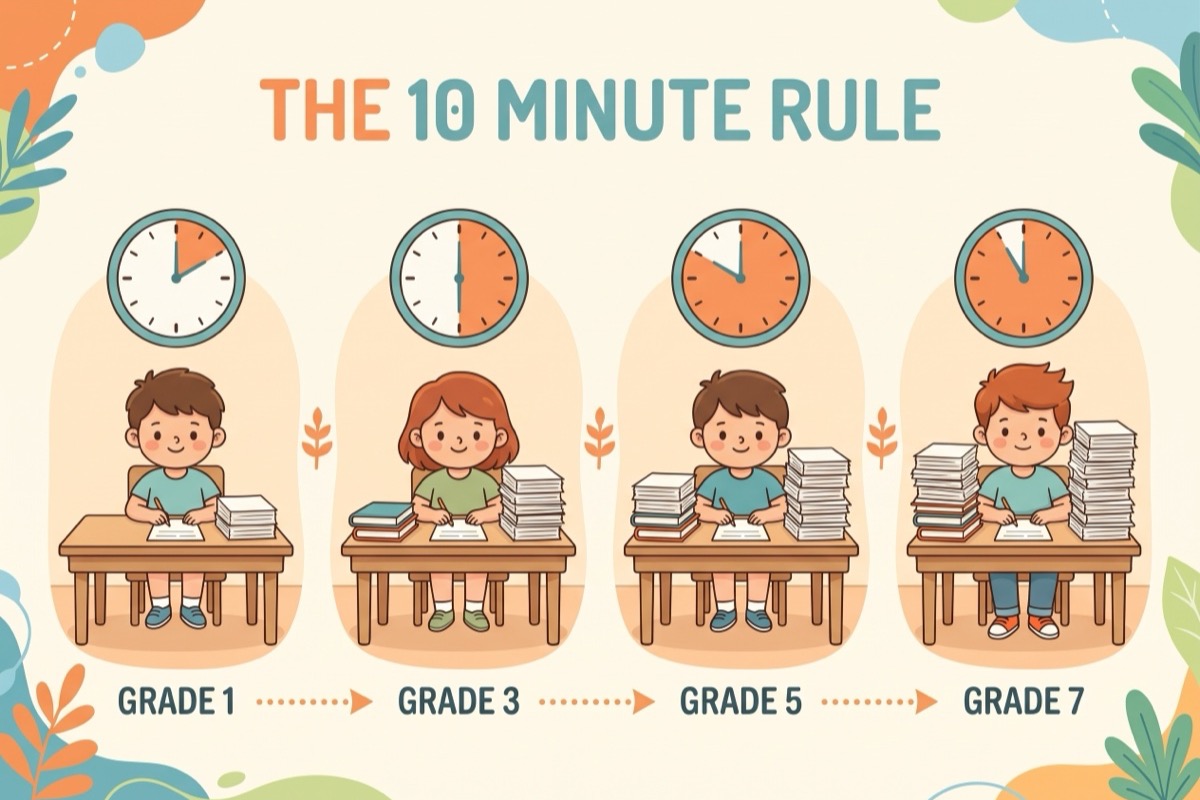
The best-known number in homework research comes from Harris Cooper at Duke. His team's review of more than 60 studies, summarized by Duke in 2006, found the link between homework and achievement much stronger for secondary students than for elementary students. Younger kids are more distractible and have not yet built study habits, so more minutes do not buy more learning. Out of it came the 10-minute rule, about 10 minutes per grade level per night. The APA's summary of the same research adds the cost side: burnout, lost family time, less sleep, stress.
| Grade | Nightly target | What it usually looks like | Stop point |
|---|---|---|---|
| Kindergarten | 0-10 min | Reading together, a letter sheet | When they stop enjoying it |
| Grade 1 | 10 min | One worksheet, 10 minutes of reading aloud | 15 min |
| Grade 2 | 20 min | Spelling, a math page, reading | 30 min |
| Grade 3 | 30 min | Math practice, reading log, occasional project piece | 40 min |
| Grade 4 | 40 min | Two subjects, 20 minutes of independent reading | 50 min |
| Grade 5 | 50 min | Two or three subjects, first multi-day projects | 60 min |
| Grade 6 | 60 min | Several teachers, a planner that must be checked | 75 min, in two blocks |
| Grades 7-8 | 70-80 min | Real workload, reading for two classes, a test to study for | 90 min, in two blocks |
The stop point is the part most families skip. When the timer hits it and the work is not done, the child stops and you write two lines in the folder: "Worked 45 minutes, stopped here." Three notes in two weeks means an email to the teacher: either the assignment is mis-sized or your child needs a different kind of help. A crying 7-year-old at minute 45 is not learning multiplication.
Variants: Aftercare Pickup, Sports Days, and Half-Days
The 3:30 table assumes a parent at home and an empty afternoon. Plenty of families have neither. The order still holds; what changes is the length of each block, and in one case which block gets cut.
| Scenario | Decompress | Homework | Chores | Screens |
|---|---|---|---|---|
| Aftercare pickup 5:45, home 6:00 |
Snack in the car; the walk in is the movement | Mostly done at aftercare. 15-20 min check-and-finish after dinner | The 3-minute reset only | None or 15 min. Honest answer: the evening is full |
| Sports day practice 5:00-6:30 |
Practice is the movement; snack at 3:35 | Short block at 4:00, grade 4 and up may finish after dinner | The gear bag, packed and unpacked | None. The day is already full, and nobody misses it |
| Half-day home 12:30 |
Lunch, then 60-90 min of free play | Full block at 2:00 | 15-20 min at 3:00 | After the list, then a normal afternoon |
The aftercare row is the one that needs saying out loud: on those nights dinner comes before homework, because a child who got home at 6:00 is past hungry. Sports days go better than parents expect, since practice decompresses better than a backyard can. And a half-day is not a screen day; it is a routine day that started early.
The Routine by Age: 5-7, 8-10, 11-14
The order holds at every age. The block lengths move, and so does how much of it you run.
- Ages 5-7. Decompression stretches to 30 minutes; homework is 10-20 with you at the table; one ten-minute chore. The chart is pictures, not words: a snack, a bike, a pencil, a dish, a tablet, with a box under each.
- Ages 8-10. The routine as written. This is the age to hand over the two-minute plan and the timer and move yourself from the table to the counter. When it sags in week three, our guide on how to motivate kids to do chores covers what works once the novelty is gone.
- Ages 11-14. They need the decompress block more than anyone and admit it less. Keep it at 20 minutes as a rule, not an offer. Homework runs 60-80 minutes in two blocks, phone in another room, and the media plan needs their signature too.
The "No Questions for 20 Minutes" Rule
Here is the rule that makes the decompress block work: for the first 20 minutes after your child walks in, you ask nothing. Not "how was school," not "do you have homework." You say hello, one plain sentence about the snack, and you leave the room. The answers come later, at the dish rack or over dinner.
It is hard on parents, because we have been waiting all day for the report. But a question at the door asks for one more piece of executive function from a child who has none left, and "fine" followed by a slammed door is the honest answer to it.
If you need a script: "Hey. Apples and cheese on the table. I'm in the kitchen." Then go be in the kitchen.
What Not to Do After School: Homework at 3:31, Screens First, the Interrogation
Mistake 1: homework at 3:31
The logic is understandable: get it done while it is fresh, free up the evening. But "fresh" is the wrong word for a child at 3:31. The attention is gone, the blood sugar is low, and the body has been still since lunch. Homework then takes longer and goes worse than it would at 4:00, and it teaches the child that coming home means more school.
Mistake 2: screens first as a bribe
"Twenty minutes of tablet, then homework" feels like a fair trade, and it is one your child will accept every time. Then the timer goes off, and you have put the hardest transition of the day immediately before the hardest task of the day. That is not a routine; it is a fight with a start time.
Mistake 3: the interrogation at the door
"How was school? Who did you play with? Do you have homework?" Three questions in thirty seconds, each one reasonable, each one a withdrawal from an empty account. The child answers "fine, nobody, I don't know," and the snack is still on the counter. Ask the specific question at dinner instead: "Who did you sit with at lunch" gets an answer, "how was school" gets a shrug.
Making It Stick: The Chart, the Checklist, and the Hand-Off to Dinner and Bedtime
A routine that lives in your head is a routine you have to enforce. A routine on the fridge argues with the child on your behalf. The chart has one job: show the order. Six lines maximum, a box for each, screens as the last box. When the child asks for the tablet, you point at the chart, and the chart is the bad guy.
The Chore Chart Maker builds a printable version in about 90 seconds; put the homework block and the daily reset on it alongside the chore, and print two, one for the fridge and one for the folder. Our printable chore charts have after-school layouts if you would rather start from a template.
Give it time. New behaviors take 66 days on average to become automatic, with a range from 18 to 254. That number comes from a University College London study of habit formation (Lally and colleagues, European Journal of Social Psychology, 2010), which we unpack in the 21-day habit myth. Week three is when most families quit, because week three is when the child tests whether the order is real. It is real.
The last two rows of the table are the hand-off. The 6:30 repack is the best thing you can do for tomorrow's morning routine: it moves the morning's hardest ten minutes to a time when nobody is late. And 7:00 belongs to the bedtime routine, which starts on time only because the afternoon did.
When It Is Not Working
Five places this routine usually breaks, and what to change.
- The child melts down at the door, every day, for weeks. Lengthen decompression to 30 minutes and move the snack to the car. If the meltdowns run past 45 minutes or come with morning stomachaches, talk to the teacher and then the pediatrician.
- Homework takes two hours. Use the stop point, write the note, email the teacher after three. Then check the block itself: phone in the basket, plan on the sticky note, break scheduled. Adding minutes fixes neither a sizing problem nor a focus problem.
- "Screens last" causes a fight at 3:31 instead of 5:00. Good: that fight is shorter and it moves. Hold the line for ten school days without discussing it, and the request stops.
- Two kids, three years apart. Same order, different lengths, staggered by 15 minutes, so the 6-year-old's homework block ends as the 9-year-old's begins.
- It worked for two weeks and died. That is week three, and it is normal. Restart the same routine with the same chart. Do not add a reward, do not add a rule.
Key Takeaways
- The order is the routine. Decompress, homework, chores, screens. Times move with your pickup; the sequence does not.
- Snack and movement before homework is not lost time. It is the reason the homework block works.
- Homework runs about 10 minutes per grade, with a stop point. When the timer ends, the work ends and the teacher gets a note.
- Screens go last because a screen is the one thing a child never wants to stop. First it is an anchor; last it is a finish line.
- No questions for 20 minutes. Hello, snack, leave the room. The report comes out at the dish rack.
- The 4 PM order decides the 8 PM outcome. Nine to twelve hours of sleep means the afternoon ends at 7:00.
Frequently Asked Questions
What is a good after school routine for kids?
A good after school routine for kids is an order, not a list of rules. Land first: backpack, shoes, folder. Decompress for 15-30 minutes with a snack and active play. Then homework, about 10 minutes per grade level. Then one 15-20 minute chore and the daily reset. Screens come last, on a timer, once the checklist is done.
What order should kids do things after school: snack, homework, or play first?
Snack and play first, homework second. A child's self-control is mostly spent by 3:30, and a snack plus 20 minutes of movement rebuilds enough attention to make the homework block shorter and calmer than it would be at 3:31. Chores come after homework because they need little focus, and screens last because they are the one thing a child never wants to end.
Should kids do homework right after school or later in the evening?
Neither extreme. Homework at 3:31 hits a child with no attention left, and homework after 7:00 competes with sleep. For most elementary kids the sweet spot is 20 to 30 minutes after they get home, once the snack and some movement are done, and always before screens. Middle schoolers can split it, half before dinner and half after.
How long should homework take in 2nd grade, 4th grade, and 6th grade?
Using the 10-minute rule from Harris Cooper's research at Duke: about 20 minutes in second grade, 40 in fourth, and 60 in sixth, with sixth grade best split into two blocks. Set a stop point 10-15 minutes past the target; when the timer reaches it, the child stops and you write a two-line note in the folder.
Should screen time come before or after homework?
After, and after chores too. "Twenty minutes of tablet then homework" puts the hardest transition of the day right before the hardest task, which is why that trade fails so reliably. The AAP's guidance is to set screen-free times and use built-in timers; this routine makes screens the last box, so the timer rather than the parent ends the session.
How do I get my child to do homework without a fight every day?
Change the conditions before you change the child. Same place and same time every day, a real snack and movement first, a two-minute written plan, a visible timer with a stop point, scheduled breaks, and the phone in another room. Sit in the room but not at the table, and answer "how do I start" rather than "what is the answer."
Related Reading
- Morning Routine for Kids: 5 School-Day Steps That Actually Stick (2026)
- Bedtime Routine for Kids: 7 School-Night Fixes That Work (2026)
- AI Homework Rules for Kids: When To Say Yes, When To Say No (2026)
- Printable Chore Chart for Kids: 10 Free School-Year Templates (2026)
- How Much Screen Time Is OK for Kids? The 2026 AAP Answer (By Age)
- After School Meltdowns: Why Kids Fall Apart at 3 PM and What Helps (2026)
- Life Skills for 12-Year-Olds: The Middle School Independence List (2026)
Put the after-school order on the fridge in 90 seconds
Our free Chore Chart Maker builds a printable daily checklist: snack, outside, homework, chore, reset, screens, with a box for each. Picture version for ages 5-7, written version for 8-12, no signup.
Try the Chore Chart Maker
