Life Skills for 12-Year-Olds: The Middle School Independence List (2026)
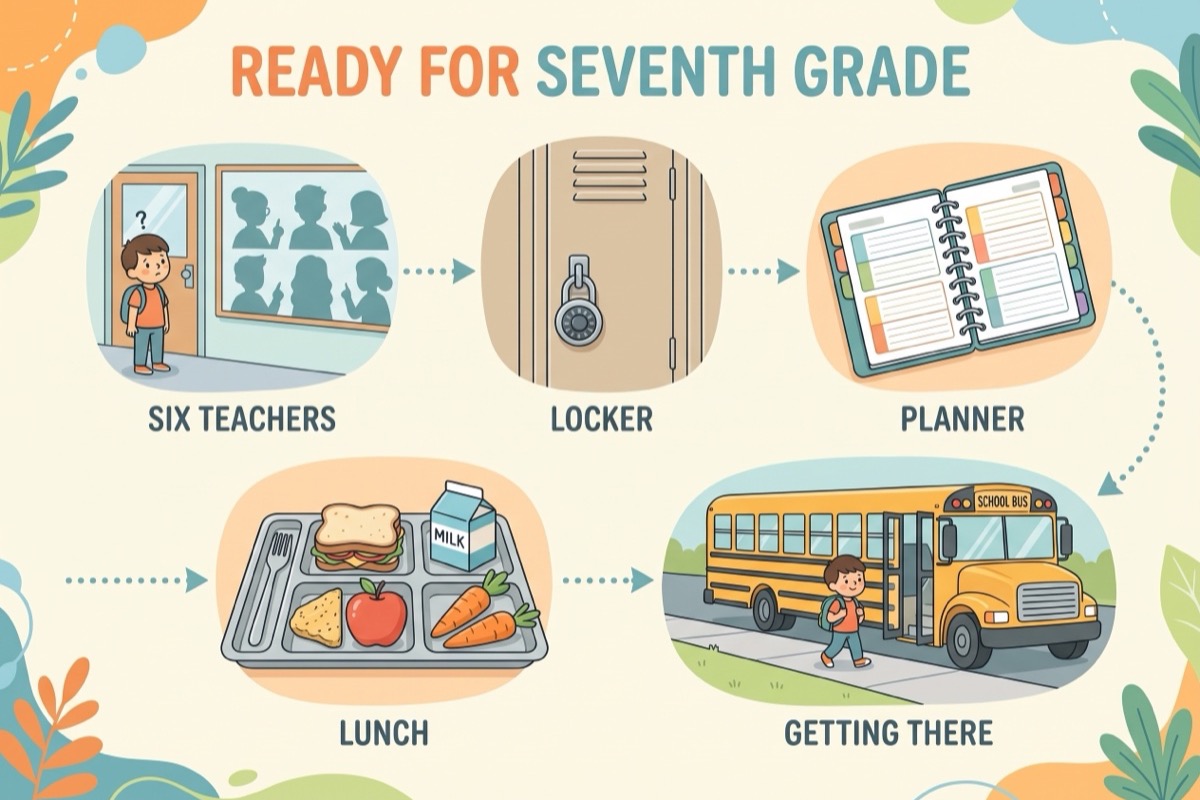
Twelve is the year the door starts closing. Not slamming, usually. Just a few inches at a time: shorter answers at dinner, a group chat you are not in, a body changing faster than the wardrobe can keep up. Meanwhile school hands them six or seven teachers, a locker, and the assumption that they are tracking it themselves.
Life skills for 12-year-olds aren't a longer version of the age-10 list; they're a step up in kind. At 10 the goal was one load of laundry, done solo, after weeks of coaching. At 12 it's the whole weekly cycle, on their own day, with no one tracking whether they remembered. Our life skills checklist by age (5, 8, 10, 12) maps the arc alongside the 10-year-old and 8-year-old guides.
What Changes Between 10 and 12
The CDC's parenting guidance for young teens (12–14) and the American Academy of Pediatrics' account of early adolescence describe the same child from two angles. Four things have moved since age 10.
First, puberty is no longer theoretical. The AAP puts typical first-period age at around 12 to 13, with boys starting puberty about a year later than girls, and the physical changes run over several years, so body care has to be routine now. Second, thinking goes abstract: they argue about fairness in general, not just their own bedtime, which is why a written agreement beats a rule.
Third, peers move to the center. The CDC's advice is blunt: know your child's friends and their parents. Fourth, sleep gets harder at the worst moment, because puberty pushes the body clock later even as school still starts early. A 12-year-old awake at 11 p.m. is not lazy; see the AAP's sleep recommendations below. They are fighting biology, a phone and a 7 a.m. bus at once.
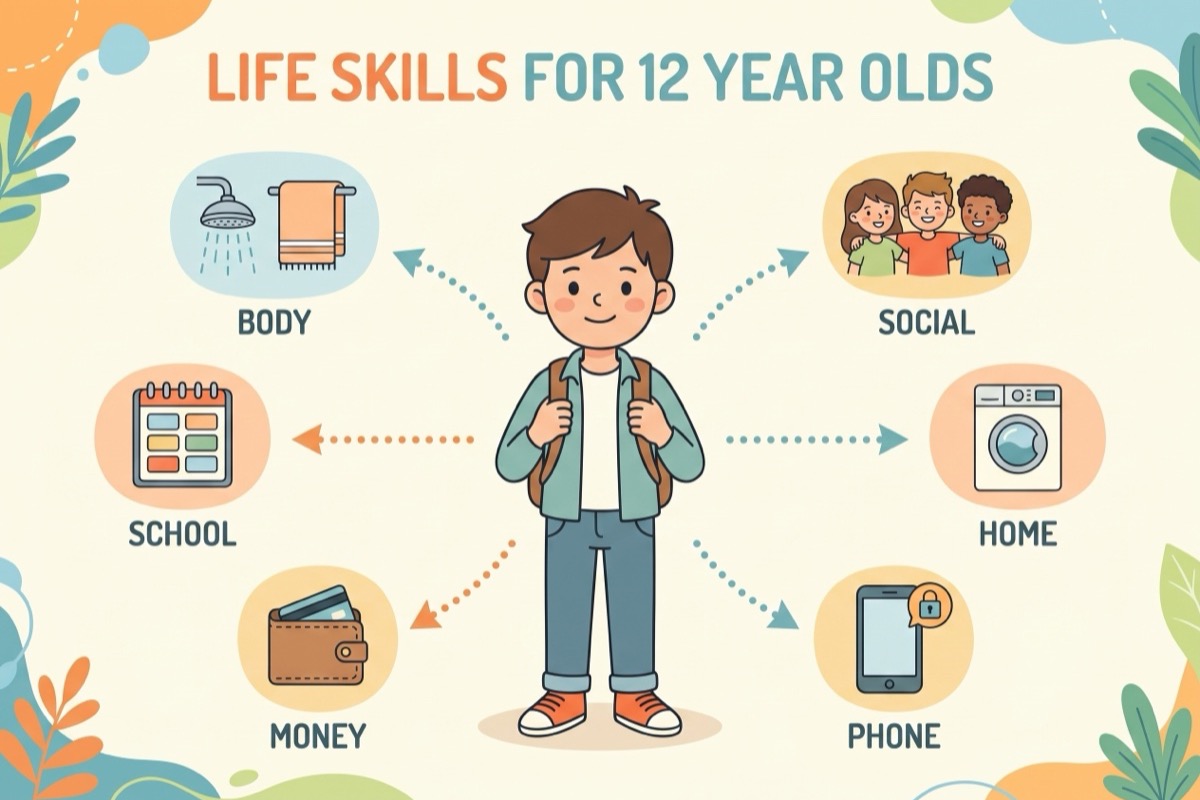
The 6 Life Skills for 12-Year-Olds, by Domain
Same six domains as age 10, every item different. Nothing repeats unless the standard has genuinely moved. The rule of thumb: at 12, "with supervision" becomes "on their own," and "helps" becomes "owns."
- Self-Care Through Puberty. Body care as an automatic routine, plus their own sleep.
- Social-Emotional & Saying No. Peer pressure, exit lines, repair, reporting what happens online.
- Cognitive & Organization. Six or seven classes, a planner that survives, emailing a teacher.
- Household Contribution. Laundry solo, one full meal cooked start to finish.
- Money & First Paid Jobs. Earning outside the family, a longer savings horizon.
- Safety & Independence Outside the Home. Home alone properly, getting around, and the phone.
Treat each list as the target for the year between the twelfth and thirteenth birthday. As a rough rule of thumb, most 12-year-olds are strong in two domains and behind in at least one. Finding that one is the exercise.
Domain 1: Self-Care Through Puberty
At 10 you started the deodorant conversation. At 12 it is over and the routine is the point. Parents skip this domain because it feels awkward, and then a classmate gives the feedback instead.
What most 12-year-olds can do
- Showers daily unprompted and washes hair on a schedule they know. Oil glands wake up in puberty. Daily for some kids, every other day for others.
- Uses deodorant every morning and keeps a spare in the backpack. Automatic, like shoes.
- Understands period care, whatever their own gender. Girls carry a small kit and can change a pad at school; boys should know what a period is and that it's not a joke.
Ask a pediatrician if there's no breast development by 13 for girls, or no testicular enlargement by 14 for boys, or if changes started unusually early, per the AAP.
- Washes their face twice a day and leaves spots alone. A two-product routine they chose gets used. A lecture does not.
- Defends their own bedtime against the phone. Nine to twelve hours is the target; the skill at 12 is ending the chat and starting the wind-down unprompted, even when friends are still online.
- Deals with sweaty sports gear the same evening. Into the wash, not fossilizing in a bag until Thursday.
- Leaves the house on their own timing. If mornings still run on your voice, rebuild the sequence once with our morning routine for kids, then step back out.
Domain 2: Social-Emotional & Saying No
At 10 the skill was surviving a fight with a friend; at 12 it's staying yourself inside a group. A child who hasn't said the words out loud won't invent them under pressure — rehearsal is the intervention.
To sort the normal from the worrying, our guide to what is normal at ages 6–14 puts both columns side by side.
Domain 3: Cognitive & Organization Across Six Classes
Middle school gets harder in logistics before content: six or seven teachers, a rotating schedule, a locker, a portal, and nobody whose job it is to notice your kid has not opened the science tab since Monday. Most academic problems at 12 are organizational problems in a costume.
What most 12-year-olds can do
- Keeps one planner for all six or seven classes. Written the moment work is assigned. Two systems equals no system.
- Checks the grade portal themselves once a week. A missing assignment they find is a lesson. One you find is an argument.
- Emails a teacher directly for help. Give them the template once, then never send one for them again.
- Asks for an extension before the deadline, not after. Self-advocacy at its most useful, and it works more often than they expect.
- Studies across several days and self-quizzes. Rereading notes feels productive and mostly is not. Cover the page and say it out loud.
- Starts homework at a set time without a reminder. The block matters more than willpower; our after-school routine guide has a sequence that survives a bad day.
- Knows where the AI line sits in their school. Explaining a concept, yes; writing the paragraph, no. Our AI homework rules for kids has a signable agreement.
Domain 4: Household Contribution — Laundry Solo, One Full Meal
A 2019 study in the Journal of Developmental & Behavioral Pediatrics (White, DeBoer and Scharf) tracked 9,971 US kindergartners in the ECLS-K:2011 cohort: chore frequency at five predicted higher self-rated academic and social competence in third grade — an association, not proof, and the effect is modest. Chores research in general gets cited with more confidence than the data earns; our piece on the Harvard chores study covers the older, shakier claim. At 12 the standard moves from "does chores" to "carries a share": 45 to 60 minutes a day, including one job the family would miss.
Age-12 jobs the family relies on
- Runs their own laundry end to end on their day. Sorting, settings, dryer, folding, drawers, with no reminders from you. The first week of wrinkled shirts teaches the rest.
- Cooks one full meal for the family. A protein, a side, something green, landing together. Planned, shopped for, cooked with an adult in the house but not over the pan.
- Owns a bathroom, not just the cleaning of it. Weekly to the agreed standard, and they restock soap or toilet paper before it runs out, not after someone complains.
- Owns the trash and recycling cycle. Which night, which bin, to the curb without a countdown.
- Handles small maintenance. Changes a bulb, resets the router, clears the drain trap, uses a screwdriver.
- Watches a younger sibling for an hour while you are out. Only after the ladder below, and only if the sibling relationship is calm on a normal day.
Keep it visible: at 12 the fight is about whether the load is fair, not the chore. Our free Chore Chart Maker builds a weekly chart in 90 seconds; whether it comes with money is argued both ways in should you pay kids for chores.
Domain 5: Money & First Paid Jobs
Twelve is the first age a child can plausibly earn money from someone outside the family, which changes the subject. The CFPB's Money as You Grow milestones put the preteen years in the window for longer savings goals and comparison shopping, and the American Red Cross opens its babysitting and child care training to students from age 11 — the most concrete first step available.
What most 12-year-olds can do
- Earns from one job outside the family. Babysitting after a course, pet sitting, dog walking, yard work. Small, local, arranged by them.
- Quotes a price and follows up on getting paid. Awkward, useful, and far easier at 12 than at 22.
- Saves toward a goal three months out. A written date and amount, no rescue halfway.
- Splits income on a fixed rule. Say 50% save, 40% spend, 10% give. Automatic matters more than the exact percentages.
- Converts a purchase into hours worked. "That skin costs two hours of babysitting" is the best money sentence at this age.
- Knows a subscription renews, and how to cancel one. Free trials are aimed at 12-year-olds with a parent's card on file.
Domain 6: Safety & Independence Outside the Home
At 10 this domain unlocked; at 12 it widens: further from home, longer alone, sometimes responsible for someone smaller. AACAP is clear there is no magic age for staying home alone — it rests on maturity, past responsibility, and rehearsing the emergency plan first, starting under an hour.
Before you widen the boundary
Out in the world
- Gets somewhere unfamiliar and back. A bus route with one change, or a 20-minute walk across an unfamiliar area, with a check-in at each end.
- Has a plan for a dead phone. Two numbers memorized, cash in the bag, a meeting point. A plan that depends on the phone is not a plan.
- Asks the right stranger for help. A parent with children, a shop employee, a transit worker.
- Says no to a ride, a vape or a drink, and leaves. The CDC puts talking about alcohol, tobacco and drugs in the 12-to-14 window. Have it early and twice.
Home alone and first aid
- Locks the door, ignores the doorbell, never says they are alone. Not to a caller, a driver or a group chat.
- Cooks safely alone on the stove, or knows the rule is no stove. Either is fine. Vague is not.
- Runs the fire plan from memory. Out first, call second, from outside, at the meeting point.
- Handles real first aid. Pressure on a cut, cool water on a burn, what an allergic reaction looks like, when to call 911.
- Calls the backup adult on their own when something is actually wrong. A locked door, a missed bus, a changed plan: the standard is starting that call unprompted, not just answering one.
If solo trips feel like a jump, the Japanese solo errand method starts children far younger with one short, rehearsed, unaccompanied task.
Digital Life & Phone Readiness: The Family Agreement Approach
This barely existed on the age-10 list and now dominates the questions parents of 12-year-olds ask. Common Sense Media's guide to first phones puts the average first phone around age 11, though many experts suggest waiting until 13. The useful question isn't the age; it's whether this child can hold the rules.
One fact worth having before the argument starts: most social platforms set 13 as their minimum under US children's privacy law, per the FTC's guidance. A 12-year-old with a standard TikTok, Snapchat or Instagram account entered a false birth date to get one; a few platforms' COPPA-compliant under-13 modes are the narrow exception.
Readiness is behavior, not a birthday. Do they follow rules without reminders, handle frustration, keep track of their belongings, and tell you when something goes wrong even when it makes them look bad? Four yeses beat any birthday.
What to write down together before the phone is handed over
- Where the phone sleeps. Outside the bedroom, charging in the kitchen, every night. The single highest-value line in the agreement.
- Which hours it is off. Homework block, dinner, after a set time. Yours are off too, which is what makes it work.
- New apps need a yes. You install it together and check the settings once.
- Passcodes are shared and checks are announced. Random searches read as surveillance and end the flow of information.
- Telling you never costs them the phone. If reporting a problem triggers confiscation, they will handle the next one alone.
- Any request for a photo of their body comes straight to you. No trouble, no blame, whatever they already sent. This line matters more than every filter you install.
- What happens when a rule breaks. Agreed in advance, proportionate, time-limited. A repair, not a cliff.
For the numbers behind the limits, our breakdown of how much screen time is OK by age and the AAP 5 Cs framework give the evidence base. Write it on paper, sign both names, revisit in three months.
Independence Skills for 12-Year-Olds: Home Alone, Getting Around, Babysitting
Independence is not one decision. It is a ladder, climbed a rung at a time with a rehearsal before each.
| Rung | First trial | Ready for the next rung when |
|---|---|---|
| Home alone, short | 45 minutes while you run an errand, after a run-through | They stayed calm and can say what they would do if the doorbell rang |
| Home alone after school | Ninety minutes, check-in text on arrival, a neighbor as backup | Homework started, snack made safely, no unplanned visitors |
| Out alone locally | A known 20-minute walk or ride with a check-in at both ends | They arrive when they said and message without being chased |
| Watching a sibling | One hour with you out of the house but nearby | Both children safe and the younger one was not miserable |
| Babysitting for others | A paid daytime hour for a neighbor with a parent at home | Course done, first aid solid, and they know when to call an adult |
Watching a sibling is a higher bar than being alone, since they are now responsible for someone else's judgment too — and an anxious 12-year-old should not be pushed up the ladder faster than they want to go.
The 7th-Grade Readiness Check
Sixth grade is the shock. Seventh is where the workload compounds and teachers stop chasing. What to check now, and what to practice if the answer is no.
| Seventh-grade demand | Ready looks like | If not yet, practice this term |
|---|---|---|
| Six or seven teachers, one schedule | Knows which day is which, packs the night before | A copy in the locker and on the fridge, updated by them |
| Work assigned in class and online | One planner, everything written down the same day | A two-minute planner check nightly for three weeks, then weekly |
| Longer projects, distant deadlines | Works backwards from the due date on a calendar | Plan one project together, hand over the next |
| Asking adults for help | Emails or approaches a teacher without you | Draft one email together, then step back completely |
| Unsupervised social time | Leaves a situation that feels wrong and tells you | Rehearse three scenarios out loud, code word agreed |
When to Worry — Red Flags at 12
Twelve is genuinely moody, and most of it passes by Thursday. Most of the signals below come from NIMH's guidance on whether it's just a stage, plus one we'd add. One is a conversation; two or more, lasting over two weeks, is a call to the pediatrician.
- Pulling away from friends and family, much more time alone. Withdrawal differs from wanting privacy: it shows up everywhere at once.
- Losing interest in things they liked, low energy most days. Sport dropped, hobby abandoned, weekends flat.
- Eating changes. Dieting, skipped meals, excessive exercise, fear of gaining weight.
- Marks on arms or legs, long sleeves in warm weather, talk of self-harm. AACAP's facts on self-injury in adolescents is worth reading before you need it.
- Any talk of not wanting to be here. Take it seriously the first time. The 988 Suicide & Crisis Lifeline takes calls from parents too.
- Grades falling across every subject, or refusing school. One bad subject is a subject problem. All of them is not.
- A mood that crashes after being online, plus secrecy about the phone. That points at bullying, a group chat, or someone who should not be in contact.
None of these is a diagnosis, and 12-year-olds are allowed bad weeks. What changed since 10 is that your window for noticing is narrower, because they tell you less. Our calm guide to normal teen behavior sorts ordinary from concerning for the next stage.
The 30-Day 12-Year-Old Independence Plan
Do not open all six domains at once, and do not announce a new regime at dinner. One domain a week, two or three targets, agreed with them.
| Week | Focus | Two-to-three targets |
|---|---|---|
| Week 1 | Organization & sleep | One planner for every class, a Friday portal check they run, phone charging outside the bedroom. |
| Week 2 | Household | Their laundry start to finish with no reminders, one full meal cooked and served, the trash cycle handed over. |
| Week 3 | Independence & safety | One 45-minute home-alone trial after a run-through, one unfamiliar route, fire plan and first aid rehearsed. |
| Week 4 | Money, phone & social | Phone agreement written and signed, one paid job arranged, three refusal scripts and a code word practiced. |
At the end of the month your 12-year-old has evidence, which is what they will argue with next year. That is the trade: more rope in exchange for proof.
Key Takeaways
- At 12, "with supervision" becomes "on their own." Same six domains, higher standard in each.
- Body care is a routine now, not a conversation. Shower, deodorant, a period kit, and 9–12 hours of sleep with the phone out of the room.
- Logistics beat content in middle school. One planner, a weekly portal check, and emailing a teacher themselves.
- Laundry solo and one full cooked meal are the household milestones. Forty-five to sixty minutes a day.
- Phone readiness is behavior, not a birthday. Write the agreement together and make telling you cost-free.
- Independence is a ladder. Under an hour alone first, plan rehearsed, then further.
Frequently Asked Questions
What should a 12-year-old be able to do independently?
Most 12-year-olds can run their own morning and hygiene, keep a planner across six or seven classes, email a teacher, do a load of laundry alone, cook a simple meal, stay home alone briefly, get around a known route and manage money they earned. Those are the core life skills for 12-year-olds, in the six domains above. As a rough rule of thumb, most kids are strong in two, fine in three and behind in at least one.
What chores should a 12-year-old do, and how many is reasonable?
Aim for 45 to 60 minutes a day, including one job the family would notice if it stopped: their own laundry end to end, one full cooked meal, a bathroom cleaned weekly, the trash cycle, and small maintenance. A 2019 study of nearly 10,000 US kindergartners linked chore frequency with higher self-rated competence three years later, though the effect is modest.
Can a 12-year-old stay home alone or babysit a younger sibling?
Usually yes for short periods; babysitting is a separate, higher bar. AACAP says there is no universal age — it rests on maturity, past responsibility, and whether the emergency plan has been rehearsed. Start under an hour, door and fire rules run through first, with a backup adult nearby. Watching a sibling adds managing someone else's behavior, so add a babysitting course and start with one supervised hour.
Should a 12-year-old have a phone, TikTok or Snapchat?
The average first phone in the US arrives around age 11, while many experts suggest 13 or later, so age alone settles nothing. Judge readiness by behavior: do they follow rules, handle frustration, track their things and tell you when something goes wrong? Most platforms set 13 as the minimum for a standard account under US privacy law, so a 12-year-old with one has lied about their age. Say yes, and write the agreement first.
How much sleep does a 12-year-old need?
Nine to twelve hours a night through age 12, dropping to eight to ten from 13, per the American Academy of Pediatrics. The complication: puberty shifts the body clock later, so a 12-year-old genuinely cannot fall asleep at the time that worked at nine, while school still starts early. Two changes help most: the phone charges outside the bedroom, and the wind-down starts 30 minutes early.
How do I teach my 12-year-old responsibility without nagging?
Hand over whole jobs, not tasks, then let the consequence teach. "Your laundry, your day" works; "put your clothes in the machine" is still your job with an extra step. Agree the standard once in writing so "done" is not a nightly negotiation, and resist rescuing them from the forgotten swimsuit. Twelve-year-olds respond to being trusted with something real, not to reminders, which they now hear as noise.
Related Reading
- Life Skills Checklist for Kids by Age 5, 8, 10, 12 (the parent pillar)
- Life Skills for 10-Year-Olds: The Checklist Before Middle School (2026)
- Normal Teen Behavior or Warning Sign? A Parent's Checklist
- The After-School Routine That Survives a Bad Day
- AI Homework Rules for Kids: When To Say Yes, When To Say No
- AAP Screen Time Guidelines 2026: The 5 Cs, Age by Age
Build your 12-year-old's weekly chart in 90 seconds
Our free Chore Chart Maker sets up an age-12 week: laundry day, their cooking night, the homework block and the trash cycle. Printable, no signup required.
Try the Chore Chart Maker
