Life Skills Checklist for Kids: What They Should Know by Age 5, 8, 10, and 12
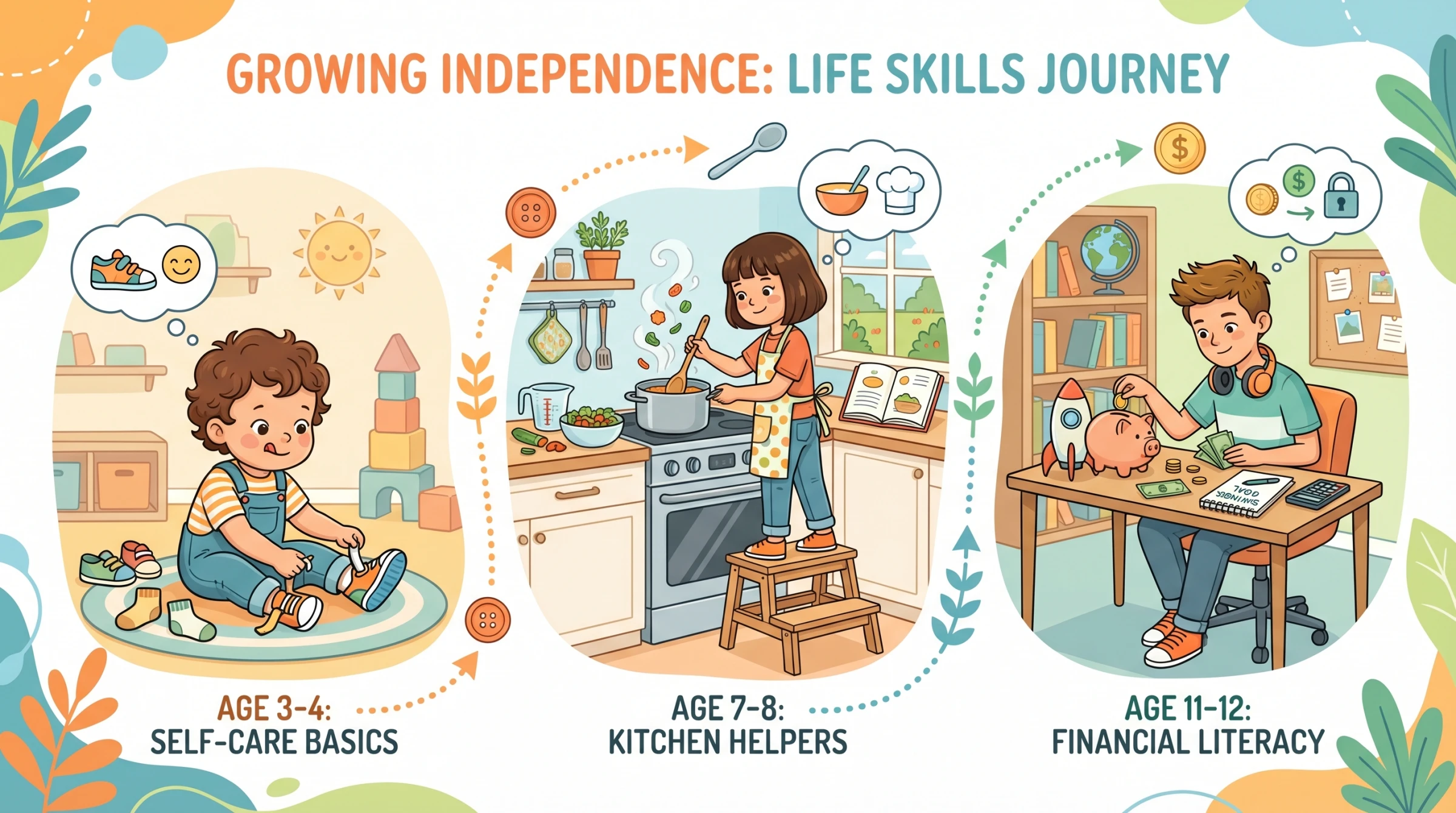
The short answer: by 5, most kids can dress themselves, wash their hands and put toys away; by 8, make a simple breakfast and pack their own school bag; by 10, run a load of laundry and cook a simple meal with you nearby; by 12, cook a full meal, manage their own schedule and stay home alone for an hour or two. The chart below shows all 46 skills at a glance, and each age section explains how to teach them.
Your child can recite the planets in order and solve two-digit addition. But can they make a sandwich? Do their own laundry? Call a relative on the phone without prompting? Life skills are the things school does not test—and they matter more than most things school does test.
In the Harvard Study of Adult Development, George and Caroline Vaillant followed 456 inner-city Boston boys from age 14 to 47. How well the boys handled work in childhood—school, chores and jobs—predicted their adult mental health and relationships better than social class, IQ or any other childhood factor measured (American Journal of Psychiatry, 1981). We wrote about this finding in detail in our deep dive on the Harvard chores study.
According to the American Psychological Association, self-sufficiency is one of the key building blocks of resilience in children. Not self-sufficiency in the "figure it out alone" sense—but in the "I know I can handle this" sense. Every life skill a child masters is a small proof to themselves that they are capable.
The problem is not that parents disagree with this. The problem is knowing what skills to teach, and when. A 5-year-old can learn to set the table but should not be operating a stove. A 12-year-old can cook a full meal but probably is not ready to manage a bank account alone.
This guide breaks it down by age. Forty-six skills across four age groups. Print it, stick it on the fridge, and pick two or three to work on this month. Not all forty-six at once. That would be a recipe for a meltdown—yours, not theirs.
Life Skills by Age Chart
One row per age group, one column per kind of skill. Each skill is explained in its age section below, and safety skills have their own section.
| Age | Self-care | Home | Social | Money & digital |
|---|---|---|---|---|
| 3–5 | Brush teeth (you check), wash hands for 20 seconds, get dressed, put on velcro or slip-on shoes | Put toys away, help set the table, help feed a pet | Say please and thank you, share, take turns | Not yet |
| 6–8 | Make a simple breakfast, pack the school bag, follow a hygiene routine | Make the bed, sort laundry, water plants, wipe the table | Introduce themselves, answer the phone, settle small conflicts with words | Know coins, save toward a goal |
| 9–10 | Wake up with an alarm, plan outfits for the week, manage homework time | Run a load of laundry, vacuum a room, cook a simple meal (first with you, then alone), take out trash and recycling | Write a thank-you note, order at a restaurant | Budget a small allowance, compare prices |
| 11–12 | Manage their own schedule, plan weekly meals with you, handle hygiene without reminders, stay home alone for 1–2 hours | Cook a full meal, deep-clean a bathroom, shop from a list | Disagree respectfully, text and email well | Understand a savings account and that work pays money, spot online scams |
Ages 3–5: Foundation Skills
At this age, children are in what the CDC's developmental milestones framework describes as a period of rapid growth in motor skills, language, and social-emotional development. They can follow two-step instructions, they want to do things "by myself," and they learn primarily through imitation and repetition.
According to Zero to Three, children between 3 and 5 are developing the self-regulation skills that make independent action possible. The tasks below work with that development rather than against it.
Self-Care
- Brush teeth with supervision. A 2-minute timer makes this measurable. They do the brushing; you do a quick follow-up check.
Builds routine and hygiene awareness.
- Wash hands with soap for 20 seconds. Sing a short song to mark the time. This one has obvious health benefits and gives them ownership of their own body care.
The CDC recommends scrubbing for at least 20 seconds—about two rounds of "Happy Birthday."
- Get dressed independently. Lay out two choices the night before. Avoid buttons and complicated zippers—elastic waistbands are your ally.
Dressing independently is a fine motor milestone that supports confidence and body awareness.
- Put on shoes (velcro or slip-on). Place a sticker inside each shoe's heel so they can tell left from right. Independence in getting ready to leave the house starts here.
Social
- Say please and thank you without prompting. Model it relentlessly. They will copy what you do far more than what you tell them to do.
NAEYC research shows that social courtesies develop through consistent modeling, not correction.
- Share toys with siblings or friends. True sharing (not forced sharing) emerges around age 4. Let them practice with low-stakes items first.
- Take turns in games and conversation. Board games, card games, and even mealtime conversation are turn-taking training grounds.
Turn-taking is an early executive function skill linked to later academic success, per CASEL's SEL framework.
Home
- Put toys away after playing. The key is having labeled bins with pictures (not just words). "Cars in the red bin, blocks in the blue bin." Visual systems make this doable without your help.
- Help set the table. Start with napkins and spoons—nothing breakable. Count family members together: "We need four napkins. Can you count them?"
Practical life skills are central to Montessori education, which emphasizes purposeful work from age 2.5.
- Help feed a pet. Scoop the food, pour the water. Another living creature depends on them—that is a powerful motivator at any age, but especially at this one.
Ages 6–8: Growing Independence
Children in this range are in what psychologist Erik Erikson called the "industry vs. inferiority" stage. They are building their self-concept around what they can do. Six-to-eight-year-olds can handle multi-step tasks, are starting to understand time, and are getting better at managing frustration.
This is the age where competence feels like a superpower to them. Every new skill mastered is fuel for their growing sense of "I can handle things."
Self-Care
- Make a simple breakfast. Cereal and milk, toast with butter, fruit with yogurt. No stove required. Teach them to clean up after themselves too—making breakfast is only half the skill.
How to teach it: Do it together three times, then supervise twice, then let them fly solo.
- Pack their own school bag. Use a printed checklist taped inside the bag. Lunch, water bottle, homework folder, jacket. They check, you verify (at first).
How to teach it: Start by packing it together each evening. Move to them packing while you watch.
- Follow a basic hygiene routine. Shower, brush teeth, comb hair, deodorant (if needed)—in order, without being told each step. A laminated routine card in the bathroom helps.
Social
- Introduce themselves to adults. "Hi, I'm [name]. Nice to meet you." Eye contact, handshake if offered. Practice at home before expecting it in public.
How to teach it: Role-play at home. Make it a game—pretend to be the new neighbor, the teacher, the coach.
- Answer the phone politely. "Hello, this is [name]. May I ask who's calling?" Simple, clear, and it makes them feel like a real participant in family life.
How to teach it: Practice with a toy phone or by calling from another room.
- Resolve small conflicts with words. "I don't like it when you take my turn. Can we figure this out?" Not perfectly—but the attempt matters.
CASEL identifies conflict resolution as a core social-emotional competency for this age group.
Home
- Make their own bed. By 6 or 7, they can do this without the result looking like a geology experiment. Pull up the comforter, straighten the pillow. Done.
- Sort laundry into lights and darks. A sorting game they already know from preschool, just applied to a bigger pile.
How to teach it: Start by sorting together. Label two hampers with color dots.
- Water plants on a schedule. Assign them specific plants and a watering day. They learn routine, responsibility, and the consequence of forgetting (wilted leaves are a powerful teacher).
- Wipe down surfaces after meals. Hand them a damp cloth and point at the table. Low stakes, visible result, immediate satisfaction.
Money
- Identify coins and their values. Quarters, dimes, nickels, pennies. Count out exact change for small purchases. This is math in the real world.
How to teach it: Play "store" at home. Price items at 25 cents, 50 cents, a dollar. Let them pay.
- Save money in a jar toward a goal. A clear jar works better than a piggy bank—they can see the progress. Choose a small, reachable goal (a book, a toy under $10).
Visible saving teaches delayed gratification, which APA research links to better outcomes in adolescence and adulthood.
Ages 9–10: Real Responsibility
Nine and ten are pivot years. Kids can now own tasks the family actually relies on—not busy work, but jobs that matter if they are skipped.
Their brains are now capable of planning, sequencing, and thinking ahead. They can handle real tasks with real consequences. If something does not get done, they experience the result—and that experience is the best teacher you have.
For a detailed guide on chores for this age range, see our age-appropriate chores guide from 6 to 14. For the full age-10 deep dive, including home-alone readiness and the middle-school checklist, see life skills for 10-year-olds.
Self-Care
- Wake up with an alarm clock. Set it themselves, get up themselves. You are not their alarm. This one skill changes the entire morning dynamic.
Start on weekends when there is no school-morning pressure. Let them experience oversleeping once.
- Plan outfits for the week. Sunday evening, lay out five outfits. It eliminates daily decision fatigue and teaches planning ahead.
Planning ahead is a skill that grows a lot at this age, and a weekly outfit plan is an easy way to practice it.
- Cook a simple meal with supervision. Scrambled eggs, pasta with sauce, a sandwich with multiple ingredients. They follow a recipe. You supervise the stove.
Cooking combines reading, math, sequencing, and motor skills—it is the ultimate multi-skill activity.
Social
- Write a thank-you note. After birthdays, holidays, or receiving a gift. Handwritten, with specific mention of what they are thankful for. Three sentences is enough.
Harvard's Making Caring Common project emphasizes gratitude practices as central to raising ethical, caring children.
- Order their own food at a restaurant. Look the server in the eye, speak clearly, say please and thank you. It is a small social confidence exercise that pays dividends.
- Manage homework time independently. Set a start time, estimate how long each assignment will take, work through it without constant supervision. You are available for questions—not sitting next to them.
According to APA guidelines, parent involvement in homework should decrease as children enter upper elementary.
Home
- Do a load of laundry start to finish. Sort, load, set the machine, transfer to dryer, fold, put away. It takes three weeks of guided practice before they can do it alone.
- Vacuum a room properly. Edges, corners, under furniture. Show them the pattern once. Let them own a specific room.
- Cook a simple meal independently. Grilled cheese, quesadilla, rice and beans. They choose the recipe, gather ingredients, cook, and clean up.
Montessori practical life philosophy places food preparation among the most valuable independence-building activities.
- Take out the trash and recycling. Know the schedule, remember without being told, bring the bins back. A weekly responsibility they fully own.
Money
- Budget a small allowance. Divide into spend, save, and give. Even $5 a week teaches allocation.
- Compare prices at the store. "Which is a better deal: the 12-ounce box for $3 or the 20-ounce box for $4.50?" Real math, real context, real skill.
Ages 11–12: Pre-Teen Readiness
By 11 and 12, your child is on the doorstep of adolescence. Pre-teens are starting to reason about hypothetical situations, plan multi-step projects, and grasp abstract ideas like budgeting and online safety.
Kids who start middle school already able to cook, plan their week and settle a disagreement have fewer things to learn at the same time as everything else changes.
These are the years to hand over genuinely significant responsibilities. If they are heading to middle school and cannot cook a meal, manage their own schedule, or navigate a disagreement without you refereeing—now is the time.
Self-Care
- Manage their own homework and activity schedule. Use a planner (paper or digital). Know what is due when. Plan study time around sports, music, and free time. You check in weekly, not daily.
CASEL's self-management competency identifies time management as a critical skill for middle school readiness.
- Plan meals for the week (with guidance). Sit down together on Sunday and plan three to four dinners. They pick recipes, you check feasibility. This introduces project planning in a tangible way.
- Handle personal hygiene completely independently. Shower schedule, deodorant, clean clothes, dental care—all without reminders. If they are about to enter middle school, this is non-negotiable.
Social
- Navigate a disagreement respectfully. Listen to the other person's point, state their own without yelling, find a compromise or agree to disagree. This is hard for many adults—practicing it at 11 gives them a head start.
Harvard's Making Caring Common project identifies perspective-taking and respectful disagreement as skills that need explicit practice, not just passive absorption.
- Communicate responsibly via text and email. Appropriate tone, no all-caps, think before sending, understand that written words lack vocal nuance. Show them examples of how the same message can sound friendly or hostile depending on phrasing.
- Stay home alone safely for 1–2 hours. Know the emergency numbers, know the rules (no stove, no opening the door for strangers, check in by phone). Start with 30 minutes and build up.
The AAP's HealthyChildren.org says child experts typically agree that 11 or 12 is an appropriate age to stay home alone for a few hours.
Home
- Cook a full meal from scratch. Choose a recipe, make a shopping list, prepare the meal, serve it, clean up. This is a complete project management exercise disguised as dinner.
- Deep clean a bathroom. Toilet, sink, mirror, floor. It is not glamorous, but it is a life skill that every college-bound teenager will need and most do not have.
- Do grocery shopping with a list. Give them the list and a budget. Drop them at the store (or send them in while you wait). They find items, compare prices, stay within budget, and carry it all out.
This combines reading, math, decision-making, and social interaction—a real-world skill stack.
Money
- Understand the concept of a savings account. Open a youth savings account together (many banks offer them with a parent as co-owner). Show them interest accrual—even a few cents makes the concept real.
- Grasp the relationship between work and money. Not just "do chores, get paid," but understanding that adults trade time and skill for income, and that income has limits. This prevents the "just buy it" mentality.
Digital
- Recognize basic online scams and manipulation. "If something seems too good to be true, it probably is." Phishing emails, fake giveaways, strangers asking for personal info. Walk through real examples together.
Safety Skills by Age
Most age checklists list chores and skip safety. These are the skills to practice first, as games rather than tests. Treat the ages as a guide; where an expert body gives a specific age, we cite it.
Ages 3–5
- Say their full name and a parent's full name. Then start on your phone number and street address. KidsHealth (Nemours) advises that kids know your phone number and street address by heart, even though most 911 calls can now be traced.
- Know what 911 is for. Someone is hurt or in danger right now. Say it as "nine-one-one": KidsHealth notes that a child who thinks "nine-eleven" may hunt for an 11 key that does not exist.
- Start swim lessons when they are ready. The AAP recommends swim lessons for all children and says they can begin after the first birthday, depending on readiness. Lessons add a layer of protection; they do not replace an adult watching.
Ages 6–8
- Know the home fire escape plan. NFPA recommends two ways out of every room, an outside meeting place, and practicing the plan twice a year. Let your child pick the meeting spot and lead one of the drills.
- Get out first, then call. KidsHealth's rule for fires: leave the house before calling 911.
- Cross streets with an adult. Safe Kids Worldwide says children under 10 need to cross with an adult, because most cannot judge the speed and distance of oncoming cars until about 10. Use the walks to teach eye contact with drivers.
Ages 9–10
- Cross streets on their own, once you have watched them do it well. Around 10, practice the habits Safe Kids lists: look for cars that are turning or backing up, and never dart out between parked cars.
- Role-play a 911 call. The dispatcher will ask "Where are you?" and "Who needs help?" Practice answering in full: what happened, the address, who is hurt.
- Try short stretches alone. According to the AAP, most children are not mature enough to be alone on a regular basis until about 10 or 11. Some parents leave a more mature 8- or 9-year-old for half an hour once in a while.
Ages 11–12
- Stay home alone for a few hours. Agree on the rules first: who may come in, what to do if the smoke alarm goes off, when to call you. Some U.S. states set minimum ages for leaving a child home alone, from 8 to 14 per the AAP, so check your state's rules.
- Know who to call when you do not answer. A neighbor or relative they can reach, written down and saved in their phone.
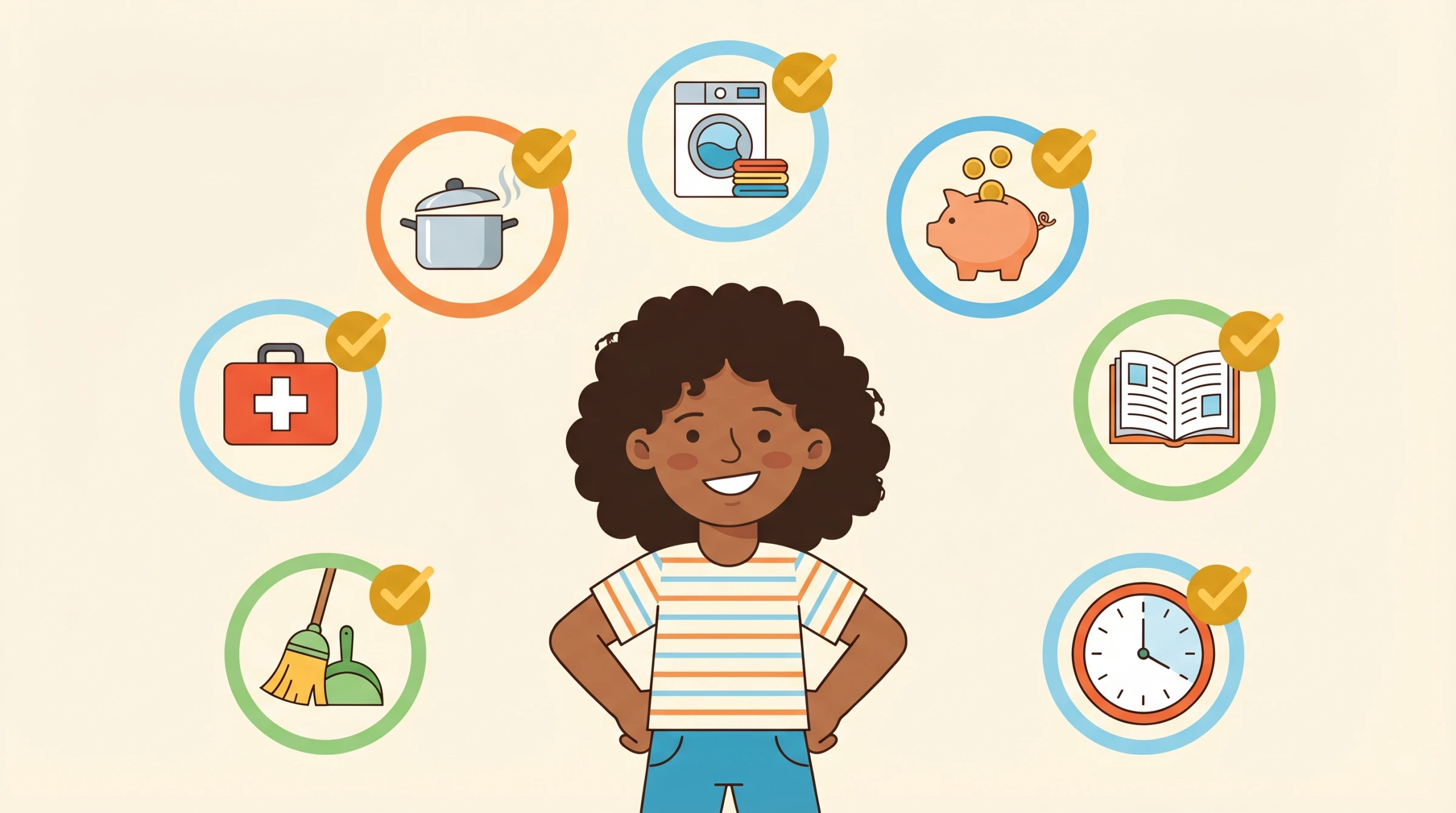
The "Not Ready" Myth
One of the most common things parents say when presented with a life skills list is: "My kid isn't ready for that yet." And sometimes that is true—development varies. But more often, it is not about readiness. It is about comfort. Ours, not theirs.
In Japan, children as young as six routinely run errands alone—taking the train, buying groceries, navigating city streets. The TV show Hajimete no Otsukai ("My First Errand") has documented this for decades. Japanese parents are not reckless; their culture simply has a different threshold for when children are "ready." We explored this fascinating tradition in our article on Japanese solo errands and childhood independence.
Montessori education has spent over a century demonstrating that children are capable of far more than most adults assume—if the environment is prepared and the tasks are appropriately scaffolded. Maria Montessori herself observed that children who were given real, purposeful work (not pretend tasks) developed concentration, self-discipline, and confidence at rates that surprised even experienced educators.
The question is rarely "Can my child do this?" It is almost always "Am I willing to let them try, fail, and try again?"
Often the biggest barrier to independence is not ability. It is well-meaning adults doing things for them. Overhelp.
Your child will spill the milk. They will burn the toast. They will pair a striped shirt with plaid shorts. These are not failures. They are practice.
How to Use This Checklist
Please do not treat this as a test your child needs to pass. It is a menu, not a mandate. Here is how to make it actually work.
Pick two or three skills per month
Look at your child's age group. Choose one skill they are almost ready for and one that will stretch them. Work on those for two to four weeks before adding more. Mastery takes repetition—and real habit formation takes longer than most people think. We debunked the popular "21 days" myth in our article on the science of habit formation.
Use a visual checklist
Print the relevant age section. Stick it on the fridge or in their room. Let them check off skills as they master them. The act of physically marking progress creates a sense of ownership that verbal praise alone cannot match. For younger children, use pictures alongside the words. Prefer a phone? Here is how the main chore apps compare.
Celebrate progress, not perfection
"You did your own laundry this week without being asked" matters more than "You folded everything perfectly." The independence is the achievement. The technique will come with time.
Adjust for your child
Some 8-year-olds are ready for skills in the 9–10 bracket. Some 10-year-olds are still working on the 6–8 list. Development is not a race. What matters is forward motion, not hitting every milestone at the "right" age. If your child is far behind peers on basic self-care such as dressing, toileting or feeding themselves, mention it at the next checkup. For children up to 5, the CDC milestone checklists are a good starting point; for older kids, describe what you see to your pediatrician. When a skill turns into something your child wants to reach, breaking a big goal into steps is the next move.
Key Takeaways
- Childhood work matters. In a Harvard study that followed boys into middle age, being able to work as a child (school, chores, jobs) predicted adult mental health and relationships better than social class or IQ.
- Match skills to developmental readiness. Use the age groups as a guide, not a rigid schedule. Every child develops at their own pace.
- Start with two or three skills, not forty-six. Mastery matters more than coverage. Go deep before going wide.
- The biggest obstacle is overhelp, not under-readiness. Children can do more than we assume. Let them try, mess up, and try again.
- Visual checklists build ownership. Print it out, let them track their own progress. The physical act of checking off a skill matters.
- Celebrate independence, not perfection. A lumpy bed made by a 6-year-old is a victory. A perfectly cooked meal by a 12-year-old is a triumph. Both count equally.
Track your child's life skills progress with Family Checklist
Create visual checklists for each age group. Watch your kids check off skills and build real independence—one small win at a time.
Get Family Checklist Free
