Age Appropriate Chores by Age: What Kids 2–14 Can Do (2026)
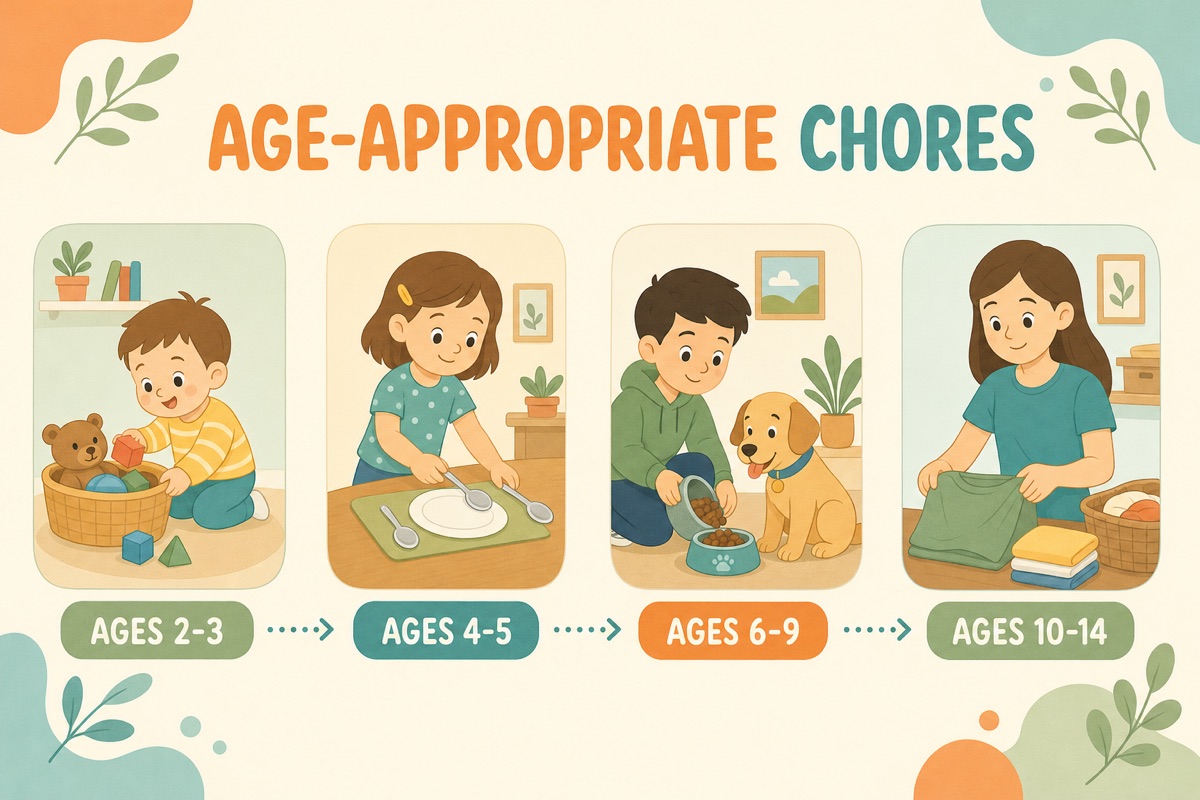
Kids can start chores earlier than most parents expect. Chores can begin at 2: a 2-year-old can put away toys and groceries that won't break. A 6-year-old can set the table and sweep. By 11 or 12, the AAP lists doing laundry and cooking a simple meal with supervision. The table below shows what kids 2 to 14 can usually do, and what you still do yourself.
Jump to your child's age: 2–3 · 4–5 · 6–7 · 8–9 · 10–12 · 13–14
The lists come from the American Academy of Pediatrics (AAP) and the American Academy of Child and Adolescent Psychiatry (AACAP), with CDC milestones for the skills underneath. Where we filled a gap ourselves, we say so. For self-care, money and safety, see our life skills checklist by age.
Age Appropriate Chores: The Quick Table
Find your child's age and pick three chores. The right column is what most lists leave out: the jobs that stay with you.
Swipe the table sideways to see all three columns.
| Age | Chores they can usually do | What you still do |
|---|---|---|
| 2–3 | Put toys away; put away groceries that can't break; get dressed with help; drop dirty clothes in the hamper; carry their plastic cup or plate to the counter; wipe up a spill | Do the real job alongside them. Expect "help" that slows you down. Keep anything breakable or hot out of reach. |
| 4–5 | Help feed the pet; make their bed (lumps allowed); help clear the table; match socks; pour their own water while you watch; put shoes away | Measure the pet food. Leave the lumpy bed alone. Keep each job to about 5–10 minutes. |
| 6–7 | Set and clear the table; wipe tables and counters; put clean laundry away; sweep floors; empty wastebaskets; water plants | Run the washer and dryer. Carry the bins outside. Check the work without redoing it. |
| 8–9 | Load and unload the dishwasher; vacuum; make their own snacks; pack their own lunch; put away groceries and their own laundry; walk the dog | Own the stove and sharp knives. Set the weekly plan. Spot-check. |
| 10–12 | Change their sheets; wash and fold laundry; clean the kitchen and bathroom, toilets included; cook a simple meal with supervision; yard work; walk-behind mower from 12 | Supervise cooking. Hand out the cleaning products. Be home when they watch a younger sibling. |
| 13–14 | Own laundry start to finish; wash the car; mow with a walk-behind mower; help with grocery shopping and errands; cook a family meal; help with younger siblings | Riding mower stays off-limits until 16. Back them up on money and scheduling. Let them choose their own method. |
Where each entry comes from: the plastic plate, the spill and the early hamper at 2–3, shoes at 4–5 and the family meal at 13–14 are our suggestions. Matching socks and pouring water are CDC milestones (age 4, age 5). The rest of the middle column is from the AAP and AACAP lists. The right-hand column is ours, except the mower ages and the rule about an adult at home, which are the AAP's.
What not to expect yet: a finished job at 2–3, jobs past about 10 minutes at 4–5, remembering without a cue at 6–7, the stove or sharp knives alone at 8–9, judgment about cleaning chemicals at 10–12, or your exact method at 13–14.
Picked your three? Here's how to put them on a list your child can see. See how
Where These Ages Come From
The AAP's chores-by-age list (updated February 2024) is the most detailed. It covers 5–7, 8–10 and 11–12, each band "all of the above, plus" harder jobs from 8 on, and stops at 12.
The AACAP's "Chores and Children" fact sheet (Facts for Families No. 125) starts at 2 and runs through the teens. Its age groups overlap (6–7 and 7–9).
The CDC has no chore list, but by 5 the CDC's age-5 milestones name chores directly: "Does simple chores at home, like matching socks or clearing the table after eating."
Two limits. This is expert guidance, not research: nobody ran a trial showing 6 is the right age for sweeping. And CDC milestones are what "most children (75% or more)" can do by a given age, so plenty of typical kids get there later. Treat every row as a range, a year either side.
Chores for Kids by Age, Band by Band
The tips are ours unless a source is named.
Chores for 2‑ and 3‑year‑olds
- Put toys away. One bin per kind of toy, with a picture on the front.
- Put away groceries that can't break. Cereal and potatoes for them, eggs for you.
- Get dressed with help. The CDC lists putting on "loose pants or a jacket" by 3. Lay out easy clothes.
- Drop dirty clothes in the hamper. The AAP lists this at 5–7. Starting earlier is our suggestion; use a low, open hamper.
- Carry their own plastic cup or plate to the counter. Our suggestion. Some of it lands on the floor.
- Wipe up a spill. Our suggestion. Give them their own small cloth.
Their help often makes the job slower. That's normal; see the research section below.
Chores for 6‑ and 7‑year‑olds
- Set and clear the table. AAP, 5–7. Tape a drawing of one place setting inside a cupboard.
- Wipe tables and counters. AACAP, 6–7. A spray bottle of water and a cloth.
- Put clean laundry away. AACAP, 6–7. You fold, they put away.
- Sweep floors. On both lists. A short broom helps.
- Empty wastebaskets. AAP, 5–7. Into the big bin; you take the bin outside.
- Water plants. AAP, 5–7. A small watering can and one plant that's "theirs."
The AAP's 5–7 list also includes dusting, sorting laundry, bringing in the mail and washing plastic dishes in the sink.
Chores for 8‑ and 9‑year‑olds
- Load and unload the dishwasher. AACAP, 7–9. Start with unloading; sharp knives stay with you.
- Vacuum. AAP, 8–10. One room, the same day each week.
- Make their own snacks. AAP, 8–10. Keep a snack shelf at their height.
- Pack their own lunch. On both lists. A formula helps: one main, one fruit, one drink.
- Put away groceries and their own laundry. AAP, 8–10.
- Walk the dog. AAP, 8–10. Start with a short loop you both know.
Our chores for 8-year-olds guide lists 20 jobs an 8-year-old can own.
Chores for 10‑ to 12‑year‑olds
- Change their sheets. AACAP at 10–11, AAP at 11–12. Do it together twice before they go solo.
- Wash and fold laundry. The AAP says "do and fold laundry" at 11–12.
- Clean the kitchen or bathroom. AACAP at 10–11; the AAP adds "scrub toilets" at 11–12. You choose the products.
- Cook a simple meal with supervision. AAP, 11–12. Eggs, pasta or quesadillas, with you in the room.
- Yard work. AACAP, 10–11. Start with raking and weeding.
- Watch a younger sibling for a short stretch. AAP, 11–12, but "with an adult present at home."
For the wider picture, see life skills for 10-year-olds and life skills for 12-year-olds.
Chores for 13‑ and 14‑year‑olds
- Own laundry, start to finish. Builds on the AAP's 11–12 list. They pick the day; you stop asking.
- Wash the car. AAP at 11–12, AACAP at 12 and up.
- Mow the lawn. Walk-behind only, from 12. The AAP says 16 for a ride-on or riding mower.
- Help with grocery shopping and errands. AACAP, teens. Hand them the list and a budget.
- Cook a family meal. Our suggestion; the AAP stops at "a simple meal with supervision." Pick one night a week and stay within earshot.
- Help with younger siblings. AACAP, 12 and up. Short stretches first.
The CDC notes that at 12 to 14 kids "will make more of their own choices." Hand over whole jobs, not steps.
How to Tell If Your Child Is Ready
Age gets you to the right row. These five signs tell you whether a specific chore will stick. They're our practical checks, anchored to CDC milestones where possible.
- They can follow the steps after one demo. At 5, most kids hold attention for 5 to 10 minutes (CDC). If the chore runs longer than their attention span, split it.
- They have the hand skills. By 2, most can hold a container in one hand and take the lid off with the other (CDC). By 4 they pour with supervision; by 5 they manage some buttons.
- They ask to help. The CDC lists "likes to be a 'helper'" at 4. When the interest shows up, use it.
- They can say what "done" looks like. "The table is empty and wiped" is a finish line. "I'll clean up" isn't.
- They respect safety warnings. By 3, the CDC says most kids avoid touching hot objects like a stove when warned.
Four or five signs: start. Three or fewer: pick an easier chore and try again in a few months.
Teach One Chore in 4 Steps
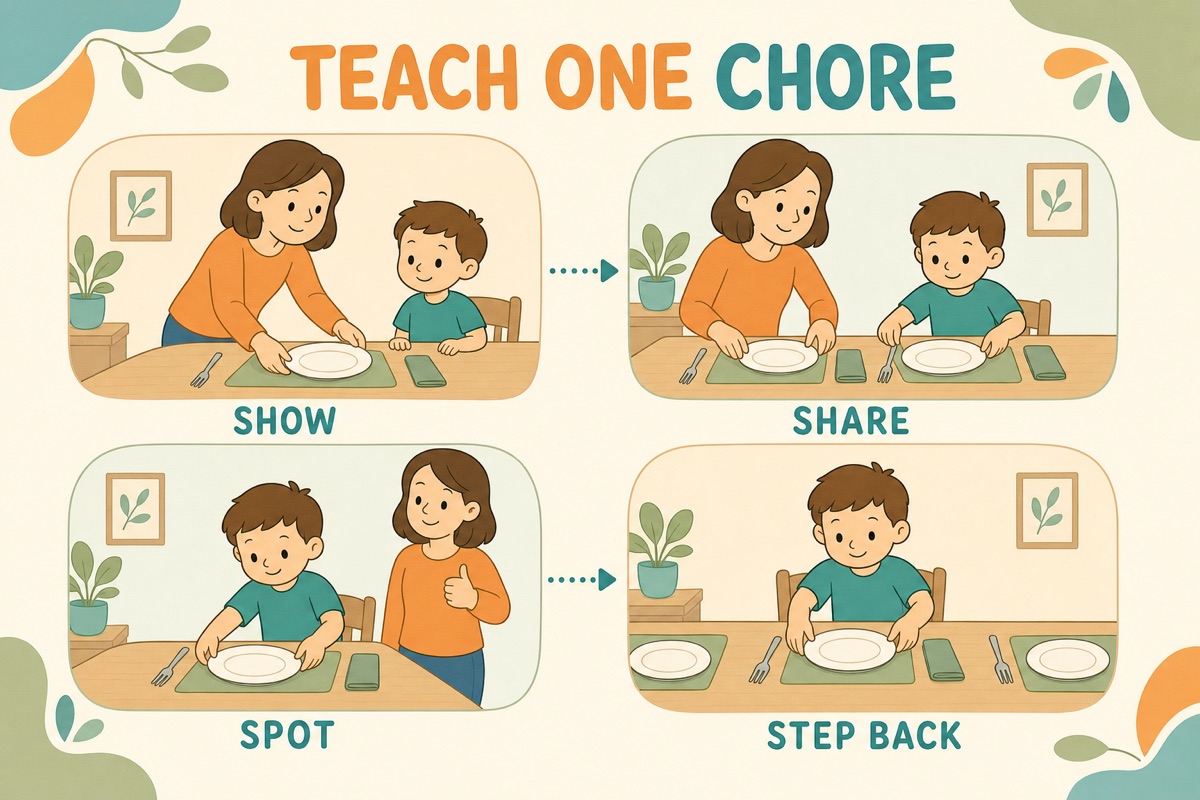
Handing a child a chore and walking away is how you end up redoing it. Teachers call this scaffolding: you hold the job up, then take the support away one piece at a time. The term is from Wood, Bruner and Ross (1976), not Vygotsky, as Simply Psychology notes.
The 4 steps, using "set the table" as the example
- Show. Do it once while you narrate. "Plate in the middle, fork on the left, napkin under the fork."
- Share. They do the easy half, you do the rest. They put out plates; you add the cutlery.
- Spot. They do it all while you stand nearby. Step in only when they're stuck, with a question, not your hands.
- Step back. They do it alone. You check later. Then put it on the checklist, so the reminder isn't you.
This fading pattern isn't our invention. In a 2025 study of 125 preschoolers, Xia and colleagues also filmed a smaller group of parents helping their child through a task. Parents gave more guidance at the start, then "gradually reduce interventions as the task progressed to allow the child to feel autonomy." Our addition is step 4's last half: move the reminding to a list the child can see.
The AAP's advice is short: "Praise your child's effort in each task, not the outcome." If the problem is motivation rather than skill, our guide on how to motivate kids to do chores covers what to try beyond money.
What the Research Says About Chores (and What It Doesn't)
You've probably heard that "a Harvard study proves chores make kids successful." The real picture is less tidy.
Toddlers want to help, and their help is often unhelpful
Warneken and Tomasello (2006) found that children "as young as 18 months" readily help others in lab tasks, such as picking up something dropped. Hammond and Brownell (2018) surveyed over 500 families of 1- to 4-year-olds. "The majority of parents reported their children engaged in unhelpful helping," and it "did not increase by age." One parent described the standard move: "I tell him what a good job he is doing, and when he's not looking, I redo it." The good news: "unhelpful toddlers become helpful, even caring, preschoolers." The limit: an online survey, mostly white US families.
The strongest US data: kindergarten chores and third grade
White, DeBoer and Scharf (2019) used data on 9,971 children from the Early Childhood Longitudinal Study (kindergarten class of 2011). Some kids did chores more often in kindergarten. In third grade, they rated themselves higher on social, academic and life-satisfaction competence. This held regardless of sex, family income and parent education. Any chores at all were linked to better third-grade math. The catch: it's observational. Parents reported the chores, and kids rated themselves. The effects are modest.
Chores and working memory
Tepper, Howell and Bennett (2022) surveyed 207 parents of children aged 5 to 13, mostly in Australia. Self-care chores (making yourself a meal) and family-care chores (making someone else a meal) predicted better working memory and inhibition, even after age and gender were taken into account. Pet-care chores showed no link. The effects were small: self-care chores explained an extra 4.8% of the variation in working memory. With a one-time survey, the authors note, "the directionality of the relationship cannot be determined."
The "Harvard study" claim
The popular version, from a 2015 TED talk, says professional success "comes from having done chores as a kid." The peer-reviewed source is Vaillant and Vaillant (1981). They followed 456 inner-city Boston men from 14 to 47. Childhood "industry" predicted adult work success, mental health and relationships. That meant a capacity to work in general, not a chore count. The men were all born around 1930. It's a real finding, but not "chores equal success."
The Rossmann study
A 2002 University of Minnesota feature covers Marty Rossmann's work. She looked at 84 young adults from one long-running San Francisco Bay Area study, run by psychologist Diana Baumrind. Chores at three or four were "the best predictor" of success in their mid-20s. Starting at 15 or 16 "backfired." We couldn't find it as a peer-reviewed paper. Rossmann herself wanted a larger, more diverse sample.
Bottom line: every study here shows an association, not cause and effect. Chore-doing families may differ in other ways. Still, the AAP's reasoning holds on its own: "Children need to have obligations and duties within the family, so they learn to accept responsibility." That's a good enough reason to start.
Common Mistakes (We've Made Most of Them)
- Redoing it in front of them. If you must fix the bed, do it later, out of sight.
- Scolding and badgering. The AAP: "Badgering or scolding a child is not an effective method to get them to accept more responsibility."
- Vague instructions. The AACAP: "Let your child know exactly what needs to be done." "Clean your room" is five jobs.
- Too many at once. Start with one to three. Add more when those run without reminders.
- Waiting until the teens. Rossmann's "backfired" finding is unreplicated, so take it as a caution, not a law.
- Pet care as the only chore. In Tepper's study only self-care and family-care chores were linked to executive function. Mix in one job done for the whole family.
- Tying every chore to money. A values call with thin evidence. We weigh it up in should you pay kids for chores.
When to Worry (and When Not To)
A child who can't do a chore from their row is not, by itself, a sign of anything. The lists are guidance with overlapping ages.
- Not a worry: a 3-year-old whose "help" makes the job longer.
- Not a worry: a 5-year-old who drifts off after ten minutes, in line with the CDC's attention span.
- Worth a closer look: if the skills under the chores are missing, not just the chores. For example, a 2-year-old who doesn't yet eat with a spoon, or a 5-year-old who can't manage any buttons. Start with the CDC's "Learn the Signs. Act Early." milestone checklists and your pediatrician.
For older kids, see our guide to what's normal at ages 6–14.
Set It Up in Family Checklist
We built Family Checklist so the reminder comes from a list your child can see, not from you. Family Checklist is our app, so weigh this accordingly.
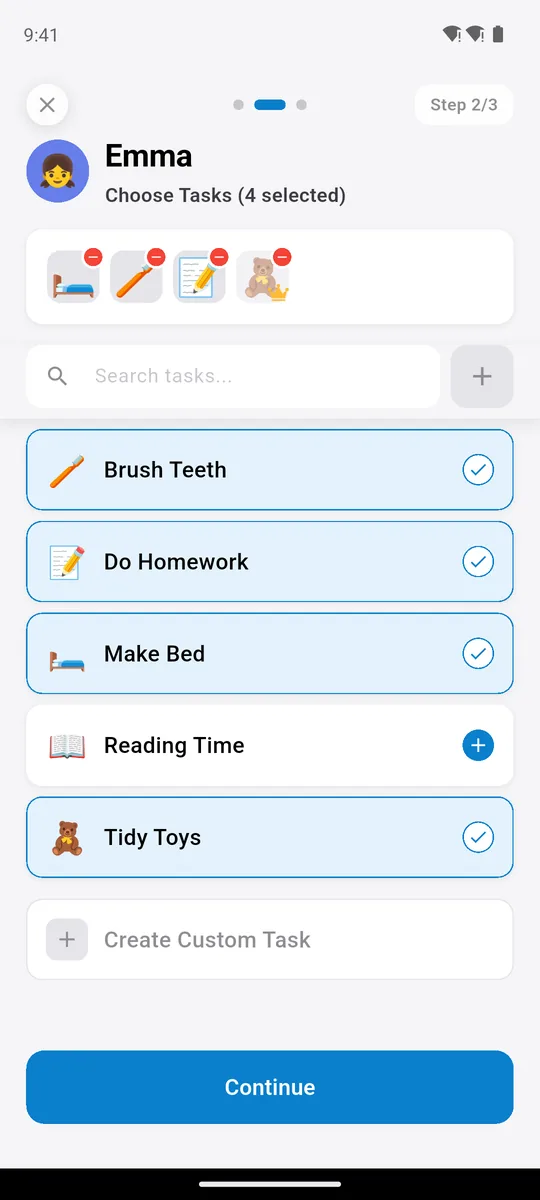
4 tasks selected for Emma

"Feed the dog" for Leo, every day
Pick three chores from your child's row and set them up in Family Checklist.


Prefer paper on the fridge? Our printable chore chart guide covers making one and keeping it going. To compare apps first, our best chore apps for kids roundup puts seven side by side.
Key Takeaways
- Start at 2. The AACAP lists putting away toys and groceries at 2–3, and in lab studies toddlers as young as 18 months help others.
- Know what stays with you. Stoves, sharp knives, cleaning products, riding mowers.
- Teach in four steps. Show, share, spot, step back.
- The research is encouraging, not proof. Chores are linked to self-rated competence, math and working memory, as associations.
- Pick three chores this week. Put them where your child can see them, and praise the effort, not the result.
Frequently Asked Questions
What age should kids start chores?
As toddlers. In lab studies, children as young as 18 months readily help others, and the AACAP says 2- to 3-year-olds can put toys and groceries away and dress themselves with help. Expect the help to slow you down: most parents of 1- to 4-year-olds report "unhelpful helping."
What chores can a 6-year-old do?
The AAP lists making the bed, setting and clearing the table, sweeping, emptying wastebaskets, watering plants and filling the pet's dish for ages 5 to 7. The AACAP adds wiping tables and counters and putting laundry away at 6 to 7. Pick three and show each one once.
Do chores really help kids succeed?
The best US data, from 9,971 children, link kindergarten chores to higher self-rated competence and better math in third grade. A smaller study ties self-care and family-care chores to working memory and self-control in children aged 5 to 13. Both are associations, not proof that chores cause the gains.
Is the Harvard study claim about chores true?
Partly. A Harvard-run study of 456 inner-city Boston boys, followed to age 47, found that childhood capacity to work (industry, not chores alone) predicted adult mental health and relationships better than social class or any other childhood factor. "Chores predict professional success" is a popular paraphrase of that finding, not the finding itself.
What chores can a 10-year-old do?
The AACAP says 10- to 11-year-olds can change their sheets, clean the kitchen or bathroom and do yard work. The AAP adds vacuuming, making snacks and putting away groceries from 8 to 10. Cooking a simple meal with supervision comes at 11 to 12.
At what age can my child mow the lawn?
The AAP says 12 for a walk-behind power mower and 16 for a ride-on or riding mower. Younger children should stay well away while someone mows.
Related Reading
- 7 Chores 5-Year-Olds Actually Finish
- Chores for 8 Year Olds: 20 Jobs They Can Actually Own (2026)
- Life Skills Checklist for Kids: What They Should Know by Age 5, 8, 10 and 12
- How to Motivate Kids to Do Chores: 10 Ways Beyond Money
- Why Japanese Parents Send 4-Year-Olds on Solo Errands
- Best Chore Apps for Kids 2026: 7 Apps Compared Honestly
Three chores, on a list your child can see
Pick three from the table above and add them tonight.