Chores for 8 Year Olds: 20 Jobs They Can Actually Own (2026)
An 8-year-old can empty a dishwasher faster than you can explain how to empty a dishwasher. That is the problem with chores at this age. The skill arrived months ago, the job never got handed over, and everyone settled into the old arrangement. Third grade is the year to fix it, and the research on chores and competence points at almost exactly this age.
This is the long version of the list: twenty jobs in four categories, each with a line on why 8 is the right age and a line on what "done" actually looks like. "Clean your room" and "the floor is clear and the hamper is full" are two different instructions. Our life skills for 8-year-olds guide covers the whole third-grade picture, and the life skills checklist by age 5, 8, 10 and 12 gives the arc. This one stays on chores: the list, the rollout, the time budget, the limits, the refusals.
Why 8 Is the Age Chores Stop Being “Helping”
At 5, a chore is practice with an audience. You hold the dustpan, they sweep three crumbs into it, everyone claps. At 8 the same job can be genuinely theirs. They remember it, they do it without you in the room, and the house is different afterward.
The best age-specific evidence is a 2019 study in the Journal of Developmental and Behavioral Pediatrics. Elizabeth White and colleagues at the University of Virginia tracked 9,971 children in the national ECLS-K:2011 cohort (PMID 30507727). Parents reported how often their child did chores in kindergarten; three years later, in third grade, the children rated their own competence. Regular chore-doers scored higher on perceived competence in academics, peer relationships, prosocial behavior and life satisfaction, independent of sex, family income and parent education, and did better in math.
That is an association, not a promise. Nobody randomly assigned dish duty to five thousand kindergartners. What it does establish is that the payoff lands at eight, in how a child answers the question "am I any good at things?" Erik Erikson called this stage industry versus inferiority, roughly ages 5 to 12: children measure themselves against their peers, and real work done competently builds the virtue he called competence. The CDC's picture of middle childhood at 6 to 8 says it plainly: more independence, more peers, more responsibility.
The long-run evidence is thinner than the internet suggests. Marty Rossmann's University of Minnesota analysis followed 84 young adults whose household tasks had been measured at ages 3 to 4, 9 to 10 and 15 to 16. Starting at 3 to 4 predicted mid-twenties success best; starting only at 15 to 16 predicted nothing good. Eight sits inside the useful window. The Harvard Study of Adult Development gets cited with more confidence than the original data earned; our piece on the Harvard chores study. Starting from zero with a third grader, the visual formats in chores for 5-year-olds are worth borrowing for two weeks.
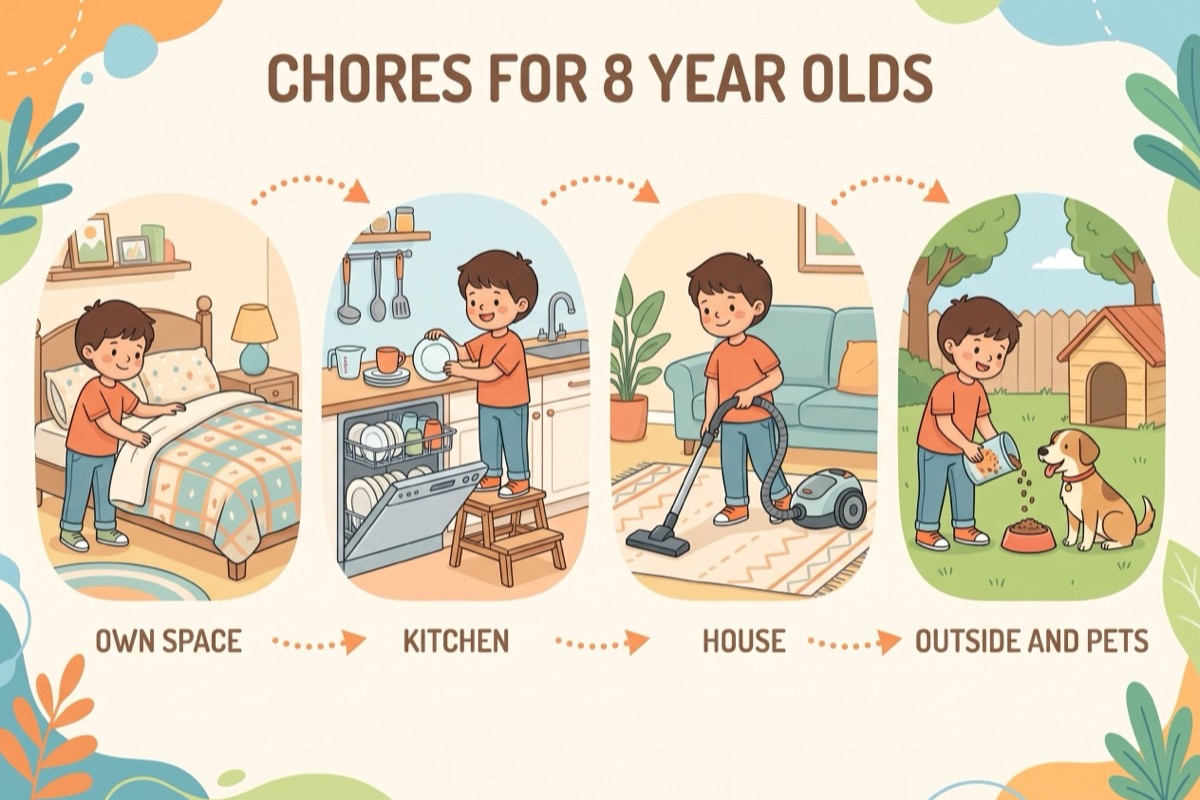
The 20 Chores for 8 Year Olds, by Category
Four categories, five jobs each. Nobody does all twenty in a week. The list is a menu: your child picks some, you assign a few, the rest sit in reserve for when the first set gets boring. Rossmann makes the same point from the research side, that children should help choose their tasks and that the load should not overwhelm them.
- Their own space. Bed, laundry, floor, backpack.
- The kitchen. Dishwasher, counters, their own meals, one cooking night.
- The whole house. Table, vacuum, trash, laundry, bathroom sink.
- Outside and pets. Feeding, walking, mail, plants, yard work with limits.
Each job carries a one-line standard in italics, and that line is the point. "Unload the dishwasher" is an argument waiting to happen. "All racks empty, cups on the second shelf, nothing on the counter" is something a third grader can check and call finished without you.
Category 1: Their Own Space
Start here. Low stakes if it goes badly, and it builds the habit of finishing one thing before starting another. These are the five most parents quietly keep doing themselves, out of speed.
Five jobs an 8-year-old can own this week
- Make the bed every morning. Two minutes at 8, and it anchors the morning.
Done: duvet pulled to the pillow, pillow at the head, floor clear beside the bed.
- Put clean laundry away. Matching a category to a drawer is third-grade work. The folding stays bad for a month.
Done: basket empty, drawers close all the way, nothing stuffed under the bed.
- Reset the bedroom floor before bed. A timed ten-minute tidy, not a deep clean.
Done: floor crossable in the dark, bricks in the bin, clothes in the hamper not on the chair.
- Strip and remake the bed on sheet day. Fitted sheets defeat adults too. Show it twice, then accept imperfect corners.
Done: old sheets in the laundry, fitted sheet on four corners, duvet back on.
- Pack the backpack the night before. The highest-return chore here, and it belongs to the evening.
Done: homework folder, water bottle, library book, gym shoes on gym days, bag by the door.
Category 2: The Kitchen
The AAP puts making snacks, putting groceries away and helping with dinner in the 8-to-10 band of its age-appropriate chores guidance, and AACAP's Facts for Families sheet on chores lists the dishwasher, meal prep and packing their own lunch for ages 7 to 9. The kitchen is where an 8-year-old stops being a guest.
Five jobs that change what dinner feels like
- Unload the dishwasher. They reach most of it and know where things live. Hand them the sharp knives yourself.
Done: all racks empty, every item on its shelf, nothing stacked on the counter.
- Load the dishwasher after dinner. Fitting bowls in rows is a puzzle third graders are good at. Resist rearranging it.
Done: plates scraped, sink and counter empty, detergent in, door shut and started if full.
- Wipe the table and the counters. The difference between a swipe and a clean surface takes one demonstration.
Done: crumbs in the bin not on the floor, no sticky ring where the syrup was, cloth rinsed and hung.
- Make their own breakfast and pack their own lunch. You stock the fridge, they assemble. This saves you the most minutes per week.
Done: sandwich, fruit, snack, filled bottle, lunch bag in the backpack, board and knife rinsed.
- Cook one part of dinner, one night a week. Measuring, stirring, cracking eggs, one heat step with you beside the pan.
Done: they can name every ingredient they added, and the burner is off before they leave.
Knives and heat have their own rules. The AAP's guidance on cooking with your children comes down to one line: supervise the whole time, so the child stays on tasks that suit their stage. Its separate kitchen safety page adds the habit worth keeping whenever a burner is on, which is to turn pot handles toward the back of the stove. A serrated butter knife on soft fruit is fine at 8. A chef's knife is a supervised skill, not a chore.
Category 3: The Whole House
These jobs make an 8-year-old load-bearing. If nobody would notice a skipped chore, the chore is not real yet, and children can tell useful work from a chart with your handwriting on it.
Category 4: Outside and Pets
Pet care has the most emotional pull and the highest failure rate. The 8-year-old who begged for the hamster in March is not the one cleaning its cage in November, so keep a quiet backup check on anything involving a living animal.
Five jobs with a bit of weather in them
- Feed and water a pet on set days. Attach it to their own breakfast so the cue is built in. The AAP puts filling a pet's dish in the 5-to-7 band, so at 8 the new part is remembering it without a reminder.
Done: measured food rather than a guessed scoop, fresh water, bowl rinsed weekly, animal fed before the child eats.
- Walk the dog with an adult, and handle the bag. They hold a leash on a known route. They do not walk a large dog alone.
Done: leash clipped properly, waste bagged and binned, water bowl refilled the moment you are home.
- Clean the litter box or cage, with gloves. Unpleasant, quick, and within reach at 8 if gloves and handwashing are non-negotiable.
Done: waste out, litter or bedding topped up, gloves in the bin, hands washed for twenty seconds.
- Bring in the mail and water the plants. Small, daily and easy to verify, which makes it a good confidence job for a child failing at bigger ones.
Done: mail on the kitchen table not the hall floor, plants watered until it reaches the saucer and no further.
- Yard work with hand tools: rake, sweep, weed, wash the car. Real outdoor work, real satisfaction, zero engines.
Done: leaves bagged, porch swept to the step, tools back in the shed, hose coiled and off at the tap.
How to Roll Out Chores: 3 in Week 1, Then 2 a Week
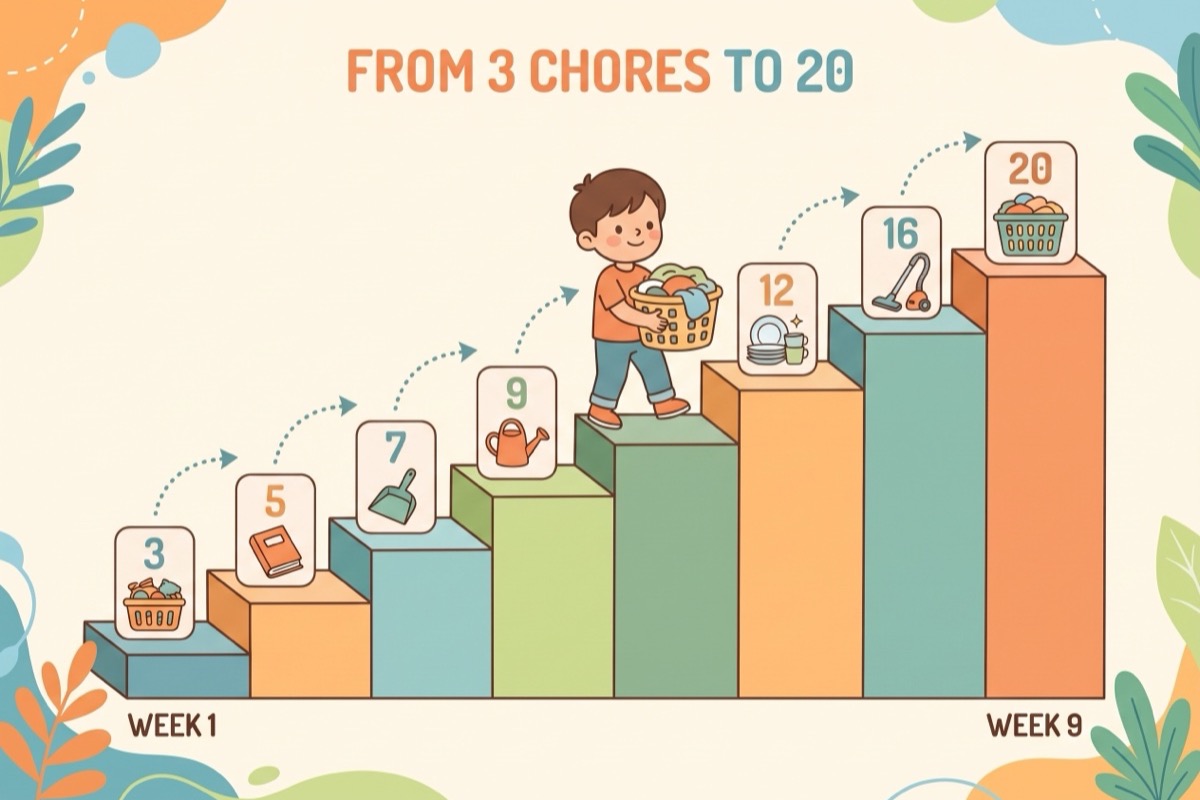
Handing a child twenty jobs on a Sunday is how chore systems die by Wednesday. Start with three, add two a week, and you reach the full list in nine weeks with very little arguing. Children's Hospital of Philadelphia describes the sequence that makes each addition stick: show them how it should be done, work through it together, then step back. Then the hard part, in CHOP's words, resist the temptation to redo anything your child has done. Do not rearrange the dishwasher. Do not re-wipe the sink.
| Week | What you add | Total | Your job that week |
|---|---|---|---|
| Week 1 | Make the bed, put laundry away, pack the backpack at night | 3 | Demonstrate each once. Write the standard where they can read it |
| Week 2 | Unload the dishwasher, feed the pet | 5 | Work alongside them twice, then leave the room on purpose |
| Week 3 | Set and clear the table, wipe table and counters | 7 | Let one job be done badly without comment. The standard gets tested now |
| Week 4 | Reset the bedroom floor, take out trash and recycling | 9 | Ask which two jobs they want next. Choice is the motivation |
| Weeks 5–6 | Pack lunch, make breakfast, load the dishwasher, vacuum a room | 12 | Expect a slump. Novelty runs out around here |
| Weeks 7–8 | Start the laundry, bathroom sink, walk the dog, cook part of dinner | 16 | Teach the two-person jobs properly. Stand at the stove |
| Week 9 | Strip the bed, litter box or cage, mail and plants, yard work | 20 | Retire what never worked. Fourteen jobs they do beats twenty they ignore |
Chores by Time of Day: A Real School Day
A list is not a plan until it has a time attached. Third graders run on cues, not intentions, and the best cues already happen daily: the alarm, the front door, dinner, the bath.
| When | Chores | Minutes | The cue that starts it |
|---|---|---|---|
| Morning | Make the bed, feed the pet, breakfast dish into the dishwasher | 5–7 | Their own alarm. Chores before screens, never after |
| After school | Lunch box rinsed, backpack unpacked, mail in, plants watered | 3–5 | Walking through the door. Before the snack, or never |
| Around dinner | Set the table, clear it, load or unload the dishwasher, wipe counters | 6–10 | The smell of dinner. AACAP suggests the rule "we clean up before dinner" |
| Before bed | Floor reset, pack tomorrow's backpack, laundry into the dryer | 10 | Bath or pajamas. Set a visible timer, stop when it rings |
| Saturday morning | Vacuum, bathroom sink, sheets, litter box, yard work, the car | 30–45 | Breakfast finished. Everybody works at once, screens after |
The morning block breaks first, because mornings are already crowded. If yours are loud, steal the sequence in our morning routine for kids guide before adding a single chore to that hour. Two morning jobs is plenty; the evening carries more.
How Much Time Should an 8-Year-Old Spend on Chores?
Ten to twenty minutes on a school day, more on weekends and in summer. That figure comes from Children's Hospital of Philadelphia, whose guidance on chores puts elementary-school children at 10 to 20 minutes of helping around the house daily, rising to 20 to 30 for teenagers. It is one of the few concrete numbers a major children's hospital publishes, and it is lower than most chore-chart articles imply. The AAP's chores page gives no minutes figure at all.
Twenty jobs sounds like more than twenty minutes, and it would be if they all happened daily. They do not. Eight are daily and short, six are weekly, the rest land on Saturday. A well-spread week is 12 to 18 minutes Monday through Friday and 30 to 45 on Saturday. If a school night runs to 40 minutes, the list is too long or a job is mis-sized, and the fix is to cut rather than push.
What 8-Year-Olds Cannot Do Yet
Every chore list on the internet grows in the comments until somebody's 8-year-old is mowing a lawn. The limits, in one place.
- No lawn mower of any kind. The AAP's lawn mower safety guidance sets 12 as the minimum for a walk-behind power mower and 16 for a ride-on, no passengers ever, with younger children indoors while anyone mows.
- No sharp knives or stovetop work without an adult in the room. Not the next room. In the room, within reach of the pan.
- No bleach, oven cleaner, drain cleaner or anything mixed from two bottles. Glass cleaner, dish soap and pre-moistened wipes cover every job on this list.
- No ladders, and no climbing furniture to reach a high shelf. A step stool at the kitchen counter is the limit. Anything they cannot reach standing on it is your job, not theirs.
- No unsupervised care of a younger sibling. Fifteen minutes while you shower is a stretch goal at 8. Bath time is never an 8-year-old's chore.
- No power tools, hedge trimmers or leaf blowers. Hand tools only until 12.
- No hot oven trays, deep frying or full pots of boiling water. They can turn the oven off. Removing the tray is yours.
None of this is about capability. Capable and safe are two different assessments, and reaction time under surprise is the part that has not developed yet.
When Your 8-Year-Old Refuses
Refusal is data, not defiance. AACAP advises looking for the reason behind the resistance before escalating the consequence. With third graders it is usually one of four.
- The job is unclear. "Tidy up" has no finish line. Read them the standard and watch the resistance drop.
- The job is too big. Twenty minutes of solo room cleaning is a lot at 8. Split it: floor tonight, drawers Saturday.
- The timing is wrong. A hungry, post-school child cannot start a chore. Snack first, chore second, screens third.
- It was never theirs. Jobs assigned with no input get done resentfully or not at all. Let them trade two for two.
What does not work: raising the payment each time they stall, doing it yourself while narrating how tired you are, and confiscating screens for a week. A consequence that outlives the memory of the offense changes the mood, not the behavior. CHOP recommends a standing rule instead: chores are finished before television, games or friends. Our field guide on how to motivate kids to do chores covers what holds up once stickers stop working.
If refusal comes with tears every time, or spreads into school and friendships, treat it as a signal rather than a discipline problem. AACAP suggests talking to your pediatrician when struggles continue or worsen, and our guide to normal behavior between ages 6 and 14 shows where the ordinary line sits.
Should You Pay an 8-Year-Old for Chores?
There is no research verdict, only a values decision. Rossmann's University of Minnesota write-up is direct about it: children should not be made to do household tasks for an allowance. Most financial educators land on a split, where baseline jobs are unpaid because you live here and a short list of extras carries a price. At 8 that works, because a paid extra job connects effort to earnings far better than a transfer that arrives regardless. We go through the arguments in should you pay kids for chores. Decide once, and say it out loud.
Tracking It Without a Sticker Chart
Eight-year-olds have outgrown sticker charts and have not outgrown wanting to see their progress. What works is a visible weekly grid with the standard written beside each job, checked by the child rather than by you. Our free Chore Chart Maker builds one in about ninety seconds, and the printable chore chart collection has ten layouts.
Paper or app is a real question at 8. Paper wins on visibility and costs nothing; an app wins on reminders and on not being lost behind the fridge. We compared both in app versus printable chore chart, and our review of the best chore apps for kids in 2026 breaks down the game mechanics each one uses. Put whichever you pick where the chore happens; a chart in the hallway helps nobody standing at the dishwasher. Two years on, the list changes again, and life skills for 10-year-olds picks up where this stops.
Key Takeaways
- Eight is the age chores become ownable. In 9,971 children, chore frequency in kindergarten was associated with self-rated competence in third grade.
- Twenty jobs, four categories, one standard each. The "done looks like" line ends the argument, because the child can check their own work.
- Three chores in week one, then two a week. Full list in nine weeks. Show it, do it together, step back, stop redoing their work.
- Ten to twenty minutes a day. The Children's Hospital of Philadelphia figure for elementary-age kids, with more on weekends.
- Attach every chore to a cue, not a clock. The alarm, the front door, dinner, pajamas.
- Hard limits: no mower before 12, no stove or sharp knives without an adult in the room, no harsh chemicals, no ladders. Capable and safe are different assessments.
Frequently Asked Questions
What chores can an 8 year old do?
Most third graders can make a bed, put clean laundry away, pack a backpack and a school lunch, load and unload the dishwasher, wipe counters, set and clear the table, vacuum a room, take out the trash, start a load of laundry, clean a bathroom sink, feed a pet, walk a dog with an adult, and rake or sweep outside. The chores for 8 year olds that stick are the ones with a clear finish line, so give every job a one-line standard the child can check themselves.
How many chores should an 8 year old have a day?
Two or three on a school day, plus one longer block at the weekend. Children's Hospital of Philadelphia puts elementary-age children at 10 to 20 minutes of helping a day, which means a couple of short daily jobs rather than a long list. Spread the rest across the week: vacuuming Wednesday, sheets Saturday, litter box Sunday. If a school night runs past 20 minutes, cut a job rather than push harder.
Should an 8 year old get paid for chores?
There is no research verdict, only a family decision. Marty Rossmann's University of Minnesota write-up says plainly that children should not be made to do household tasks for an allowance. Many financial educators use a split: baseline jobs are unpaid because you live here, while extras such as washing the car carry a price. At 8 that teaches money well, because a paid extra job connects effort to earnings better than an allowance that arrives whatever happens.
Can an 8 year old use the stove or a sharp knife?
With an adult in the room, within arm's reach, yes. Most 8-year-olds can stir a pan, scramble eggs and use a serrated butter knife on soft food. The AAP's advice on cooking with children is to supervise the whole time so the tasks stay age-appropriate, and its kitchen safety guidance adds one standing rule at the stove: pot handles turned toward the back. Chef's knives, hot oven trays, deep frying and full pots of boiling water stay with you for years yet.
What do I do when my 8 year old refuses to do chores?
Look for the reason before raising the stakes, which is what AACAP advises. The four common causes are an unclear job, a job that is too big, bad timing, and a chore they had no say in. Read them the standard, split the task, feed them first, or let them trade two jobs for two others. Then hold one rule: chores come before television, games or friends. Long screen bans rarely change behavior; a consistent order of operations does.
Is 8 too late to start chores?
No. Rossmann's follow-up of 84 young adults found that starting household tasks at ages 3 to 4 best predicted success in the mid-twenties, and that starting as late as 15 to 16 predicted nothing good. Eight sits comfortably inside the useful window. Expect the first two weeks to feel like extra work, because teaching a job takes longer than doing it. Start with three chores, and treat week three as the real test.
Related Reading
- Life Skills for 8-Year-Olds: What They Should Actually Know (2026)
- 7 Chores 5-Year-Olds Actually Finish (Tested by 200 Real Families)
- 10 Ways to Motivate Kids to Do Chores (Beyond Money and Punishment)
- Should You Pay Kids for Chores? Pros, Cons and Research (2026)
- Harvard's 85-Year Study on Kids Who Do Chores
- Life Skills Checklist for Kids by Age 5, 8, 10, 12 (the parent pillar)
Build your 8-year-old's chore chart in 90 seconds
Our free Chore Chart Maker turns this list into a weekly grid with the jobs, the days and room for the standard beside each one. Printable, no signup required.
Try the Chore Chart Maker
