Family Routine App vs. Printable Chore Chart: Which Actually Works Better?
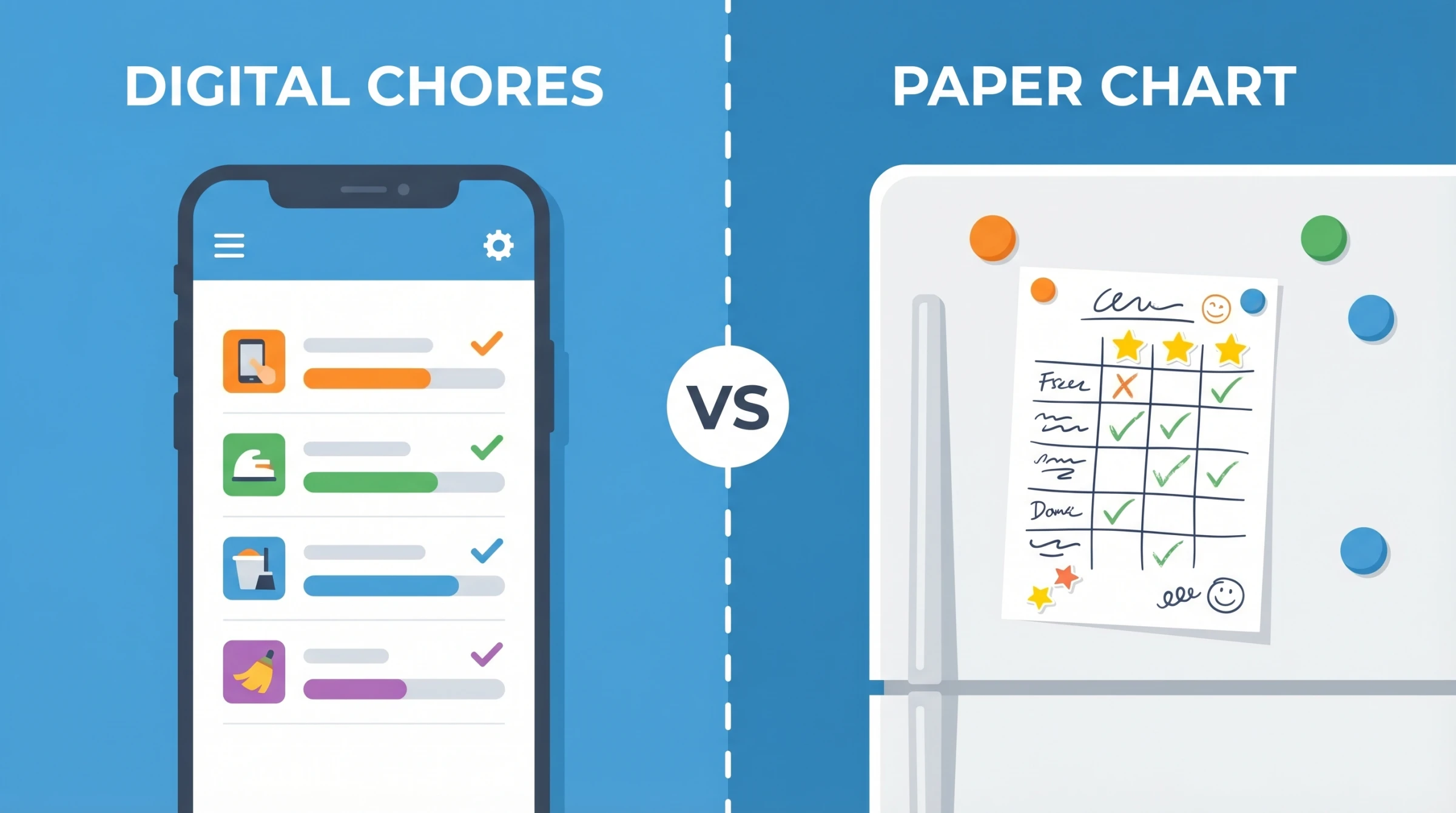
Your family needs a chore system. You have two obvious options: print something off the internet and stick it on the fridge, or download an app. Both work. Neither is perfect. And the answer for your family probably is not the one you expect.
I have been on both sides of this. Before building Family Checklist, I spent two years using printed charts with my kids. Stickers, magnets, laminated sheets—the whole collection. Some of it worked beautifully. Some of it ended up crumpled behind the recycling bin by Thursday.
So let me walk through the real tradeoffs. Not the marketing version. The version where your 7-year-old spills juice on the chart and your co-parent never sees the updates.
The Case for Printable Chore Charts
Let me be honest: printable charts deserve more respect than they get. There is a reason they have been the default for decades, and it is not just because apps did not exist yet.
What printable charts do well
- They are tangible. A chart on the fridge is always visible. Research on visual supports shows that children respond well to physical, always-visible schedules. No unlocking a phone, no finding the right app, no loading screens. It is just there, at eye level, every time your child walks into the kitchen.
- Zero screen time. In 2026, this matters more than ever. If you are already managing your family's screen time, adding another app to the mix might feel counterproductive. A paper chart keeps the system fully offline.
- Kids physically check things off. There is something deeply satisfying about drawing a checkmark or placing a sticker. For younger kids especially, the physical act of marking a task as done creates a stronger sense of accomplishment than tapping a button.
- No tech barrier. Grandparents, babysitters, anyone can look at the fridge and see what the kids need to do. No account creation, no app download, no "what is the password?"
- Free. You can print a chart at home and start today; we cover setting up a chore chart in one evening. Total cost: one sheet of paper and some ink.
- Best Chore Apps for Kids 2026: 7 Apps + Their Game Mechanics Compared
Where printable charts fall short
- They get messy fast. Juice spills, marker smudges, stickers peeling off. By Wednesday, last Monday's pristine chart looks like a crime scene evidence board.
- Weekly reprinting. Every Sunday evening you are either reprinting the chart or trying to erase last week's marks. This gets old by week three. By week six, most families have quietly stopped.
- No historical data. Was last month better or worse than this month? How many days in a row did your daughter actually make her bed? You have no idea. The old charts went in the recycling.
- Cannot sync between households. If you are co-parenting, the chart on your fridge is invisible to the other household. Consistency across two homes—which matters enormously for building real habits—becomes very hard.
- Novelty wears off. The sticker chart that had your 6-year-old bouncing with excitement in week one gets completely ignored by week four. There is no built-in mechanism to keep engagement going.
Best for
Younger kids (ages 4–6) who respond to physical stickers and checkmarks. Single-household families with a simple routine. Families actively limiting all screen time. Parents who want to start today with zero setup cost.
The Case for a Family Routine App
Apps solve most of the problems that kill paper charts. But they introduce a few new ones. Here is the honest breakdown.
What apps do well
- Automatic tracking. Every completed task is logged. You can see patterns: which days are strong, which chores get skipped, whether your child is improving over time. Data you never get from paper.
- Streaks and gamification. Points, streaks, rewards—apps can tap into the same psychology that makes games addictive, but aimed at making beds and brushing teeth. Bedtime Routine for Kids: 7 School-Night Fixes That Work (2026) confirms that streaks and habit tracking significantly boost follow-through. For kids ages 6 and up, this is often the difference between a system that lasts and one that fizzles. Our article on morning dopamine routines explains why this works neurologically.
- Multi-device sync. Both parents see the same data in real time. If Dad checks off "homework done" at his house, Mom sees it instantly. For co-parenting families, consistent co-parenting is not a nice-to-have—it is essential.
- Progress history. Six months from now, you can look back and see the trajectory. That kind of long-term visibility is motivating for parents and kids alike.
- Works for multiple children. Three kids, three different chore lists, one place to manage them all. Paper charts multiply complexity; apps absorb it.
Where apps fall short
- Requires a device. Your child needs access to a phone or tablet to check things off, or a parent needs to do it for them. For families where kids do not have their own devices, this adds friction.
- Screen time concern. Even if the app interaction is 30 seconds, some parents reasonably do not want to hand a phone to a 5-year-old for any reason. The concern is less about the app itself and more about what happens after: "Can I play a game now?"
- Some cost money. Many family routine apps are free for basic use, but premium features (unlimited members, advanced tracking, co-parenting sync) often require a subscription. You have to decide whether the value justifies $3–8 per month.
Best for
Families with kids ages 6 and up who respond to gamification. Co-parenting households that need to stay in sync. Multi-child families juggling different routines. Parents who want long-term habit data and do not mind a small learning curve upfront.
Weighing a specific app? Our Joon app review shows what the game-style approach costs and who it suits, and the Chorsee vs Neat Kid comparison puts two simpler chart apps side by side with real screenshots.
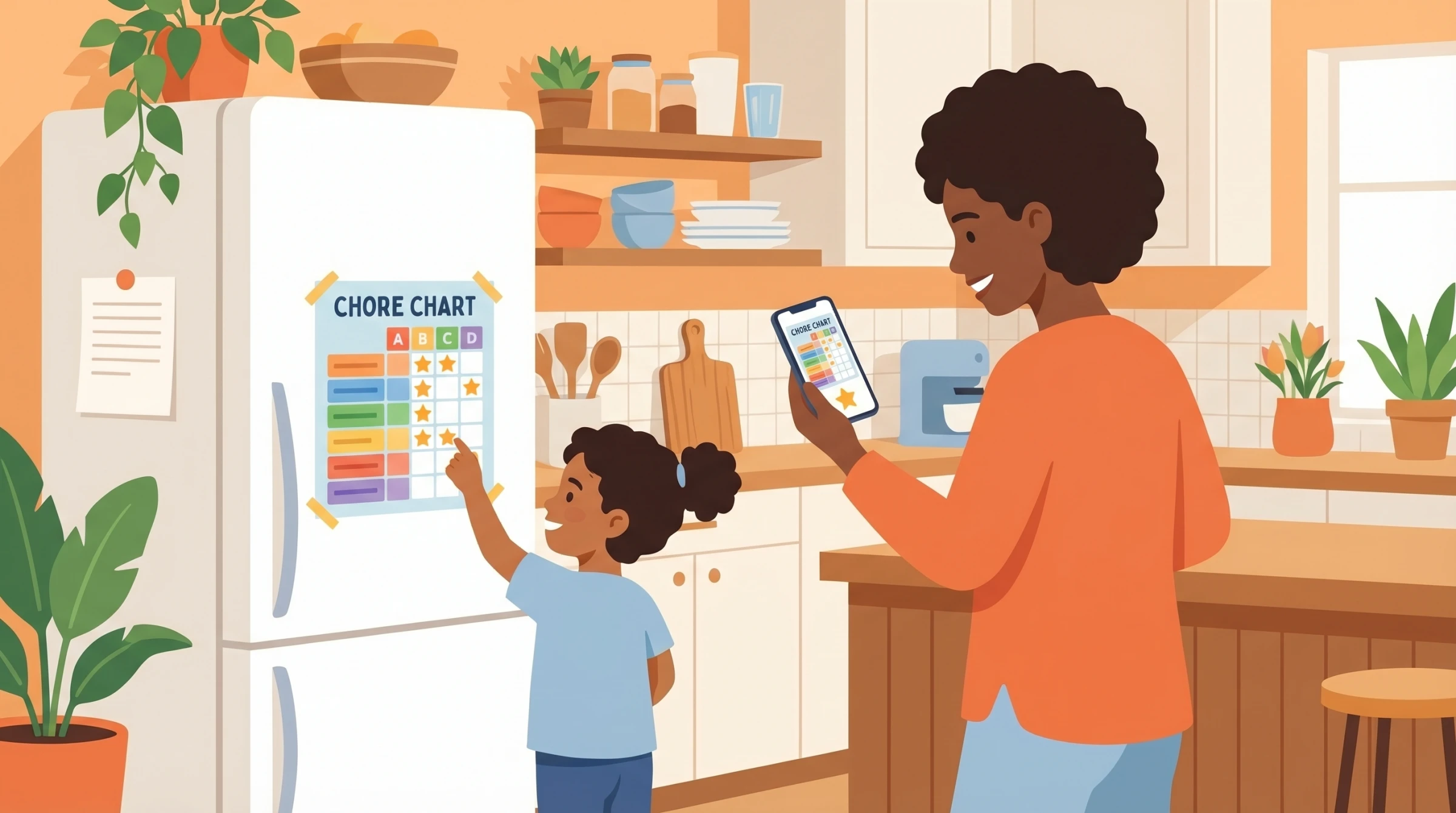
The Hybrid Approach: Why Most Families End Up Here
After talking to hundreds of parents (and living through this myself), here is what I have observed: the families that stick with a chore system longest are usually the ones who combine both methods.
It sounds more complicated than it is. Here is how it works in practice:
- Plan and track in the app. Set up the chore lists, assign tasks, track completions, view streaks. The app is the system of record—the "source of truth" that both parents can see.
- Print a weekly chart for the fridge. Many apps (including Family Checklist) let you generate a printable version of the current week's tasks. Print it. Stick it on the fridge. Now the kids have a physical thing to interact with.
- Kids check off on paper, parents verify in the app. Your child draws their checkmarks and earns their sticker. At the end of the day, a parent spends 30 seconds tapping the completed tasks in the app. History logged, streaks updated, both households in sync.
This gives you the tangible, no-screen-time benefits of paper and the tracking, sync, and gamification benefits of the app. The paper chart is the child-facing interface. The app is the parent-facing backend.
It is the same principle behind why hybrid approaches tend to outperform all-or-nothing strategies in parenting: you take the best parts of each and skip the downsides.
Side-by-Side Comparison
| Feature | Printable Chart | Chore App | Hybrid |
|---|---|---|---|
| Setup time | 5 minutes | 10–15 minutes | 15–20 minutes |
| Weekly effort | Reprint each week | Minimal (auto-resets) | Print + quick daily sync |
| Cost | Free | Free–$8/mo | Free–$8/mo |
| Multi-device sync | No | Yes | Yes |
| Co-parenting support | No | Yes | Yes |
| Gamification | Stickers only | Points, streaks, rewards | Points, streaks, rewards |
| Physical / fridge-friendly | Yes | No | Yes |
| Historical data | No | Yes | Yes |
| Works offline | Always | Depends on app | Paper always works |
| Screen time required | None | Minimal (1–2 min/day) | None for kids |
What Real Parents Say
"We used a magnetic chore chart for about a year. It worked great when the kids were 4 and 5. Once they hit 7 and 8, they completely lost interest in magnets. Switching to an app with points brought the motivation back overnight."
— Parent of two, ages 7 and 9
"My ex and I share custody 50/50. The paper chart at my house was invisible to him, and vice versa. The kids had completely different routines at each home. An app fixed that in a day. Same tasks, same expectations, two houses."
— Co-parenting mom, one child age 10
"I tried three different apps before realizing my 5-year-old does not care about a screen. She cares about putting a glitter sticker on the fridge chart. But I still track everything in the app so I can see her progress over months. Best of both worlds."
— Mom of three, ages 5, 8, and 12
"Honestly, the printable chart lasted exactly two weeks. Not because it was bad—it was great. I just kept forgetting to reprint it on Sunday. The app does not forget."
— Dad of one, age 6
Our Recommendation
If your kids are under 6 and you are in a single household, start with a paper chart and build it around the school day. It is free, it is immediate, and young kids genuinely love the physical interaction. You can always add an app later.
If your kids are 6 or older, you are co-parenting, or you have tried paper charts and they kept fizzling out after a few weeks—a family routine app will give you the structure and staying power that paper cannot.
If you want the best of both? The hybrid approach. Plan in the app, print for the fridge, let kids interact with paper while parents track digitally. It takes an extra minute per day, but it is the setup that lasts.
We built Family Checklist specifically around this idea. The app handles the planning, the tracking, the streaks, and the co-parenting sync. But it also lets you print a clean weekly chart for the fridge—because sometimes the best interface is a piece of paper and a marker.
Key Takeaways
- Printable charts work—especially for young kids. Do not let anyone tell you paper is outdated. For ages 4–6, physical checkmarks beat screen taps.
- Apps solve the problems that kill paper systems: no reprinting, automatic tracking, multi-household sync, and built-in gamification for older kids. Developing children's sense of responsibility benefits from consistent, long-term tracking.
- The hybrid approach lasts longest. App for planning and data, paper for daily interaction. Kids get stickers, parents get insights.
- Co-parenting needs an app. There is no paper workaround for keeping two households in sync.
- The best system is the one your family actually uses. If paper works, use paper. If the app works, use the app. If both work, do both.
Related Articles
App + Print. One system, both formats.
Family Checklist tracks chores digitally and prints a clean weekly chart for the fridge. Try the hybrid approach free—3 family members, 3 tasks each.
Get Family Checklist Free
