How to Make a Chore Chart Actually Work During the School Year
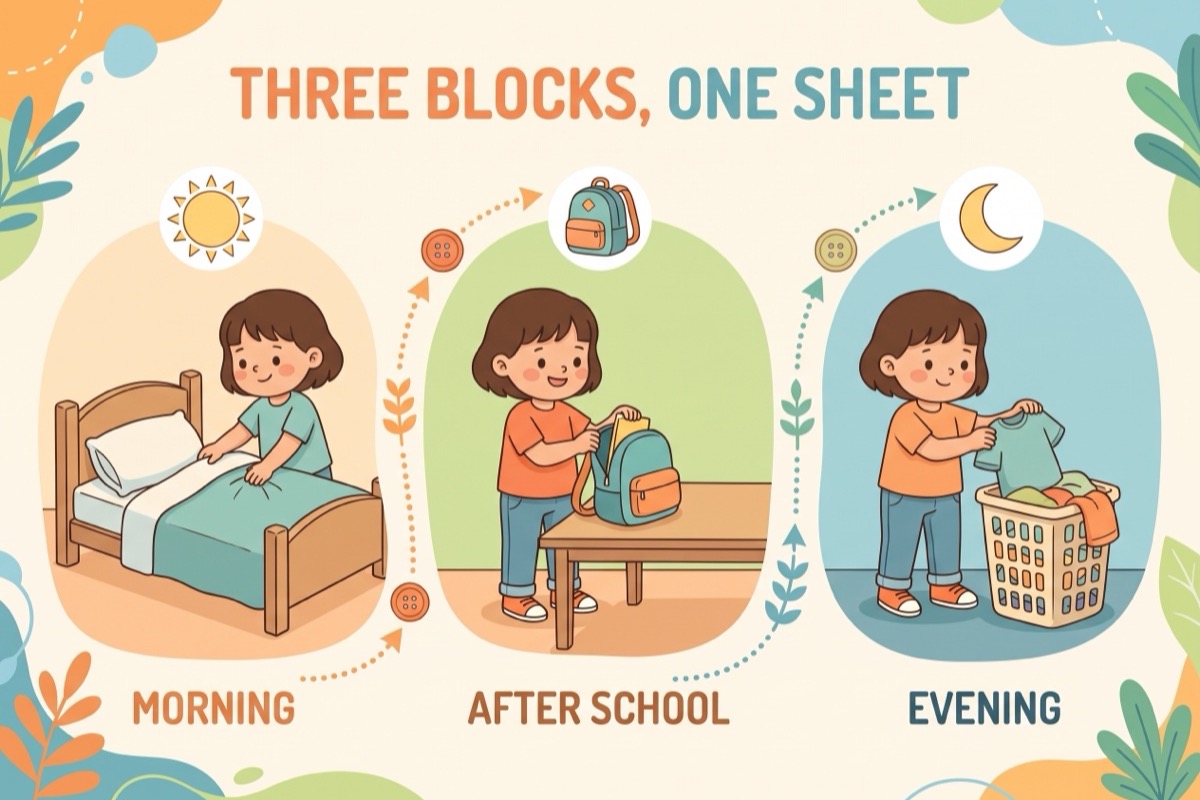
Most chore charts do not fail because of the design. They fail in October, when the school week gets busy and nobody is checking anymore. A chart that lasts the school year has four things. It follows the school day (morning, after school, evening), not a Monday-to-Sunday grid. It has two to five rows, not twelve. It hangs where the chore happens. And someone ticks it at the same moment every day. This guide shows how to set one up in an evening, what to put on it for your family's schedule, how to get it past week three, and when an app is the better tool.
Just want a sheet to print? A free set is linked in the setup steps below; this page is about making it stick.
Why Chore Charts Work, and Why They Stall in the School Year
The school year gives a chart exactly what it needs: the same times, the same places, every weekday. It also takes away slack. There are eleven minutes before the bus and forty between the bus and dinner. A chart that ignores that shape gets ignored back.
The chores themselves are worth the effort. White, DeBoer and Scharf (2019), in the Journal of Developmental & Behavioral Pediatrics, followed 9,971 US kindergartners from the ECLS-K:2011 cohort. Children who did chores regularly reported higher social competence, academic competence and life satisfaction in third grade, and scored better in math. That is an association, not proof, but it is a real study. The popular "Harvard says chores predict success" line is a loose gloss on George Vaillant's reading of the Grant Study, not a finding the Harvard Study of Adult Development publishes itself.
The chart works through a narrower mechanism. Knight, Sartini and Spriggs (2015) reviewed 31 studies and found visual activity schedules to be an evidence-based practice for students with autism. That research comes from special education, so it is not a promise for every 8-year-old. What it shows is the mechanism: when the sequence lives on the wall, the reminder stops being you. Wood and Neal (2007) add the other half: habits are cued by context, meaning the place, the time and the action just before. A chart taped where the chore happens is a cue. A chart in a drawer is paper.
The American Academy of Pediatrics lands in the same place. Its guidance on chores and responsibility suggests posting the chore list in the child's room or on the refrigerator and praising the effort rather than the result.
How to Set Up a Chore Chart in One Evening
Do this with your child, not for them. A child who helped pick the rows has less to argue with later.
- Choose blocks, not days. Draw three bands: before school, after school, evening. A 7-year-old cannot act on "Tuesday." They can act on "after school."
- Pick two to five rows per child. Start with the things that already half-happen: bed, bag, dish to the dishwasher. One household chore after school is enough to begin.
- Split personal and shared jobs. Personal jobs (their bed, their bag, their laundry) never rotate. Shared jobs (trash, table, pet) rotate weekly. More on that below.
- Fix the checking moment. Pick one time to tick the day, usually after dinner. If checking has no set time, it does not happen.
- Add a reward column that costs nothing, or skip it. Picking the Friday film or twenty extra minutes before lights-out works for many kids. Money is a separate decision; our piece on whether to pay kids for chores lays out both sides.
- Post it at the child's eye level, where the chore happens. Morning card by the door, evening card in the bathroom or bedroom, the weekly sheet on the fridge.
- Write the date range at the top. A chart that says "Oct 13–19" gets replaced next week. A chart with no date turns into furniture.
You do not need to design the sheet yourself. A plain grid on notebook paper works. If you want something neater, start from a free set of printable charts on our sister site, pick the one closest to the three-block layout above, and cross out any row your child does not do yet. Laminate it or slide it into a sheet protector, and one copy lasts the whole term with a dry-erase marker.
What to Put on It: Match the Rows to Your School Schedule
The rows should follow the day your child actually lives. Here is the school-day skeleton we start families on. The times are examples; the order is what matters.
| Block | Typical window | What the child does | What the parent does |
|---|---|---|---|
| Before school | 6:45–7:40am | Bed made, dressed, teeth, breakfast dish in the dishwasher, bag by the door. | Nothing verbal. Point at the chart once, then make coffee. |
| The landing strip | First 10 minutes home | Shoes on the rack, lunchbox emptied into the sink, folder or planner on the table. | Snack on the counter before they walk in. This block runs on food, not willpower. |
| After school | 3:45–4:30pm | One household chore, 10–15 minutes, done before screens or practice. | Check by looking, not by asking. Same chore all week. |
| Homework block | 4:30–5:30pm | Homework at a fixed spot, phone in another room, planner ticked when done. | Available from the next room, not sitting beside them. |
| Evening | After dinner | Table cleared, bag repacked for tomorrow, clothes laid out, chart ticked. | Initial the day's column. Thirty seconds, not an inspection. |
Two rules make the blocks hold. The after-school chore comes before the screen, not after; in our experience, flipping that order is the most common reason a chart dies in week two. And the bag gets repacked at night, because a bag packed at 7:15am is packed in a hurry.
Then adjust for the week you really have:
- Early-bus or before-care days. Cut the morning block to two rows: dressed and bag. Move everything else to the evening.
- Practice and activity nights. Mark those days on the chart and drop the after-school chore. A chart that expects a chore on a 7pm-practice night teaches your child the chart is optional.
- Homework-heavy weeks. Keep the rows that take under two minutes (bag, dish, clothes) and pause the bigger job. Shrinking beats skipping.
- Weekends and school holidays. Give them their own short card with one bigger job, like vacuuming a room or helping cook. Do not stretch the weekday chart over Saturday.
- Two households. Agree on the same two or three morning rows in both homes. The rest can differ.
How many rows by age? Our rule of thumb, not a clinical number: two or three a day at 5–7, three to five at 8–10, and four to six plus one weekly job at 11–14. In our experience, charts with more than six rows are the first to be abandoned. For which chores fit which age, see our guide to age-appropriate chores from 2 to 14. The afternoon block has its own guide too: the after-school routine that ends the 4pm fights. The morning block sits on a morning routine, and the evening block on a bedtime routine that already works. If bedtime is chaos, fix bedtime first.
One Chart for Several Kids: Fair Rotation Without Sunday Arguments
Adding a name column solves the printing problem and none of the real ones: who does the job nobody wants, why the older one has more, and what happens when one of them is at practice on trash night.
Rotate only the shared jobs, and print the rotation a month ahead. A rotation decided on Sunday is a negotiation every Sunday. A rotation already on the fridge is a fact.
| Week | Dishwasher | Trash & recycling | Pet care |
|---|---|---|---|
| Week 1 | Oldest | Middle | Youngest |
| Week 2 | Middle | Youngest | Oldest |
| Week 3 | Youngest | Oldest | Middle |
| Week 4 | Oldest | Middle | Youngest |
Fair means age-weighted, not identical: a 12-year-old's slot is the full job, a 6-year-old's is the same job scaled down. Swaps are traded, not dropped. And put a parent column on the chart. Nothing ends "it's not fair" faster than your own name on it. Use one sheet when routines overlap; use separate cards when ages differ by more than about four years or one child is still a pre-reader who needs pictures. For the sibling who watches the other get praised, our guide to motivating kids to do chores without nagging covers what to do instead of comparing.
How to Keep a Chore Chart Going Past Week Three
Week three is where most charts die, and it is normal. Gardner, Lally and Wardle (2012), in the British Journal of General Practice, summarize the evidence. Habits form by repeating a behavior in the same context. In Lally's study, it took about 66 days on average to become automatic, with wide variation. Not 21 days; we take that myth apart in our piece on the 21-day habit myth. Drop the chart at day nineteen and you dropped it in the hard-but-normal part.
- Never miss twice. James Clear's habit-tracker guide puts it simply: missing once is an accident, missing twice is the start of a new habit. A blank Tuesday is not a conversation. Two blank days in a row is.
- Shorten the list instead of adding a consequence. Two misses in a row usually means the chart is too long for this season. Drop a row for two weeks, then add it back.
- Stop asking out loud. Point at the chart once, then leave the room. If you keep reminding, the chart has become a second voice for your nagging.
- Refresh it every four to six weeks. A chart that looks the same for months becomes wallpaper. Change the color, move it, or let your child redraw it.
- Plan for school-calendar resets. After a sick week, a long weekend or a holiday break, restart with only the morning block for two days, then bring back the rest.
- Watch the upkeep cost. Clear is honest about this too: tracking can become a chore of its own. If keeping the chart takes longer than the chores, simplify it.
If chart time turns into daily meltdowns, or your child struggles to start or finish tasks at school as well as at home, that is worth raising with your pediatrician or the school. A chart helps with routines; it does not replace an evaluation. Our page on after-school meltdowns covers the common, non-clinical reasons first.
When to Switch From a Paper Chart to an App
Paper is the right tool for most families with one or two kids under ten. A child ticking a real box beats a child holding a phone, and paper costs nothing. An app starts to win in a few predictable situations:
- Two homes. A chart on one fridge is invisible at the other house, and two paper copies drift apart within a week.
- Three or more kids. Three sheets plus a rotation becomes its own chore.
- You are the only one checking. If the other parent never sees the chart, it is one person's system, not the family's.
- You want streaks without bookkeeping. Paper makes you count the ticks; an app keeps the streak for you.
- Your child is 10 or older and asks for it. Older kids often prefer a list on a device they already carry.
Many families end up with both: paper stays the child-facing sheet on the wall, and the app keeps the streaks and the second parent in sync. We compare the trade-offs honestly in app vs. printable chore chart, and our review of the best chore apps for kids in 2026 includes apps we do not make. For goals rather than chores, there are free A4 sheets at DreamBig Parenting printables.
Want the same chart in an app without a trial clock? Here is which chore apps stay free, tested side by side.
Key Takeaways
- Build the chart around the school day. Before school, after school, evening. A child cannot act on "Tuesday."
- Two to five rows. Two or three a day at 5–7, three to five at 8–10, four to six plus one weekly job at 11–14.
- Chore before screen. In our experience, flipping that order is the most common reason a chart dies in week two.
- Rotate only shared jobs. Print the rotation a month ahead so it stops being a negotiation.
- Expect week three to be hard. Habits take about 66 days on average, not 21. Never miss twice; shorten instead of punishing.
- Switch to an app for two homes, three-plus kids or tracked streaks. Otherwise, paper is fine.
Frequently Asked Questions
Does a chore chart actually work?
For most school-age kids, yes, with two conditions: it has to be visible where the chore happens, and it has to survive week three. Visual schedules are an evidence-based practice in special education (Knight, Sartini and Spriggs, 2015), and habit research shows that a cue in a stable context is what makes a behavior automatic. What a chart cannot do is create motivation that was never there, or work from inside a drawer.
What age should you start a chore chart?
Around 3 for a picture card and around 5 or 6 for written chores. Before 3, chores happen alongside you, not on a list. The useful marker is not a birthday: it is whether your child can look at a row and know what to do without you reading it aloud. Icons bridge that gap for pre-readers.
How many chores should a child have a day?
There is no official number. Our rule of thumb, from watching which charts families still use in November: two or three tasks a day at 5 to 7, three to five at 8 to 10, and four to six plus one bigger weekly job at 11 to 14. Total time runs from about ten minutes at 6 to around thirty at 13.
How do I make a chore chart work for multiple kids?
Split the rows first. Personal chores stay with each child and never rotate. Shared chores, like the dishwasher, trash and pet, rotate weekly, printed a month ahead. Use one sheet if routines overlap, separate cards if ages differ by more than about four years. Put a parent column on it too.
What do I do when my child stops using the chart?
Treat one missed day as nothing. After two in a row, shorten the list rather than adding a consequence. Stop reminding out loud, tick the chart at a fixed moment after dinner, and refresh the design every four to six weeks so it does not turn into wallpaper.
Should I use a chore app instead of a paper chart?
Paper is enough for most families with one or two young kids. An app is worth it when kids move between two homes, when you have three or more children, when only one parent ever sees the chart, or when you want streaks tracked for you. Many families keep paper on the wall and use the app behind it.
Related Reading
- Age Appropriate Chores by Age: What Kids 2–14 Can Do
- After School Routine for Kids: An Order That Ends the 4 PM Fights
- Morning Routine for Kids: School Checklist by Age
- 10 Ways to Motivate Kids to Do Chores (Beyond Money & Punishment)
- Family Routine App vs. Printable Chore Chart: Which Works Better?
- Best Chore Apps for Kids 2026: 7 Apps Compared Honestly
- Chores for 8-Year-Olds: What Third-Graders Can Really Handle
Keep the chart going when paper is not enough
Family Checklist is one weekly chore chart for the whole family. Kids check off their jobs and earn stars and streaks instead of money, the chart syncs across devices so the second parent sees it too, and you can still print it for the fridge.

