Best Math Apps for Kids: What 12,028 Reviews Say (2026)
Short answer: for ages 2–8, start with free Khan Academy Kids; for a reluctant 1st–8th grader, Prodigy; for logic puzzles at 4–8, LogicLike. The app matters less than the habit: about 10 minutes, same time, most days.
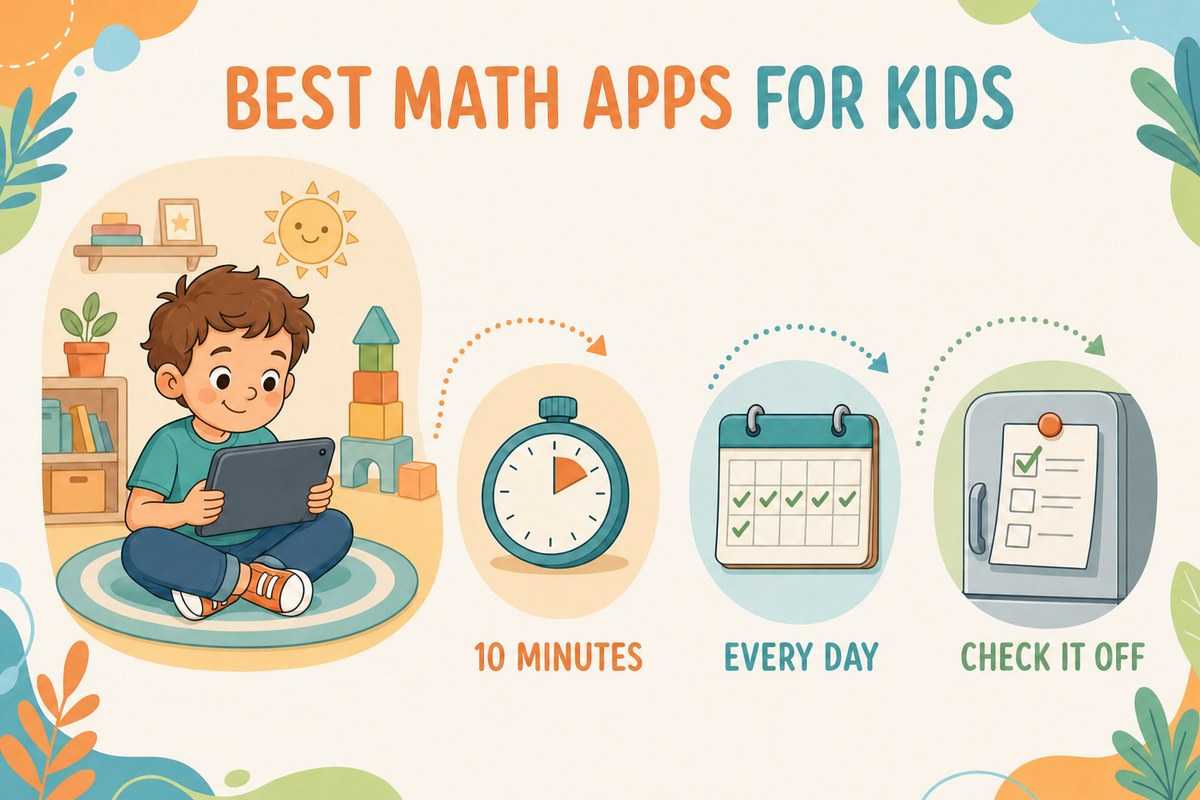
To see which of the best math apps for kids hold up, we read 12,028 public reviews of the 10 most popular ones on the US App Store and Google Play, collected October 16, 2026. Below: the data, the best and worst review of each app, the money traps, and a fixed daily slot like our after-school routine.
Disclosure: no paid or affiliate relationship with any app listed. We make Family Checklist, which appears in the habit section.
Pick by need
- Free, ages 2–8: Khan Academy Kids. Only 9.8% of its reviews are 1–2★, the lowest of the ten.
- Logic and reasoning, ages 4–8: LogicLike (4.4★ / 4.6★, about 127,000 ratings) beside a curriculum app.
- A child who "hates math," grades 1–8: Prodigy. Math is free; 53% of happy reviews say kids love it.
- Number sense, ages 4–8: DragonBox Numbers.
- Multiplication, 3rd grade up: IXL, gently: 59% of its reviews are 1–2★.
- Pre-K to 2nd grade with learning differences: Todo Math.
Why the Habit Beats the App
The research on math apps is real but modest. A 2021 AERA Open meta-analysis by Kim, Gilbert, Yu and Gale pooled 36 studies of apps for preK to grade 3 and found an average math effect of 0.29 standard deviations, close to tutoring. It also warns of "substantial variability" between apps.
Practice is the steadier part. The federal What Works Clearinghouse practice guide (2009) says math interventions "should devote about 10 minutes in each session to building fluent retrieval of basic arithmetic facts." The American Academy of Pediatrics asks parents to "focus on quality, context and conversation" and seek content that "supports reading and math." See how much screen time is OK for kids by age.
What 12,028 Reviews Say About the Best Math Apps for Kids
Method. For each app we took the US store listings and up to about 1,800 written reviews from public feeds. A keyword classifier tagged themes such as price, bugs or "kids love it." Quotes are verbatim, trimmed only with "…". US prices are as of October 16, 2026; check in-app before you subscribe.
| App | Rating: App Store / Google Play (count) | Reviews analysed | 1–2★ share | Top praise (share of 4–5★) | Top complaint (share of 1–2★) |
|---|---|---|---|---|---|
| LogicLike | 4.41 (37,642) / 4.62 (90,058) | 1,263 | 29.6% | Kids love it, 19% | Paywall / price, 60% |
| Prodigy Math | 4.76 (250,382) / 4.72 (68,690) | 1,774 | 21.1% | Kids love it, 53% | Paywall / price, 58% |
| Khan Academy Kids | 4.80 (131,843) / 4.57 (57,223) | 1,608 | 9.8% | Kids love it, 44% | Bugs / won't load, 11% |
| SplashLearn | 4.51 (32,285) / 4.78 (3,836) | 1,297 | 33.5% | Kids love it, 61% | Paywall / price, 45% |
| DoodleMath | 4.0 (236) / 3.41 (3,157) | 1,026 | 32.5% | Kids love it, 26% | Paywall / price, 19% |
| Todo Math | 4.7 (1,147) / 4.02 (4,202) | 484 | 15.5% | Kids love it, 45% | Paywall / price, 32% |
| IXL | 4.34 (205,767) / 3.92 (45,437) | 1,541 | 58.7% | Kids love it, 22% | Scoring penalties, 15% |
| Boddle | 4.46 (11,667) / 4.41 (3,184) | 1,519 | 16.7% | Kids love it, 50% | Bugs / won't load, 21% |
| DragonBox Numbers | 4.64 (4,390) / 4.7 (11,778) | 506 | 25.1% | Kids love it, 22% | Paywall / price, 40% |
| Matific | 4.67 (1,190) / 3.72 (30,828) | 1,010 | 26.3% | Kids love it, 16% | Bugs / won't load, 15% |
Limits. Unhappy people write more, Apple's feed is thin, and many reviewers are kids or non-US. Treat percentages as signals.
Money is the number one complaint: 26.9% of all 3,300 one- and two-star reviews, ahead of bugs (12.0%) and login (8.1%). Khan Academy Kids, the only app with no in-app purchases, has the fewest. Adaptive levels, a big marketing claim, come up in 4% or less of happy reviews.
10 Math Apps, Reviewed
The numbers are not a ranking. For one pick, use the short answer above. LogicLike comes first as math + logic for ages about 4–8; the order of the rest means nothing.
1. LogicLike: Logic Puzzles Plus Early Math (Ages 4–8)
LogicLike's strengths are real. It is audio-first, so pre-readers can play alone. It is built on logic puzzles, the reasoning side of math. It has about 127,000 ratings, 4.4★ on the App Store and 4.6★ on Google Play. And parents praise its built-in time limit. That built-in time limit pairs well with a "LogicLike 10 min" line on the family checklist.
- For: preschool to about grade 2 (Common Sense: 4+).
- Teaches: sorting, sequences, Sudoku, plus counting, shapes, adding and subtracting.
- Price: very limited free access; a 3-day trial, then $7.99/month or $49.99/year per Common Sense. Other plans exist.
- Pick it if your child loves puzzles and you want reasoning next to a curriculum app. Skip it if you need grade-level arithmetic, two kids on one plan, or offline play.
"…Puzzles are engaging and set in nice difficulty order… There is a time limit for the kids to spent on the app which I just loved…" Best: Google Play, 5★, January 2023
Now the honest part. 60% of its one- and two-star reviews are about price, the highest of the ten, and 18% mention a charge, refund or cancellation. Common Sense calls it "ho-hum early learning" that "focuses on quantity over quality." A 5★ parent noted "how little the numbers are used"; a 2★ parent found "no way to have two users."
"…I signed up for the 3-day free trial and unsubscribed after just one day … but I was still charged for a 6-month subscription.…" Worst (one reviewer reports): Google Play, 1★, August 2025
Tip: when the trial starts, set a reminder for the next evening, before the 3 days end, and check your phone's Subscriptions settings to see the renewal date.
2. Prodigy Math: The Game Kids Ask For (Grades 1–8)
The clearest "game first" app: 58% of its angry reviews are about money. In 2021, Fairplay and 21 groups asked the FTC to investigate the upsell; Prodigy disputed it, and we found no FTC action.
"My 11 year old is usually reluctant to do maths … To her it is a fun roleplay adventure with some maths questions to cast spells.…" Best: Google Play, 5★, May 2019
"…As a teacher I used to like prodigy. … The pay to play and ads are insane now.…" Worst: Google Play, 1★, January 2026
3. Khan Academy Kids: The Free Pick (Ages 2–8)
- For: ages 2–8. Common Sense: 3+, educational value "a lot."
- Teaches: 5,000+ games, books and videos; math is one part of many.
- Price: 100% free from a nonprofit. No ads, no subscriptions.
- Pick it if you want one safe default for ages 2–8. Skip it if your child is past 2nd grade.
Its few complaints are technical: it won't open or sign in.
"…I've spent a total of $0.00 on it, which is hard to beat. My daughter loves it…" Best: Google Play, 5★, May 2026
"Nearly a month of this app no longer opening on the device its always been used in.…" Worst: Google Play, 1★, November 2025
4. SplashLearn: PreK–5 Curriculum With Reports
- For: ages 2–11, preschool to grade 5, math and reading.
- Teaches: adaptive, curriculum-aligned games with progress reports. Common Sense Privacy: Pass, 93%.
- Price: about $8–$12/month or $70–$90/year on the App Store after a 7-day trial.
- Pick it if you want grade-by-grade coverage and weekly reports. Skip it if you're on Android: Google Play reviews report far more broken purchases.
SplashLearn has the strongest "kids love it" signal (61%), but its Google Play sample averages 3.14 against 4.21 on Apple. Reviewers report apps that won't load after paying, and billing trouble (18.7%).
"…this is worth all the money. He reads books and adds numbers.…" Best: Google Play, 5★, June 2021
"…the app doesn't work… nothing happens when we click the blue boxes…" Worst: Google Play, 1★, June 2024
5. DoodleMath: A Little Every Day (K–5)
- For: kindergarten to grade 5, Common Core aligned.
- Teaches: a placement check, then a daily personal set. Works offline.
- Price: App Store $10.99/month or $94.99/year for the first student, after a free trial.
- Pick it if you like a daily structure built in. Skip it if you want a big US user base: it is UK-born, with 236 US ratings.
Its "79%" faster-progress claim uses the company's own metric, no control group. Angry reviews split between price (19%), bugs (16%) and login (14%); several describe a placement test that sets the wrong level.
"…The 'little a day' approach helps to minimise learning loss, encourages good study habits…" Best: Google Play, 5★, April 2020
"…log in errors and then the app resetting back to baseline over and over causing him to fall behind.…" Worst: Google Play, 1★, December 2025
6. Todo Math: Gentle Practice for Pre-K to 2nd Grade
- For: pre-K to 2nd grade. Common Sense: 5+, "Great daily practice for a range of abilities."
- Teaches: 2,000+ activities, counting to multiplication. Dyslexic font, left-handed mode, offline play.
- Price: several levels free; one-year plans listed from $49.99 to $99.99.
- Pick it if your child is young, a weak reader, or learns differently. Skip it if they are in 3rd grade or above.
Liked (4.19 average); only 13 recent reviews.
"…He's only 5 but doing math at 7 year old level. For the best results, parents should definitely help…" Best: Google Play, 5★, December 2021
"…now you can only play 6 times every day for free. I wish this wasn’t a subscription.…" Worst: App Store, 1★, November 2021
7. IXL: Grade-Level Practice, Strict Scoring (PreK–12)
- For: preK to 12th grade; most useful from 3rd grade.
- Teaches: adaptive questions with step-by-step explanations, scored by a "SmartScore."
- Price: a few free questions a day; $9.95–$19.95/month or $79–$159/year (Common Sense); App Store plans from $19.99.
- Pick it if you want practice that matches the teacher's assignments. Skip it if a dropping score sends your child into tears.
IXL is the outlier: 4.34★ on its listing, yet the most angry reviews of the ten, about school-assigned work and scores that drop after mistakes (15%), not price (6%). Common Sense reviewers call the scoring "overwhelmingly frustrating and demotivating."
"…Not only has it gotten my children ahead of their class but it has stuck perfectly to the curriculum…" Best: Google Play, 5★, April 2026
"…when I got a question wrong (I was at 87) it took me down to 73.…" Worst: Google Play, 1★, January 2026
8. DragonBox Numbers: Real Number Sense (Ages 4–8)
40% of angry reviews are about money, mostly owners of the old paid app asked to subscribe.
"…Instead of rote addition kids learn real number sense.…" Best: Google Play, 5★, January 2023
"…it says that we need to buy the game or subscribe and it seems to have deleted her progress in the game.…" Worst (one reviewer reports): Google Play, 1★, May 2023
9. Matific: Short Hands-On Activities (K–6)
- For: kindergarten to grade 6, ages 4–12.
- Teaches: short adaptive activities on game "islands," with parent reports.
- Price: App Store $9.99/month or $78.99/year after a 7-day trial.
- Pick it if you want activities that feel less like a quiz. Skip it if Android reliability matters most: freezes and login loops lead its complaints.
Its "34%" test-score claim comes from a study with no control group. Caution: only 10 Apple reviews, and the Google Play sample reads mostly non-US.
"…I am actually a math prof … it’s rigorous and difficult at times… but my 4 year old girl loves it…" Best: App Store, 5★, July 2024
"My daughter loves Matific but it is not playable on her Samsung A7 Lite.…" Worst: Google Play, 2★, December 2022
10. Boddle: The School Game Kids Keep Playing
- For: elementary kids; reviews mention kindergarten to 5th grade.
- Teaches: a math and reading game where adults assign work.
- Price: free to play; a $9.99 Premium plan on the App Store and in-game "Boddle Bucks" for real money.
- Pick it if your child plays it at school and asks for it at home. Skip it if you can't lock purchases on the device.
16.7% angry reviews; the top complaint is crashes and endless "logging in" (21%).
"…My kids would be interested for a week, then never mess with those apps again. I came across Boddle…" Best: Google Play, 5★, January 2024
"There is absolutely no way to disable purchases for your children … my son just randomly makes a $21 purchase without my authorization…" Worst (one reviewer reports): Google Play, 1★, March 2025
For advanced kids: Beast Academy (Art of Problem Solving) has no app; it is a web and book curriculum for ages 6–13 who love a challenge, about $99.99/year.
Best Free Math Apps for Kids
- Khan Academy Kids (ages 2–8): 100% free, no ads, no subscriptions.
- Prodigy (grades 1–8): math content free; membership adds extras and is pushed hard.
- Todo Math (pre-K to 2nd): several levels free.
- IXL: a small number of free questions per day.
The Money Trap: Trials, Charges and Paywalls
Money complaints cluster: LogicLike 60% of angry reviews, Prodigy 58%, SplashLearn 45%, DragonBox 40%, Todo Math 32%, then DoodleMath 19%, Boddle 17%, IXL 6%, Matific 5% and Khan Academy Kids 1%. The sharpest pain is the trial that turns into a charge: in LogicLike's and SplashLearn's angry reviews, 18% of reviewers report a charge, refund or cancellation problem, against 7% or less elsewhere. With more than one child, count profiles: Prodigy prices per child (25% off extra children), DoodleMath bills each extra student, one SplashLearn parent says an account covers three kids, and a LogicLike parent found no way to add a second user. Five habits help:
- Read the "In-App Purchases" list first. Many plans means a small free part.
- Set a reminder the day you start a trial, for one day before it ends.
- Cancel where you paid: in your Apple ID or Google Play subscriptions. Deleting the app does not cancel.
- Check that one plan covers all your kids.
- Turn on purchase approval on any device a child uses.
How to Choose a Math App: 6 Checks
A study of 124 popular kids' "educational" apps rated 58% low quality, with free apps losing points for "distracting enhancements." Researchers led by Kathy Hirsh-Pasek ask whether an app is active, engaged, meaningful and social:
- Minds-on, not tap-on. Your child has to think, not tap fast for coins.
- Few distractions. None of the ten shows third-party ads, per Google Play, but membership prompts distract too.
- Grade fit. It maps to your child's grade standards.
- Explains mistakes, not just "wrong."
- Honest evidence. "Proven" usually means company data.
- Emotional fit. A University of Chicago study found math anxiety already in 1st graders, even among top students. Skip harsh scoring for anxious kids.
Math Apps by Grade, Pre-K to 8th
| Grade | What to practice | Apps that fit |
|---|---|---|
| Pre-K and K | Counting, shapes, early number sense | Khan Academy Kids, Todo Math, DragonBox Numbers, LogicLike, SplashLearn |
| 1st | Add and subtract within 20; fluent within 10 | Khan Academy Kids, Todo Math, DragonBox Numbers, SplashLearn |
| 2nd | Know all sums of two one-digit numbers from memory | Todo Math, SplashLearn, Prodigy, Matific |
| 3rd | Know all products of two one-digit numbers from memory | Prodigy, IXL, DoodleMath, DragonBox Multiplication (8+) |
| 4th | Multi-digit multiplication, equivalent fractions | IXL, Prodigy, Matific, SplashLearn |
| 5th | Multiply multi-digit numbers with the standard algorithm | IXL, Prodigy, DoodleMath, Beast Academy (advanced) |
| 6th–8th | Grade-level practice beyond elementary | Prodigy (to 8th), IXL (to 12th), Beast Academy level 5 (ages 10–13) |
Math apps for multiplication facts
Third grade is when facts must be "from memory"; Prodigy, IXL, DoodleMath and DragonBox Multiplication (8+) practice them. A newer 2021 WWC guide adds: "regularly include timed activities as one way to build fluency." Keep them short. For homework tools, our AI homework rules draw the "explain it, don't do it" line.
Dyscalculia: Apps Are Practice, Not Treatment
Dyscalculia is "a learning disorder that makes it hard to understand math concepts and work with numbers," affecting up to 7% of people, per Understood.org. Signs: trouble recalling basic facts or using + and −, still counting on fingers. No app treats it. If signs last, ask the school for an evaluation (free under IDEA) and tell your pediatrician. Hands-on teaching helps; Todo Math (dyslexic font) or audio-first Khan Academy Kids can add practice.
Make Math Practice a Habit: 10 Minutes on the Family Checklist
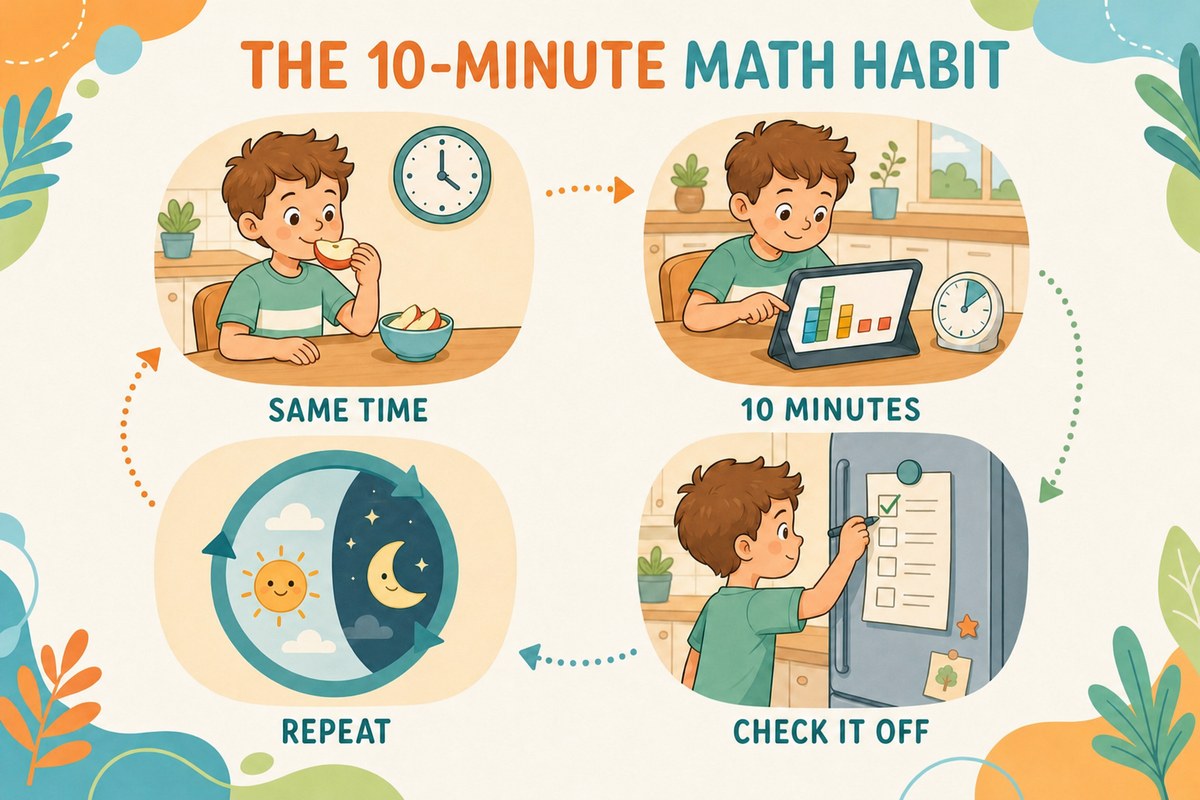
No math app does this part. Forming a habit takes a median of about 66 days, not 21, so the plan is boring on purpose:
- Same time every day, hooked to something that already happens, like snack.
- About 10 minutes on a kitchen timer or the app's own limit. Stop while it is still fine.
- One line on the family checklist: "Math app 10 min (e.g. LogicLike)."
- Tick it, repeat tomorrow. The green dot is the reward.
Pick 4 or 5 school days. If afternoons are chaos, after-school meltdowns explains why food comes first; or add it after our morning routine.
Prefer paper? This week's chart prints free (see app vs printable).
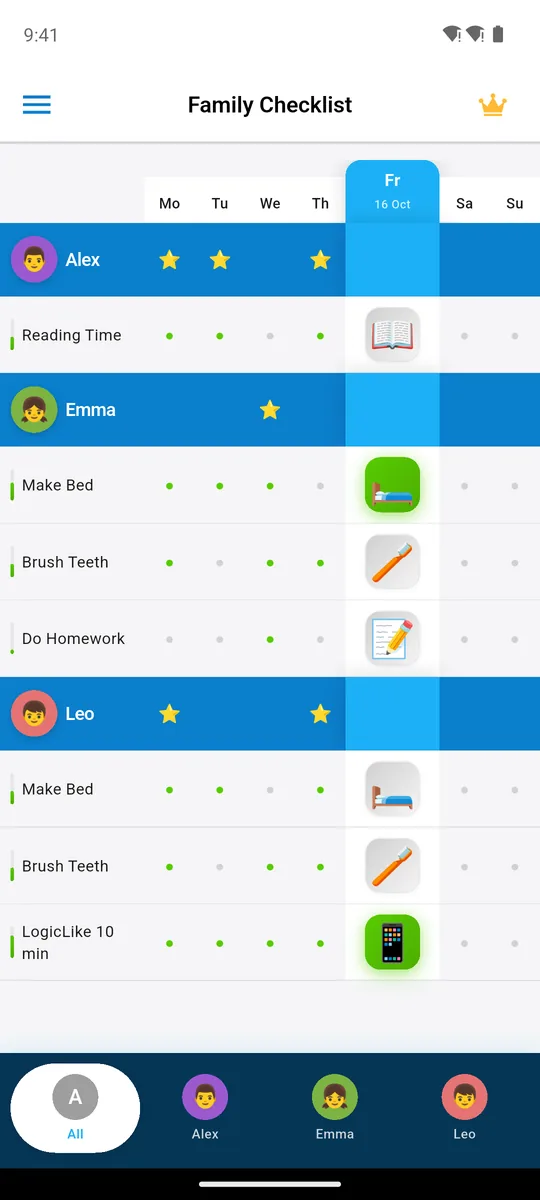
Leo's week
Key Takeaways
- The habit beats the app: about 10 minutes, most days, same time.
- Money is the top complaint: 26.9% of 3,300 angry reviews.
- LogicLike is math plus logic for ages 4–8; set a trial reminder.
- Apps don't treat dyscalculia. Ask the school for an evaluation.
Frequently Asked Questions
What is the best math app for kids?
It depends on age. Khan Academy Kids (ages 2 to 8) is free and had the fewest angry reviews among 12,028 we analysed. Prodigy suits reluctant kids in grades 1 to 8.
Are there good free math apps for kids?
Yes. Khan Academy Kids is fully free for ages 2 to 8. Prodigy's math is free but pushes a membership. Todo Math has free levels; IXL gives a few free questions a day.
What is the best math app for multiplication?
For 3rd graders, Prodigy, IXL and DoodleMath practice multiplication facts at grade level, and DragonBox Multiplication is built for ages 8 and up.
Which math apps are best for 1st, 2nd and 3rd grade?
For 1st and 2nd grade: Khan Academy Kids, Todo Math, DragonBox Numbers and SplashLearn. For 3rd grade: Prodigy, IXL and DoodleMath.
Can a math app help a child with dyscalculia?
An app adds practice; it is not treatment. If basic facts never stick, request a free school evaluation and tell your pediatrician.
How many minutes a day should a child use a math app?
About 10 minutes. The What Works Clearinghouse recommends about 10 minutes per session for fact fluency, at the same time on most school days.
Related Reading
- After School Routine for Kids: An Order That Ends the 4 PM Fights
- How Long Does It Take to Form a Habit? 66 Days, Not 21
- How Much Screen Time Is OK for Kids? AAP Guide by Age
- Life Skills Checklist for Kids by Age 5, 8, 10 and 12
- Best Chore Apps for Kids 2026: 7 Apps Compared Honestly
- AI Homework Rules for Kids: When to Say Yes, When to Say No
Make "10 minutes of math" a box your child ticks
Chores, routines and a "Math app 10 min" line on one weekly board, with green dots, stars and a free printable chart.

