Gentle Parenting vs Permissive Parenting: What It Is, With Examples by Age
Gentle parenting means staying calm and kind while the limit still holds: you name what your child feels, and you keep the rule anyway. Permissive parenting is just as warm, but the limit moves once the upset starts.
My kids are 11 and 13. When I started reading about gentle parenting, almost everything I found was about toddlers in grocery stores. I wanted to know what it means once a child can argue back, and what the research actually says.
The first study of gentle parents, a 2024 PLOS ONE survey of 100 US parents, asked what they actually do. It did not measure how their children turned out, and I found no published study that has. What is well supported is the older idea underneath it: warm and firm “authoritative” parenting. Below: the evidence, nine everyday moments handled three ways (ages 3 to 13), and a script card to print.
What Is Gentle Parenting?
The clearest definition I found is on a Cleveland Clinic page written with pediatrician Karen Estrella: “Gentle parenting is a parenting style built on empathy, respect and understanding.” Then the part people skip: “But that doesn't mean letting kids run the show.” The page's short version: “No yelling. No screaming. But no letting the kids walk all over you either.”
British author and parent Sarah Ockwell-Smith introduced the idea around 2015 to 2016. In their 2024 study, researchers Pezalla and Davidson asked self-described gentle parents what the word means. Three themes came back: “regulating one's own emotions, assisting children in regulating their emotions, and showing emotional and physical affection to children.” Almost 60% defined “gentle” as managing their own emotions: keeping a cool head and avoiding punishments such as yelling or spanking.
So it starts with the parent, not the child. For the wider toolkit, see our positive parenting techniques guide.
Gentle Parenting vs Permissive Parenting: The Difference Is the Limit
The two look identical until your child gets upset. That moment is the whole difference.
Ockwell-Smith draws the line herself in a 2019 post, “How to be a Gentle – Not Permissive – Parent.” It is about “setting age appropriate boundaries and most importantly – sticking consistently to them.”
In real homes, the line blurs. In the 2024 study, 28% of gentle parents' answers about misbehavior mentioned boundaries. About 37% showed fairly clear rules. About 40% showed a more child-directed approach with less-clear boundaries, and the rest mixed the two. The authors' summary: the “enactment of those boundaries is not uniform.” The study also scored every parent on a standard permissive (“indulgent”) scale. Self-described gentle parents scored no differently from other parents on it, or on the authoritative scale. The label alone doesn't tell you which one happens at home. The limit does.
Why the limit matters: Pinquart's 2017 meta-analysis of 1,435 studies found that warmth, behavioral control and authoritative parenting go with fewer behavior problems, though those links are “very small to small.” Harsh, authoritarian, permissive and neglectful parenting all go with more; harsh and psychological control had the strongest links. They are associations, not proof of cause; children's behavior shapes parenting too.
| Permissive | Gentle | |
|---|---|---|
| Feelings | Named and accepted | Named and accepted |
| The rule | Bends when the crying starts | Stays, said once |
| Next step | Another reminder, then you do it | Follow through, calmly |
| Who decides | Whoever is more upset | The parent, after listening |
Our summary of the sources above, not a table from a study.
Slid into permissive? How to reset
Our suggestion, not a study's:
- Announce the new rule at a calm moment, not in the middle of a fight.
- Say it once when the moment comes.
- Expect pushback at first. The limit used to move, so your child will check whether it still does.
- Hold it, calmly, every time.
Is gentle parenting the same as authoritative parenting?
Close, but not by definition. Authoritative parents are high in both warmth and discipline; permissive parents are warm but low in discipline. Research highlights authoritative parenting “as the optimal style for parents for its associations with wellbeing in children.” Ockwell-Smith says gentle parenting “falls into the official definition of Authoritative Parenting.” That is her claim, not a finding. The 2024 study found gentle parents no more authoritative than other parents. In practice, it is authoritative when the limit holds.
Does Gentle Parenting Work? What the Research Says
Honest answer: as far as I could find (November 2026), no published study has measured how children of gentle parents turn out. The Pezalla and Davidson study (July 2024) calls itself “the first systematic investigation of what gentle parenting entails.” It surveyed 100 US parents of children aged 2 to 7; 49 called themselves gentle parents. Answers were self-reported once; no child outcomes were measured. The authors name their own limit: “the relatively small, homogeneous sample.”
ParentData, Emily Oster's site, puts it well: the brand “is not well-defined enough to have been rigorously tested as a complete system.” Its core elements, “warm, responsive parenting, validation of emotions, and firm-but-kind boundaries,” are well supported by research on authoritative parenting.
Four of those parts, and what backs each:
- Warm and firm together. In Pinquart's meta-analysis, warmth and behavioral control both went with fewer behavior problems; harsh and psychological control had the strongest links with more.
- No hitting. The American Academy of Pediatrics is direct: “The AAP advises that parents and caregivers should not spank or hit children.”
- Naming feelings. In an Australian trial of Tuning in to Kids (216 parents of 4- and 5-year-olds), children's emotional knowledge improved and behavior problems fell. One preschool program, not gentle parenting as such.
- Limits with follow-through. The same AAP page says: “Set limits. Have clear and consistent rules your children can follow.” And: “Calmly and firmly explain the consequences if they don't behave. … Be prepared to follow through right away.”
Gentle Parenting Examples by Age: The Same Moment, Three Responses
Nine ordinary moments, three per age band, each handled three ways. We wrote them, modeled on the AAP's discipline steps (set limits, hear them out, give consequences, follow through); they are not real quotes or study findings. The gentle answer follows one pattern: name the feeling, state the limit, say what happens next, then do it.
Ages 3 to 5
| Moment | Harsh | Permissive | Gentle |
|---|---|---|---|
| Won't put shoes on, you're late | “Shoes. Now. Or no park ever again.” | “Okay, okay, five more minutes.” (third time) | “You wish you could keep playing. Shoes go on now. You do them or I help; you pick.” Then help. |
| Hits a sibling over a toy | Shouting, a smack on the hand | “He's just tired.” Nothing happens. | Block the hand. “You're angry he took it. I won't let you hit.” The toy goes on the shelf until both are calm. |
| Meltdown at checkout over candy | “Stop crying or we're leaving you here.” | Buys the candy to end it | “You really wanted it. We're not buying candy today.” Stay close, finish paying, no lecture. |
Our illustrations, not real quotes or study results.
If the shoes fight happens every morning, see our morning routine for kids.
Ages 6 to 9
| Moment | Harsh | Permissive | Gentle |
|---|---|---|---|
| Toys on the floor after two reminders | “That's it, I'm throwing them out.” | You tidy up yourself, sighing | “Tidying is boring, I get it. What's on the floor at 7 goes in the box until tomorrow.” And it does. |
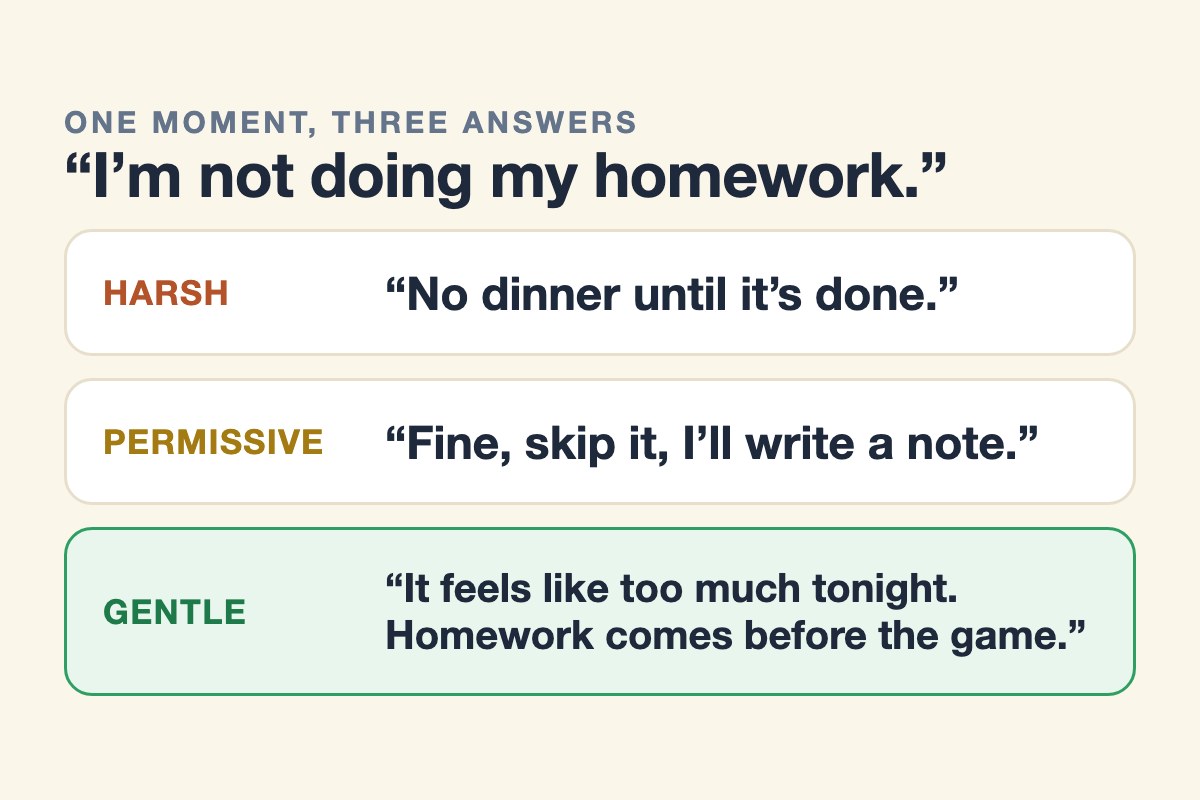
| Refuses homework | “No dinner until it's done.” | “Fine, skip it, I'll write a note.” | “It feels like too much tonight. Homework comes before the game. Easy page first or hard one?” |
| Stalling at bedtime | Threats through the door | “Okay, one more.” Until 10 pm. | “You're not sleepy yet. Lights go out at 8:30. You can read until then.” Same time tomorrow. |
Our illustrations, not real quotes or study results.
Much of this shows up right after school (after-school meltdowns). Our bedtime routine for kids has a timed version of the last row.
Ages 10 to 13
| Moment | Harsh | Permissive | Gentle |
|---|---|---|---|
| Chore not done, again | “You're lazy. Phone's gone for a month.” | You do it yourself to avoid the fight | “I know it's the last thing you want to do. Dishes are yours on Tuesdays; they're done before anything else tonight.” |
| Slams the door: “I hate this family” | “Don't you dare talk to me like that.” Follows in. | Pretends it didn't happen, drops the request | Give it ten minutes. “You were furious, and that's allowed. Slamming isn't how we do it. The answer about Saturday is still no; I'll explain why if you want.” |
| Broke an agreed plan (home late) | Grounded, no discussion | “Just don't do it again.” (fourth time) | “Something got in the way. We agreed on six. What do we change so it works, and what happens this week because it didn't?” |
Our illustrations, not real quotes or study results.
The first study looked at parents of 2- to 7-year-olds, and most advice I found stops there too. Mine are 11 and 13. My daughter pushes back, spends a lot of time in headphones, reads a lot, and sometimes simply withdraws. That is the age the 10-to-13 rows are written for: give the feeling time first, and keep the answer the same.
Some of my limits are set long before any fight: I promised both kids a phone on one condition, that they first learn how a phone works, from the cellular network to Wi-Fi.
If chores are your 10-to-13 flashpoint, check the task fits the age with our age-appropriate chores list. How to motivate kids to do chores covers what to try besides reminders.
The Script Card: Four Moves and Three Checks
Our own practical tool, not taken from a study: four moves for the moment the limit gets tested, and three questions to ask yourself afterwards.
The Cleveland Clinic's own steps for a child who won't get dressed start with the routine, not the fight. The first is “Set expectations ahead of time. Consider adding a visual calendar to help reinforce the routine every day.” The last is “Follow through if they don't cooperate.”
The four moves
- Pause. Your own breath first. Nothing gets decided while you are shouting.
- Name it. “You’re angry.” “You’re disappointed.” “You’re not ready to stop.”
- Hold it. “…and the answer is still no.” “…and it’s still bedtime.”
- Follow through. Do what you said. Once. Without a speech.
Am I sliding into permissive?
- Did the limit move after the crying started?
- Did I ask a fourth time instead of acting?
- Did I explain for longer than a minute?
A yes is not a failure. It shows where the limit moved, so you know what to hold next time.
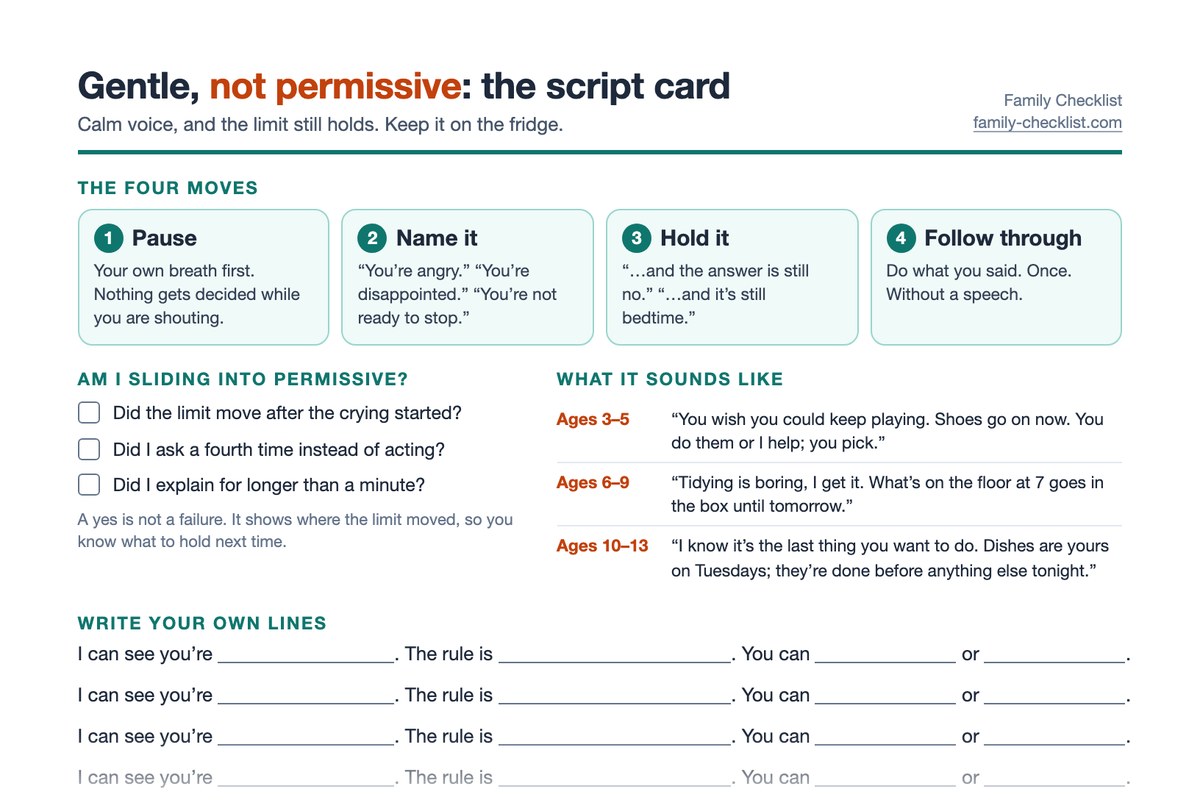
Gentle, not permissive: the script card. The moves and checks above on one US Letter page, with blank lines for your own scripts.
Download the card (PDF)Family Checklist started from the same problem: I got tired of asking my kids for the same things over and over. The best tool I found was my own example. The kids see me doing the same plain things: exercise, reading, dishes, cooking. That is why our checklist has room for the parent too: my plain tasks sit next to the kids’. A limit that lives on a chart everyone can see needs your voice less often.
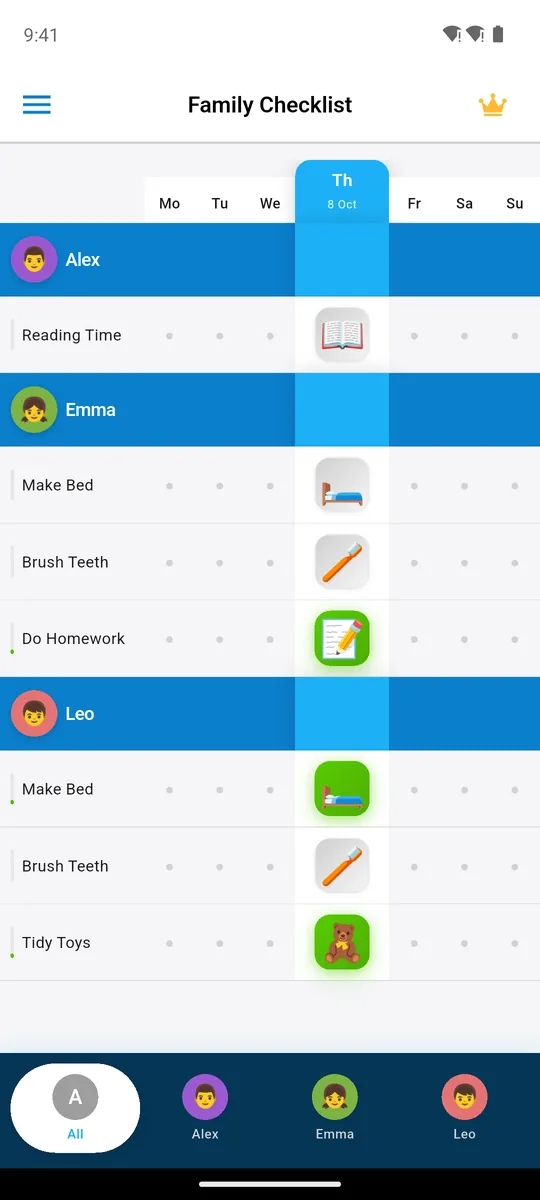
Try this for one week:
- Pick three flashpoints: the moments you repeat yourself most.
- Write each as one line a child can tick. “Shoes on by 7:40,” not “be ready on time.”
- Put them on a chart everyone can see, with one line of your own next to theirs.
- Say the limit once, then point at the chart.
Where Gentle Parenting Falls Short
The calm part is supported. The trouble is the limit that gets lost, and versions that drop tools the evidence backs.
It costs the parent a lot. In the 2024 study, most gentle parents reported high satisfaction, yet uncertainty and burnout came up in over a third of the gentle-parent sample. One mother of three wrote: “I'm hanging on for dear life.” The authors call the approach “extraordinarily gentle for the children, but perhaps not-so-gentle for the parents themselves.” Coded from free-text answers with no comparison group, it is not a burnout rate.
Brown University Health adds that gentle parenting “requires significant time and energy to execute.” What I tell other parents holds here too: don't hope for a magic pill; nothing works until you invest your time and attention.
Rewards and praise get thrown out. Brown Health notes that in gentle parenting “behavioral rewards are discouraged.” Yet a 2019 meta-analysis of 154 parenting-program trials found three of 26 techniques went with stronger effects on disruptive behavior: positive reinforcement, praise in particular, and natural or logical consequences. These were structured programs, with no stronger longer-term effects. The AAP's list includes “Catch them being good.”
Time-outs get called harmful. A 2020 longitudinal study notes that time-out “is often suggested to be harmful or ineffective by the popular media and select professional organizations.” Following US families in the Early Head Start program, it found no significant difference in later outcomes for children whose parents reported using it, though use was reported only once, at 36 months. The AAP calls time-out “especially useful when a specific rule is broken”.
When to See a Specialist
No parenting style fixes everything. The American Academy of Child and Adolescent Psychiatry notes that “all children are oppositional from time to time, particularly when tired, hungry, stressed, or upset.” AACAP calls it “a normal part of development for two to three year olds and early adolescents.” It becomes a concern, AACAP says, when:
- it is so frequent that it stands out next to other children of the same age;
- it affects the child's social, family and school life.
Our own advice, not AACAP's: if you often can't stay in control yourself, that is a reason to ask for help too. Withdrawal is different from defiance: the AAP lists more time alone and changes in sleep or eating among signs of depression, and says to talk with your child's doctor if signs last more than two weeks.
If you fear you might hurt your child, or your child talks about hurting themselves, don't wait for an appointment: call or text 988 (US), or the Childhelp hotline at 1-800-422-4453.
A pediatrician can check for conditions that often come with defiance (AACAP lists ADHD, learning disabilities, mood and anxiety disorders) and refer you to parent training. Our is it normal? child development guide helps you sort the ordinary from the worrying.
Key Takeaways
- Gentle: calm, and the limit holds. Permissive: calm, and the limit moves.
- The first study of the label: 100 US parents, 2024, self-report, no child outcomes measured.
- Well supported: warmth, firm limits, no hitting, naming feelings.
- Falls short: hard on parents; some versions drop praise (trial-backed) and time-outs (AAP-recommended).
- Move repeated limits onto a chart everyone can see, yours included.
Frequently Asked Questions
What is gentle parenting in simple terms?
Gentle parenting means staying calm and kind while the limit still holds: you name what your child feels and keep the rule anyway. The Cleveland Clinic's short version: no yelling, no screaming, but no letting the kids walk all over you either.
Is gentle parenting the same as permissive parenting?
Not by definition, but in practice they blur. In the first study of gentle parents (PLOS ONE, 2024), gentle parents scored no differently from other parents on a permissive-parenting scale, and about 4 in 10 described a child-directed approach with less-clear boundaries. The difference is whether the limit holds once your child gets upset.
Do gentle parents use consequences?
Yes. The Cleveland Clinic's gentle-parenting steps end with explaining the consequence and following through, and the AAP says to explain consequences calmly and follow through right away.
Does gentle parenting work?
Not yet known for the label itself: the first study (100 US parents, 2024) measured no child outcomes, and I found none that has. The parts it shares with authoritative parenting, warmth plus firm limits and no hitting, are well supported.
What are the problems with gentle parenting?
It takes a lot of parent energy: over a third of gentle parents in the 2024 study voiced uncertainty or burnout. Some versions discourage praise, rewards and time-outs; trials support praise and rewards, and the AAP recommends time-out. The biggest risk is the limit quietly disappearing.
Put your three flashpoints on one family chart
One chart everyone can see, yours included. Family Checklist is free for 3 family members with 3 tasks each, no time limit.


Related Reading
- Positive Parenting Without the Fluff: 7 Techniques That Actually Work
- After School Meltdowns: Why Kids Fall Apart at 3 PM and What Helps
- Breaking Parenting Cycles: 7 Patterns You're Repeating
- Morning Routine for Kids: 5 School-Day Steps That Actually Stick
- Bedtime Routine for Kids: 7 School-Night Fixes That Work
- Quiz: Are You a Positive Parent?