Healthy Screen Time Habits: Creator Time Beats Limits
Screen limits alone kept failing in our house. What I’m building instead is a habit: a little creator time every day, and it doesn’t count against the limit.
The short answer
Keep one simple limit for watching and scrolling, and add a daily “creator time” habit that sits outside it: your kid makes something instead of watching it. A drawing, a game level, a short video, a 3D-printed part. Put it on the family chart next to teeth and homework, and put yourself on the chart too.
Our limit for watching: 1 hour on school days, 2 on weekends. Creator time stays outside it. That’s my rule as a dad, not a scientific number.
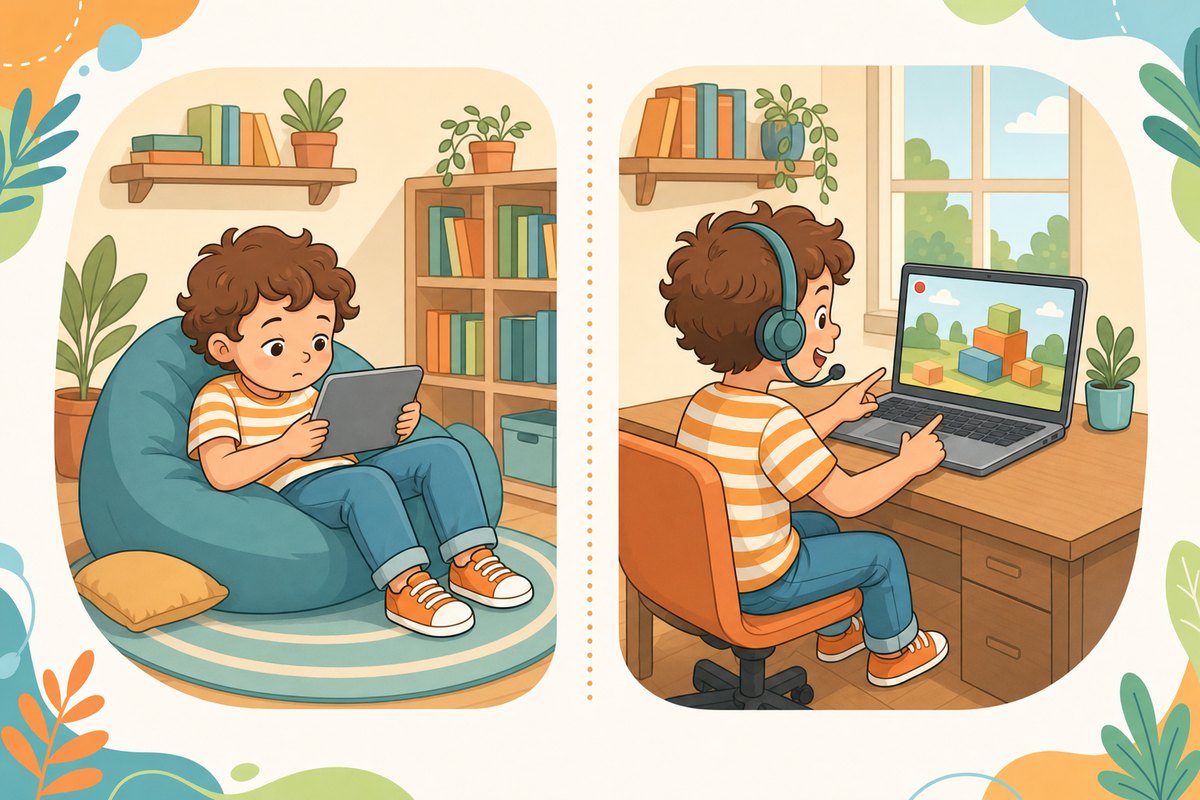
ConsumerWatching someone else’s screencast
CreatorRecording his own
I have two kids: a son who is 11 and a daughter who is 13. We live in a small town on Portugal’s Atlantic coast. My son loves LEGO and Minecraft. My daughter loves Pinterest, screencasts, Toca Boca, series and anime. Every row in the table above comes from them.
Why screen limits alone didn’t work for us
Hard bans worked badly. We tried time limits too, and my daughter keeps finding ways around them: another device, another app. We also break our own rule on purpose for family movie nights. What works best is agreements, and those are a long game.
The second problem was harder to see. A limit only counts minutes. It says nothing about what happens inside them. Twenty minutes of drawing her own character and twenty minutes of scrolling other people’s drawings look the same on a timer. They are not the same thing.
So I stopped asking only “how long?” and started asking one more question: is my kid a consumer or a creator right now? I wrote about where that question came from, and how to ask it without lecturing, in consumer or creator: the question behind passive vs active screen time. This page is the practical half: how to turn it into a daily habit.
The rule: creator time doesn’t count
In our house, time spent creating does not count against the screen-time limit. It’s a different thing. The limit is for watching, scrolling and playing games someone else made.
Counts against the limit
- Videos, shorts, series
- Scrolling feeds and pictures
- Playing a ready-made game
Creator time, outside the limit
- Drawing on a tablet, comics
- Recording your own screencast or video
- Modding, coding, designing a 3D part
To be honest about it: this is my position as a father, not science. The American Academy of Pediatrics doesn’t split screens into consuming and creating. Its 2026 policy asks families to “move beyond simple screen-time limits and focus on quality, context and conversation” (AAP, HealthyChildren.org). For the numbers by age, see our guide to how much screen time is OK for kids.
Two guardrails keep the rule from becoming a loophole. Creator time still ends before bed. And it has to produce something you can look at: a drawing, a level, a clip. “I was researching for my video” while watching other videos is still watching.
Why bother building the habit? Kids rarely get there on their own. In the 2019 Common Sense census, just 2% of tweens’ screen use and 3% of teens’ went to creating content such as writing, digital art or music, “virtually unchanged since 2015” (Common Sense Media, 2019).
A weekly creator-time plan for ages 8–13
One small thing a day. Finished beats long. Start from what your kid already watches, and pick the creator version of that exact thing.
| Day | Ages 8–10 | Ages 11–13 |
|---|---|---|
| Mon | Draw a character from a favorite show, then change one thing | Design your own anime character on a tablet |
| Tue | Draw a level for a game you play | Build that level in the game, or start a mod |
| Wed | A three-panel comic | A one-page comic with your character |
| Thu | Tell a Toca Boca or LEGO story out loud while a parent films | Record a short screencast of your game, with your voice |
| Fri | “Look what I made”: everyone shows one thing, parents included | |
| Sat | Build something without the booklet | Bigger project with a parent: a 3D-printed part, a game engine tutorial |
| Sun | Free day. Finish something, or nothing | |
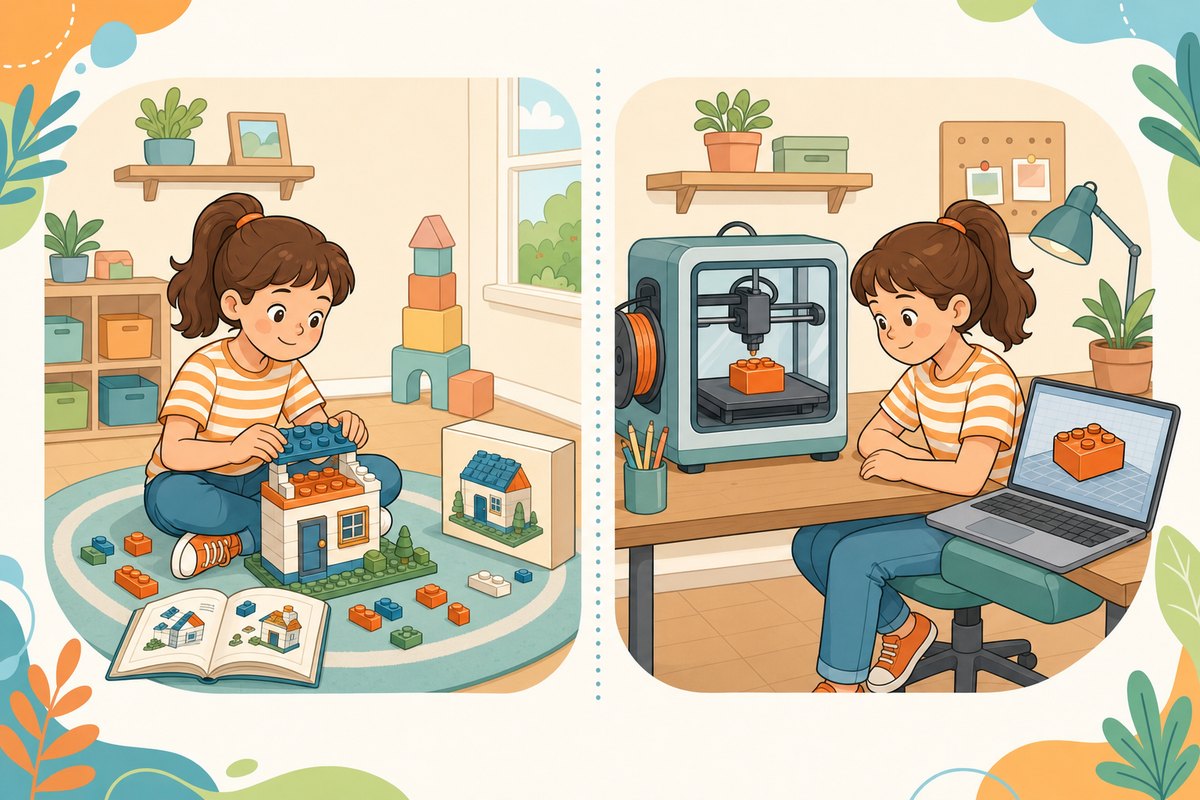
ConsumerBuilding the set from the booklet
CreatorPrinting a part she designed
Our 3D printer runs only under my supervision; the kids have printed different things on it, LEGO parts included. If you don’t have one, paper and a pencil do the same job for the first month.
How to put creator time on the Family Checklist chart
A habit needs a place to live outside your head. I built Family Checklist for my own family, so here is how I set it up:
- Add each kid as a family member. And add yourself. More on that below.
- Create a custom task called “Creator time.” Pick an icon your kid likes. You can also start from the 150+ built-in tasks for the rest of the routine.
- Choose the days. School days, weekends, or exactly the days from the plan above.
- Tick it on the weekly board when something is made. Not when time is spent. The streak grows with things made.
- Friday: look at the week together. The ticks start the “look what I made” talk for you.
The free version covers 3 family members with 3 tasks each. That’s enough for you and two kids, each with “creator time” and two other daily tasks. If you like paper, the print menu offers the current week free; next weeks and stickers are Premium.
Put creator time on the weekly chart
One custom task, the days you choose, a tick for every thing made. Free for 3 family members with 3 tasks each.


Lead by example: put yourself on the chart
Family Checklist started because I was tired of asking my kids to do the same things over and over. I’m a programmer at heart, and in programming a repeating task gets a script. In a family, the best tool I found was my own example: my kids see me doing the same simple things they do. That’s why the parent is on the chart too.
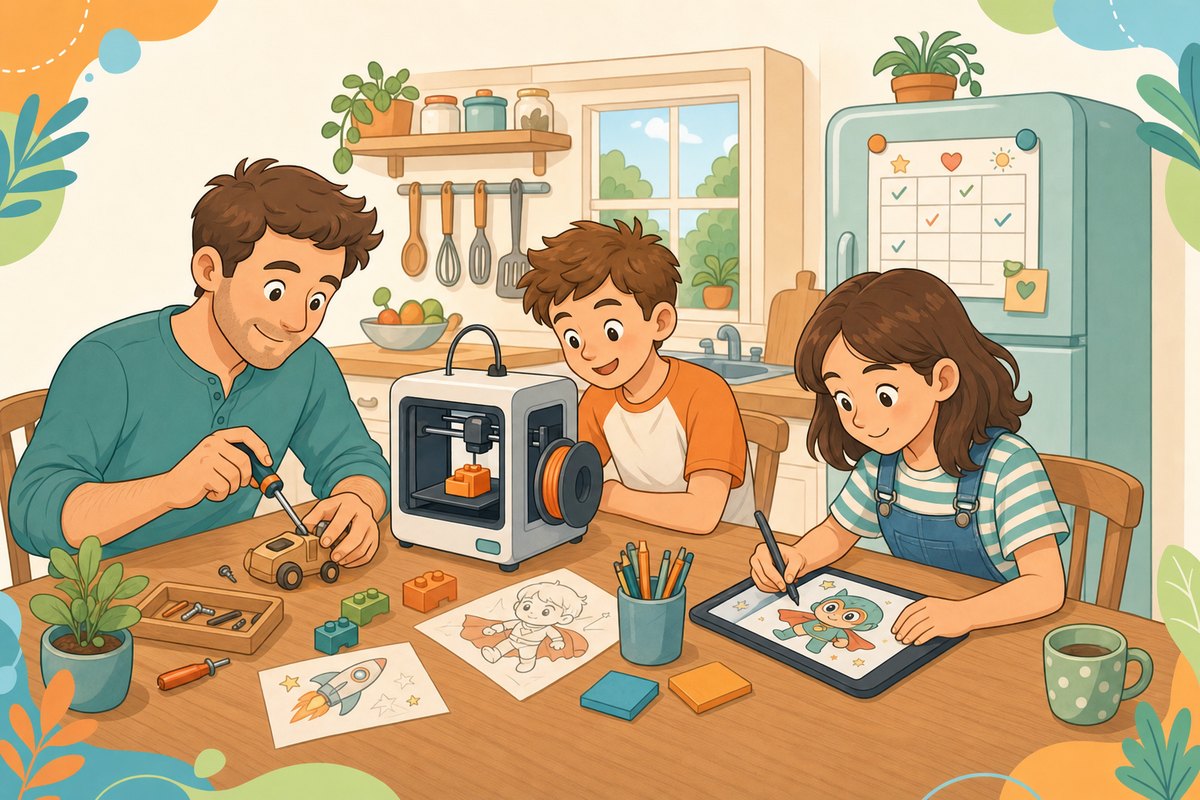
Creator time works the same way. If your child only consumes, start with yourself: sit down, make something, and say “Look what I made.” My kids constantly see me building, repairing and experimenting. One Saturday I spent the whole day learning to make a small game in Godot, a free game engine. The next day the kids sat down and drew their own levels. Nobody asked them to.
Copying works better than telling; there is research behind that too, in our piece on why children copy what you do.
When it doesn’t stick
- “I don’t know what to make.” Go back to what they watched today and ask: how was this made? Make a tiny version of that.
- Creator time turns into watching. No made thing, no tick. Calmly, without a speech.
- It feels like homework. Drop the grading. Don’t compare it with what they watched. A creation that has to pass inspection stops being theirs.
- It fades after two weeks. Normal. Habits take longer than 21 days (why the 21-day rule is a myth). Keep the tick, shrink the task.
We’re in the middle of this ourselves. There is no magic pill. Even if there were one, it wouldn’t work until you put in your own time and attention.
Key Takeaways
- Healthy screen time habits: one limit for watching and scrolling, plus daily creator time outside it, where your kid makes something.
- Creator time not counting is my rule as a dad, not an AAP rule.
- Start from what your kid already loves and pick the creator version of that exact thing.
- Tick it on the chart when something is made, not when time is spent.
- Put yourself on the chart and say “Look what I made.”
Frequently Asked Questions
What are healthy screen time habits for kids?
A clear limit for watching and scrolling, no screens in the run-up to bed, and a daily habit of making something instead of only watching. In our house the limit is 1 hour on school days and 2 on weekends, and creator time sits outside it.
Should creative screen time count toward the limit?
In our house it doesn’t, as long as it produces something: a drawing, a level, a video. That is my position as a father, not a scientific finding. The AAP doesn’t split screen time into consuming and creating.
What counts as creator time?
Anything where your kid ends up with something they made: drawing on a tablet or paper, a comic, a recorded screencast, a game level, a mod, a 3D-printed part, a story. Watching tutorials about it is still watching.
How do I make a screen time schedule my kids will follow?
Keep it short and visible. One limit, one daily creator-time task on a weekly chart the whole family sees, and the parent on the chart too. Leading by example works better than any rule I’ve tried.
Related Reading
- How Much Screen Time Is OK for Kids — the numbers by age.
- After School Routine for Kids — where creator time fits in the afternoon.
- Why Children Copy What You Do — the case for leading by example.
- Life Skills Checklist by Age — real jobs that crowd out scrolling.