5 Global Parenting Strategies: What Science Says About Each Approach
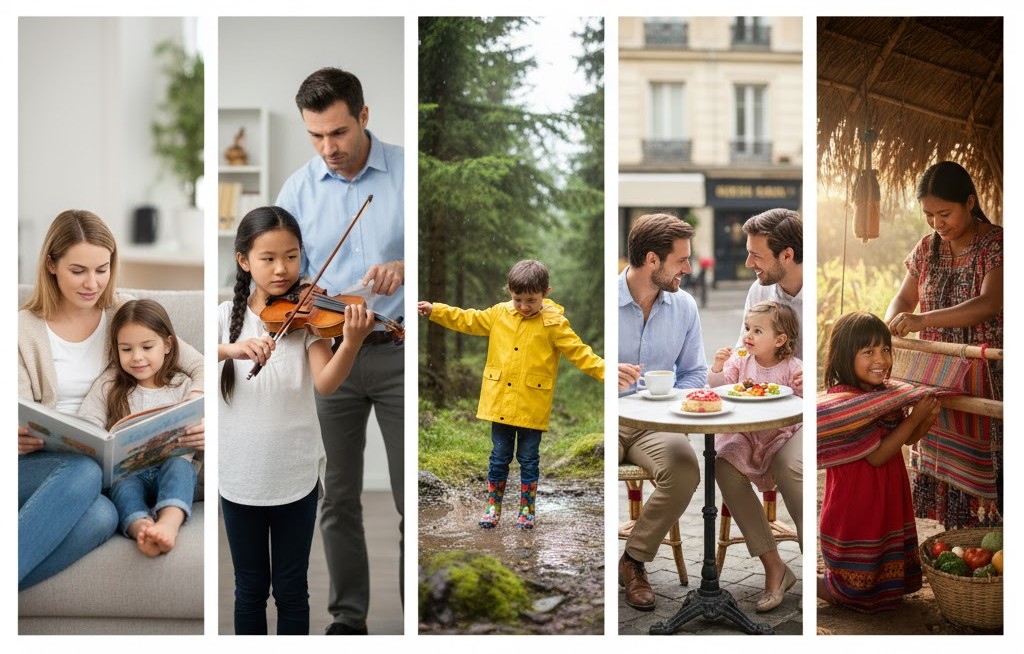
Every culture has developed its own philosophy for raising children. Some emphasize strict discipline, others prioritize freedom and play. But which approach actually works best for building good habits and raising happy, responsible kids?
We examined five major parenting philosophies from around the world, diving into the research behind each one. The results might surprise you—there is no single "best" approach, but understanding the science can help you find what works for your family.
The Science of Parenting Styles
In the 1960s, developmental psychologist Diana Baumrind identified three primary parenting styles: authoritative, authoritarian, and permissive. Later, researchers added a fourth: uninvolved. These categories remain the foundation for most parenting research today.
According to a comprehensive review published by NCBI, parenting styles significantly influence various dimensions of child development, encompassing emotional, cognitive, and social outcomes.
But here is the critical insight: cultural context matters enormously. A 2024 cross-national study of 10,909 families across Southeast Europe found that the effectiveness of parenting styles varies significantly by cultural and economic context (ScienceDirect, 2025).
1. Authoritative Parenting (The "Gold Standard")
Origin: Identified by Diana Baumrind (USA, 1960s)
Core Philosophy: High warmth + high expectations + clear boundaries
Authoritative parents set clear rules and expectations while remaining responsive to their children's emotional needs. They explain the reasoning behind rules, encourage open communication, and use positive discipline rather than punishment.
What Research Says
A 2024 study in Frontiers in Psychology found that authoritative parenting was positively associated with better academic outcomes and improved self-control in children. A 2025 meta-analysis confirmed that children of authoritative parents show the highest levels of life satisfaction and emotional regulation across cultures.
Pros
- Children develop strong self-regulation
- Higher academic achievement
- Better social skills and emotional intelligence
- Lower rates of anxiety and depression
Cons
- Requires significant time and energy
- Constant negotiation can be exhausting
- May be seen as "too soft" in some cultures
2. Tiger Parenting (The Achievement-Focused Approach)
Origin: East Asian cultures, popularized by Amy Chua's 2011 book
Core Philosophy: High expectations + strict discipline + academic excellence above all
Tiger parenting emphasizes academic achievement, structured schedules, and strict control over children's activities. Made famous by Yale professor Amy Chua's controversial memoir Battle Hymn of the Tiger Mother, this approach prioritizes success and discipline over immediate happiness.
What Research Says
Contrary to popular belief, an eight-year longitudinal study of 444 Chinese American families published in the Asian American Journal of Psychology found that tiger parenting did NOT lead to superior academic performance. In fact, children of supportive parents had higher GPAs than children of tiger parents, along with better socio-emotional adjustment and stronger family bonds.
Pros
- Clear structure and expectations
- Emphasis on hard work and persistence
- Strong focus on skill development
Cons
- Higher rates of anxiety and depression in children (PMC Study)
- Can damage parent-child relationship
- Children may lack intrinsic motivation
- Research shows lower academic outcomes than supportive parenting
3. Nordic Parenting (The Happiness-First Approach)
Origin: Denmark, Sweden, Norway, Finland
Core Philosophy: Free play + emotional well-being + outdoor time + trust-based autonomy
Denmark has been ranked among the happiest countries in the world for nearly four decades. Nordic parenting emphasizes unstructured play, outdoor time in all weather, and giving children age-appropriate freedom to make decisions and learn from natural consequences.
The book The Danish Way of Parenting presents six principles that spell out P-A-R-E-N-T: Play, Authenticity, Reframing, Empathy, No ultimatums, and Togetherness (hygge).
What Research Says
Research consistently shows that Scandinavian children demonstrate remarkably higher levels of life satisfaction, resilience, and social competence. Studies show that 4-6 hours of daily unstructured outdoor play fosters cognitive development, emotional well-being, and stress management skills.
Pros
- Higher reported happiness in children and adults
- Strong emphasis on emotional intelligence
- Children develop independence and resilience
- Less parental burnout
Cons
- Requires societal support (parental leave, safe outdoor spaces)
- May seem "too relaxed" for achievement-focused parents
- Less emphasis on structured academic preparation
4. French Parenting (The Cadre Approach)
Origin: France, popularized by Pamela Druckerman's Bringing Up Bébé
Core Philosophy: Firm boundaries (cadre) + teaching patience + treating children as rational beings
French parenting centers on establishing a clear "cadre" (framework) of non-negotiable rules while allowing significant freedom within those boundaries. Children are expected to wait, develop patience, and adapt to the adult world rather than having adults constantly adapt to them.
According to Druckerman's research, French babies typically sleep through the night by 2-3 months (using "la pause" technique), and French children eat a wide variety of foods and behave calmly in restaurants.
What Research Says
French parenting draws on the famous Stanford marshmallow experiment by Walter Mischel, which demonstrated that children who could delay gratification had better life outcomes decades later—including higher SAT scores, better health, and lower rates of substance abuse.
Pros
- Children develop strong self-control
- Less picky eating and better sleep habits
- Parents maintain their own identity and interests
- Clear boundaries reduce power struggles
Cons
- May feel overly rigid to attachment-focused parents
- Less emphasis on verbal praise and emotional validation
- Cultural norms (4 meals/day, no snacking) may not transfer easily
5. TEAM Parenting (The Indigenous Wisdom Approach)
Origin: Maya, Inuit, and Hadzabe cultures, documented by Michaeleen Doucleff
Core Philosophy: Togetherness + Encouragement + Autonomy + Minimal interference
In her bestselling book Hunt, Gather, Parent, NPR journalist Michaeleen Doucleff traveled to Maya, Inuit, and Hadzabe communities and discovered children who were remarkably helpful, calm, and cooperative—without yelling, nagging, or timeouts.
The key? Including children in adult activities from a young age, allowing them to contribute meaningfully, and stepping back to let them learn through observation and practice.
What Research Says
This approach aligns with Self-Determination Theory, which identifies autonomy, competence, and relatedness as the three basic psychological needs for motivation and well-being. When children feel genuinely useful and connected to family activities, intrinsic motivation naturally develops.
Pros
- Children become genuinely helpful without rewards or punishments
- Less parent-child conflict
- Children develop real-world competence
- Strong family bonds through shared activities
Cons
- Requires rethinking modern "child-centered" activities
- Patience needed—letting kids help is initially slower
- May conflict with academic-focused schedules
The Praise Paradox: A Critical Insight
Regardless of which parenting style you lean toward, research on praise deserves special attention. Stanford psychologist Carol Dweck's groundbreaking studies revealed something counterintuitive:
"When children were praised for their intelligence ('You're so smart!'), they were more likely to avoid challenges and give up after failure. When praised for effort ('You worked so hard!'), they embraced challenges and persisted."
This finding, replicated across five separate studies, shows that praising the process (effort, strategies, choices) rather than the person (intelligence, talent) leads to what Dweck calls a "growth mindset"—the belief that abilities can be developed.
A follow-up study found that mothers' process praise to their babies (ages 1-3) predicted the child's growth mindset and desire for challenge five years later.
What This Means for Building Habits
When it comes to helping children develop good habits, the research points to several universal principles:
- Model the behavior yourself — Children learn primarily through observation (see our article on modeling)
- Praise effort and strategies, not outcomes — "I noticed you put your backpack away right when you got home" works better than "Good job!"
- Give age-appropriate autonomy — Let children make choices within clear boundaries
- Include children in family routines — Chores aren't punishment; they're contribution
- Be consistent but warm — The authoritative combination works across cultures
Quick Comparison
| Style | Warmth | Structure | Best For |
|---|---|---|---|
| Authoritative | High | High | Overall development, self-regulation |
| Tiger | Low-Medium | Very High | Skill development (with trade-offs) |
| Nordic | High | Medium | Happiness, resilience, creativity |
| French | Medium | High | Self-control, patience, independence |
| TEAM | High | Low-Medium | Cooperation, helpfulness, family bonds |
The Bottom Line
There is no one-size-fits-all approach to parenting. The most effective strategy is one that combines warmth (responsiveness to your child's emotional needs) with structure (clear expectations and consistent boundaries)—while adapting to your family's cultural context and values.
What the research consistently shows is that children thrive when they feel both loved AND challenged, when they have both freedom AND limits, when they are treated with respect AND held to high standards.
The goal is not to pick a "style" and follow it rigidly, but to understand the principles behind each approach and thoughtfully apply what works for your unique family.
By Ilya Makarov, Founder of Family Checklist
Related Articles
Ready to build better habits as a family?
Family Checklist helps you model good habits while tracking progress together.
Get Early Access